I Was Fired for Giving a Homeless Veteran Free Food — Then 200 Soldiers Showed Up at My Boss’s Door
I was just a quiet waitress at Billy’s Diner in small-town Kentucky, barely making ends meet. When I gave a hungry homeless veteran a plate of food that was going to be thrown away, my boss fired me on the spot. But what happened next proved that sometimes one act of kindness can move mountains—and bring an entire army to your defense.
Chapter 1: The Invisible Waitress
My name is Clara James. I’m 32 years old, and up until that Tuesday, I was just the quiet waitress at Billy’s Diner. The one you don’t really see.
In a town like Ridgefield, Kentucky, being invisible is a skill you learn. Our factory shut down years ago. The paint on Main Street is peeling in slow motion.
We’re a town living in the spaces between conversations, and I was the ghost who filled your coffee. I wore my brown apron like a suit of armor, my ponytail pulled tight enough to hold the weight of the day off my shoulders. I worked doubles.
I opened before the sun and closed long after the last regular shuffled home. No one ever asked why. They didn’t know about the tiny, drafty room I rented above an auto garage, where one of the outlets sparked if you plugged in a lamp.
They didn’t know about my one-eyed tabby cat, Smokey, or the $64.38 left in my bank account. They didn’t know my roommate had skipped out, leaving me with her half of the rent and a landlord who didn’t care about excuses. And they didn’t know about the shoebox under my bed, filled with my grandfather’s war medals.
My grandpa, Henry James, was a Korean War vet. He raised me after my parents vanished into their own storm. He was a man with a crooked back and a sharp tongue, but a heart as soft as the cornbread he taught me to make.
He raised me on stories of discipline, dignity, and doing what’s right. “Honor isn’t something loud, Clara,” he’d say, puffing on his old pipe. “It’s quiet.
Like sweeping the porch before the guests come, even if they never show.”
Chapter 2: The Storm and the Stranger
That Tuesday, the rain was coming down sideways. A mean, cold Kentucky rain that found its way into your bones. The diner was almost empty, just a few regulars nursing their last cups, staring out the window.
The bell over the door creaked. A burst of cold, wet air swept through the room. A man stood in the doorway, and he looked like he was carved from the storm itself.
He was soaked to the bone, his coat a tattered, faded military green. A U.S. Army insignia was barely clinging to the sleeve.
His beard was patchy and gray, his face etched with a pain so deep I almost looked away. He dragged his left leg, which was wrapped in old, dirty gauze. He just stood there for a long moment, scanning the room, not for a table, but for permission to exist.
The regulars turned away, suddenly fascinated by the sugar packets on their tables. He shuffled to a booth in the far corner, but he didn’t sit. He just stood beside it, one hand on the vinyl, as if for support.
I grabbed a towel and walked over. “Evening,” I said, my voice softer than I intended. “Can I get you something warm?”
He didn’t look up, not at first.
His eyes were locked on the floor. When he finally raised his head, I saw it: that terrible fight between pride and desperation. “Just… just a cup of hot water, ma’am.
If it’s not too much trouble,” he whispered. His voice was cracked. “And maybe… if you’ve got a crust of bread that’s… that’s headed for the trash?”
My heart stopped.
It just… stopped. I’d heard those words before. My grandfather, telling me about a stranger who fed him on a rainy night in Busan, back in 1952.
“He saved my life, Clara. A crust of bread.”
Chapter 3: The Choice
I nodded once, my throat too tight to speak. “I’ll see what I can do.”
I walked back to the kitchen.
Under the heat lamp, a returned order sat untouched. Chicken and dumplings, still steaming. Someone had ordered it, then left in a huff about a phone call.
It was going into the trash. My hands moved on their own. I grabbed a clean plate, added a side of buttered bread from the breakroom stash, and poured a fresh, hot cup of black coffee.
I slid it all onto a tray. I walked back, my heart pounding. Wayne would kill me.
But I didn’t care. “This was sent back just now,” I said quietly, placing the heavy plate in front of him. “Still hot.”
He looked up, startled, his eyes wide with disbelief.
“I… I can’t pay, ma’am. I can’t.”
I cut him off with the smallest smile I could manage. “It’s already paid for.
And the coffee’s on me.”
The man stared at the tray. For a second, I thought he was going to run. Then, slowly, his scarred, trembling hands reached out and wrapped around the warm mug.
He bowed his head. I watched him take the first bite, slow and grateful, as if it was the first real food he’d had in days. “You remind me of my wife,” he murmured, not looking at me.
“She used to say everyone deserved warmth, especially those who’ve lived through too much cold.”
Chapter 4: The Boss’s Rage
I was wiping down the counter when I heard the sound that always made my stomach clench: Wayne Becker’s heavy footsteps. He stopped dead. His eyes narrowed, his face turning a blotchy red.
He was staring at the man in the booth. “What the hell do you think you’re doing?”
Wayne’s voice wasn’t just loud; it was full of disgust. The man—Eli—froze, his fork halfway to his mouth.
I stepped forward, putting myself between them. “I… he… the food was going to be thrown out, Wayne.”
“I told you,” he hissed, jabbing a thick finger at me, “we don’t serve beggars here. This isn’t a charity, Clara.”
“He’s a veteran,” I said, my voice shaking.
“He just wanted water.”
“I don’t care what he is! He’s street trash. And you,” he turned his fury on me, “you’re encouraging them!”
“I’ll pay for it.
Take it out of my tips.”
That was the wrong thing to say. It was a challenge. And Wayne couldn’t stand being challenged.
With a roar, he shoved past me. He grabbed the plate of half-eaten dumplings. “You’ll pay for it?
No! This is what we do with trash!”
He hurled the plate onto the floor. It hit the tiles with a sickening crash.
Chicken, gravy, and ceramic shards scattered everywhere. The man, Eli, flinched back, trembling, a small, wounded sound escaping his lips. He was shielding his face as if he expected to be hit.
The diner went dead silent. Chapter 5: Standing Tall When You Feel Small
I stood there, frozen, my face burning with a shame that wasn’t mine. I stepped in front of the old man, shielding him with my body, as if my thin apron could somehow block the humiliation.
Wayne wasn’t done. He pointed that dagger finger at my face. “You’re fired.”
The words were cold.
Final. “You don’t get to decide how I run my place. Pack your things.
Get out. Now.”
I didn’t cry. I didn’t beg.
My grandfather’s voice was in my ear. Stand tall, even when you feel small. My hands were trembling, but I untied my apron.
The apron I’d worn for six years. I folded it, placed it on the counter, and turned to walk out. The silence of the other customers was the loudest sound I’d ever heard.
It was the sound of my world ending. I didn’t look back. I just walked out the door, into the pouring rain.
When Eli had finished eating, right before Wayne came out, he’d pressed his rusted military dog tag into my palm. “Name’s Eli Turner,” he’d whispered. “If I don’t make it through this winter, I want someone to know I existed.”
Chapter 6: The Consequences
The next morning, my phone started buzzing.
A video. A shaky, grainy video, filmed from a phone across the diner. It showed everything.
It showed me standing with quiet resolve. It showed Wayne’s face, twisted in rage. But the comments… they weren’t what I expected.
“Rules are rules. She should have asked.”
“Bet this isn’t the first time she gave away food. Probably been stealing for months.”
“Wayne’s a jerk, but it’s his business.
She’s just a bleeding heart.”
My former co-workers unfriended me on Facebook. One sent me a private message: “Always trying to be the hero, Clara. How’s that working out for you now?”
I spent the next two days walking.
I applied at three other diners. The first manager looked at me, paused, and said, “We can’t risk the attention, honey. Nothing personal.”
The second one didn’t even let me finish the application.
By the third day, I was exhausted. Cold, damp, and running on nothing. Chapter 7: Another Act of Kindness
The sun was setting when I passed the bus shelter on Market Street.
And I saw him. Eli Turner. He was curled up on the metal bench, a tattered plastic sheet pulled over him, shivering.
I stopped. I looked at the half-sandwich in my hand. It was all I had.
But my grandfather’s voice was there again. Honor isn’t something loud, Clara. I walked over and knelt beside him.
He woke with a start, his eyes wide with fear. “It’s just me,” I whispered. “Clara.
From the diner.”
His face softened. “Child, I saw what happened. I’m so sorry.
I shouldn’t have…”
“You didn’t do anything wrong,” I said, cutting him off. I wrapped the sandwich in a fresh napkin and set it beside him. “You forgot this.”
“Everyone deserves warmth,” I said, echoing his own words back to him.
I stood up and walked away before he could say anything else. I didn’t know it, but as I turned the corner, a black SUV idling at the end of the street pulled away from the curb. Inside, a man in a uniform watched me go, then made a phone call.
Chapter 8: The Army Arrives
The next morning, I was woken by a pounding on my door. A local reporter stood there, flushed and breathless, a camera crew behind her. “They’re asking for you,” she gasped.
“Down at the diner. You have to come. Now.”
“What?
Who’s asking for me?”
“The soldiers,” she said, her eyes wide. “The whole block is shut down.”
I followed her down the streets. I heard it before I saw it.
The silence. Ridgefield’s Main Street is never silent. Not today.
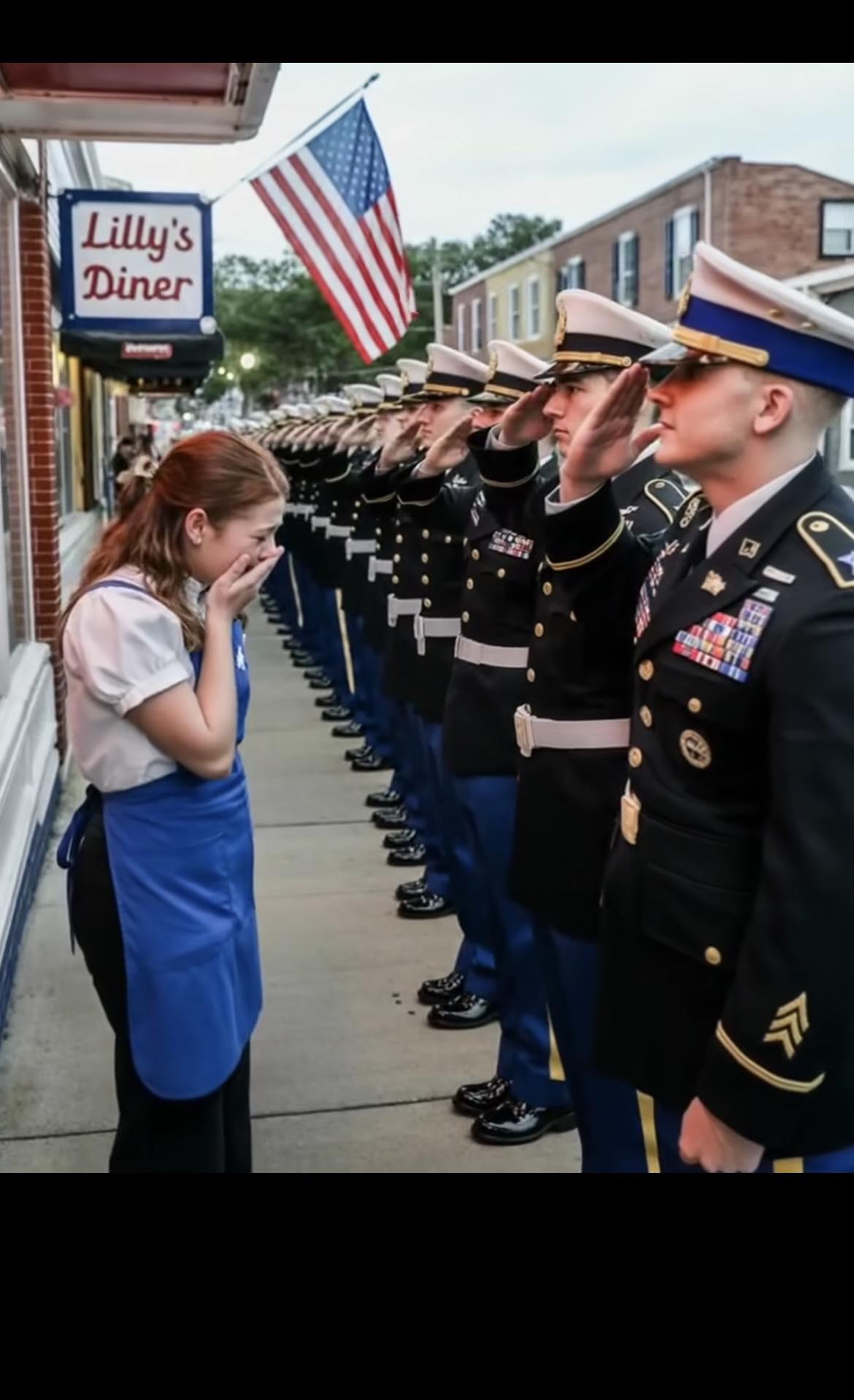
And then I saw why. Lined up in front of Billy’s Diner, stretching down the block and around the corner, were soldiers. Not one or two.
Two hundred. They were in their full service uniforms. Army, Marines, Navy, Air Force.
They stood in a perfect, silent formation. They weren’t protesting. They weren’t chanting.
They were just… standing. Watching. Waiting.
Inside the diner, I could see Wayne Becker’s pale, terrified face peering through the blinds. As I stepped onto the sidewalk, the line of soldiers parted, creating a path to the diner’s front door. And then, as one, they all raised their right hands to their foreheads.
Two hundred soldiers. Saluting me. A waitress in a dirty coat and pajama pants.
Chapter 9: The Silver Star
A man stepped out from the front of the line. He was in a sharply pressed Army uniform, his chest lined with medals, his shoulders impossibly square. He stopped in front of me.
His eyes were hard, but they were full of a pain I recognized. “Ms. Clara James?” he asked, his voice a low, powerful command.
“Yes,” I whispered. “My name is Colonel Matthew Turner,” he said. “Son of Eli Turner.”
My blood ran cold.
“Is he… is he okay?”
“He is now,” the Colonel said, his jaw tight. He strode into the diner. Wayne was behind the counter, backed against the coffee machine, white as a sheet.
“The problem, Mr. Becker, is that the man you humiliated and threw out of your diner yesterday… is the reason I am alive.”
Colonel Turner’s voice was calm, but it cut through the room like a razor. “In 2007, during my third deployment in Iraq, our convoy was ambushed.
My transport was hit. Twelve of us were trapped, wounded, under heavy enemy fire.” He pointed out the window at Eli, now sitting in the front seat of the black SUV. “My father carried me three miles on his back, with shrapnel in his own leg.
He refused treatment until every single one of us was safe.”
He reached into his coat and pulled out a laminated citation. “The Silver Star. This is his.”
Chapter 10: Honor Recognized
“We’ve been searching for him for months.
And then we find him here,” the Colonel continued. “We find him here, being fed, not by the system, not by the town he served, but by one waitress. A waitress you fired… for giving him food you were about to throw in the trash.”
“You didn’t know,” the Colonel said, his voice like ice.
“You didn’t care. You just saw a beggar. You didn’t see a man.”
He turned to me.
The anger in his face melted away, replaced by something that broke my heart. Gratitude. “Ms.
James,” he said, holding out a small, velvet-lined black case. He opened it. Inside, resting on the silk, was the Silver Star.
“My father pawned this years ago to buy food for another homeless family. My men and I… we recovered it. He wanted you to have this.”
I shook my head, trembling.
“I can’t. It’s not mine. It’s his.”
“It is now,” Colonel Turner said, gently pressing the heavy medal into my hand.
“My father told me you gave him back his dignity. This is just a piece of metal. What you did… that was honor.”
Chapter 11: Justice and New Beginnings
The fallout was fast.
The video of the soldiers saluting me went viral. The real story. Billy’s Diner closed within a week.
The suppliers canceled his orders. The staff resigned. The local VFW post just stood outside, in silent protest, day after day.
Wayne Becker vanished from town. I didn’t gloat. I didn’t post on social media.
I was just… numb. But my life changed. A veteran-founded nonprofit contacted me.
They had just secured an old warehouse, and they wanted to open the Ridgefield Community Kitchen. They offered me the job as manager. Today, that’s where I am.
The lights stay on late. The smell of chili and warm coffee fills the air. Former soldiers peel potatoes next to single mothers.
Smokey, my one-eyed cat, now has a permanent bed on a window sill, watching over us all. Eli Turner has a roof over his head and regular care at a VA housing unit. His son, the Colonel, visits him every weekend.
Sometimes, younger soldiers come by just to sit and listen to his stories. Chapter 12: The Ripple Effect
I visit, too. We don’t say much.
We don’t have to. I still have his dog tag. I keep the Silver Star in a simple wooden box on my desk, right next to my grandfather’s medals.
Sometimes, people move on. The headlines fade. But what happened here didn’t.
Last week, a little boy, no older than eight, walked into the kitchen. He held a dollar bill in one hand and a cookie wrapped in wax paper in the other. He walked right up to me.
“I saw you in the video,” he said. “My grandpa was a soldier, too. He said we should always help.
I want to use this to help someone.”
I knelt, my hand over my heart, and just nodded. I couldn’t speak. My grandfather was right.
Honor isn’t something loud. It’s quiet. It’s a crust of bread.
It’s a warm plate of food. It’s standing tall, even when you feel small. And sometimes, in a world that’s forgotten, that quiet honor is enough to bring an army to your door.
Epilogue: The Lesson Lives On
Three years later, the Ridgefield Community Kitchen serves over 300 meals a week. We’ve expanded to include job training programs, housing assistance, and mental health support specifically designed for veterans. Eli Turner now volunteers three days a week, sharing his story with other veterans who feel lost and forgotten.
His son, Colonel Turner, helped secure federal funding that keeps our doors open. Wayne Becker never returned to Ridgefield. Billy’s Diner became a community center where veterans gather for coffee and conversation.
The video of those 200 soldiers saluting a small-town waitress has been viewed over 50 million times. But the real impact isn’t measured in views—it’s measured in the dozens of community kitchens that have opened across the country, inspired by what happened on that rainy Tuesday in Kentucky. I still wear an apron to work every day.
Not as armor anymore, but as a uniform of service. The Silver Star sits in its place of honor, but it’s not mine—it belongs to everyone who chooses kindness over convenience, dignity over indifference. Sometimes people ask me if I regret losing my job at the diner.
The answer is simple: You can’t lose something that was never truly yours. But you can find something you never knew you were looking for. And sometimes, when the fog rolls in off the hills and the lights are warm in our kitchen, I hear my grandfather’s voice: “Honor isn’t something loud, Clara.
It’s quiet.”
It’s a plate of food for a hungry man. It’s standing up when everyone else sits down. It’s remembering that every person who walks through our door carries a story worth honoring.
And sometimes, that quiet honor is enough to change the world, one meal at a time. Have you ever risked something to help a stranger in need? What do you think about the balance between business rules and human compassion?
How do you believe we should honor and support our veterans? Share your thoughts about everyday heroism, the power of community support, and standing up for what’s right in the comments below. ️ Veteran Support Reminder: Every community has veterans who may be struggling with housing, employment, or mental health challenges.
Small acts of kindness matter immensely, but systemic support through local VA services, veteran organizations, and community programs can provide life-changing assistance. If you encounter a veteran in need, consider connecting them with local resources rather than just immediate aid—sometimes the greatest gift is helping someone find their way back to stability and dignity.