The silence that enveloped the house after my husband’s passing was not just an absence of sound—it was a tangible weight pressing down on every surface, every corner, every memory-infused object. It seemed to seep into the seams of the furniture, into the worn floorboards, into the very air I breathed. For months, our home had functioned as a sanctuary of necessity, a place where life and death coexisted in a delicate, exhausting rhythm: the wheeze of the oxygen concentrator marking the passage of each day, the metallic tang of medications filling the kitchen, and the quiet, desperate prayers I whispered into the hollow hours of 3:00 a.m., hoping for a miracle that would never come. I had spent years as a sentinel, sleeping on the razor’s edge of the mattress, careful not to disturb his fragile body, my ears tuned to every subtle change in his breathing. And when he finally let go, the stillness that followed was not peace—it was a hollow, suffocating vacuum, an emptiness that seemed to stretch into forever.
The funeral passed in a surreal haze. Friends and distant relatives brought casseroles that went uneaten, tissues damp with tears I did not have the energy to share, and expressions of well-meaning pity that vanished as quickly as they arrived, leaving me alone with the enormity of the house, the mortgage, and a grief that no currency could assuage. My husband had left me the house, but our lives had been liquidated to buy him more time: our retirement funds, our emergency savings, and every sense of security had been traded for a few more sunsets. And though I never regretted a single sacrifice—I would have dismantled the roof and sold the shingles if it had meant one more hour of his laughter—love, however profound, is not legal tender. It cannot pay the bills, cannot refill the empty fridge, and cannot warm the cold silence that now hung over every room.
My stepson, Leo, was nineteen at the time, a mirror image of the man I had loved. The same sharp jawline, the same casual lean against doorframes, the same easy confidence that had once drawn me to his father. He had been present through the darkest months, witnessing the unrelenting reality of my double shifts at the hospital and the even more grueling nights of hospice care at home. He had seen the stacks of unpaid bills, the mountain of envelopes sprawled across the kitchen table like tombstones marking the death of financial security.
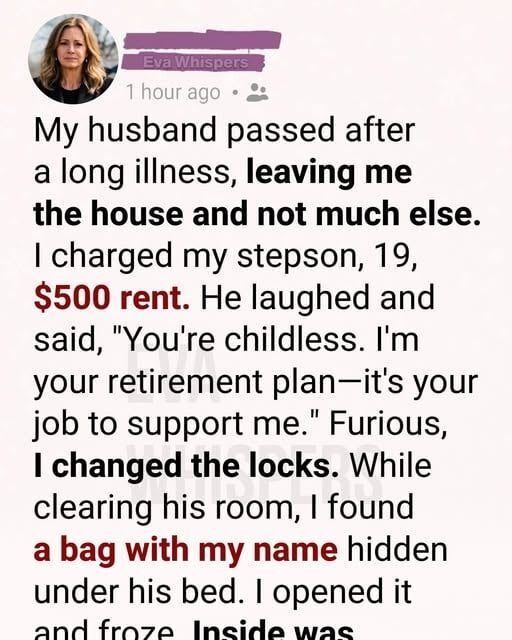
One evening, exhaustion weighing on me like concrete, I sat him down at the kitchen table. The room smelled of stale coffee, lingering antiseptic, and the faint ghost of burnt toast. My hands trembled around the mug I clutched, heat from the ceramic doing little to warm the cold that had settled in my bones. I asked him, in the gentlest way I could muster, for help: five hundred dollars a month, a modest contribution toward keeping the lights on and taxes paid.
Leo’s reaction was not what I expected. No sympathetic nod, no tentative question about how I was doing. Instead, he leaned back in his chair, a smirk tugging at his lips—a smirk that felt like a slap to my exhausted face. He laughed, a dry, dismissive sound that ricocheted off the kitchen cabinets, the ones I had spent years filling for him, stocking with groceries, cleaning with my own hands. He told me bluntly that I was “childless” and, by default, he was my retirement plan. It was my obligation, he said, to support him now, as though every night I had spent rocking him to sleep, every scraped knee I had kissed, every lesson in resilience I had imparted was nothing more than a contractual debt he had already “paid” by being alive.
The word “childless” cut through me like a jagged blade. It dismissed the countless nights I had watched him, monitored his homework, soothed his fears, and held him together when he had no one else. It disregarded the devotion I had poured into a boy who was not mine by blood, but who had become entirely mine through love and choice. I said nothing. I had no energy left for confrontation or argument. I simply nodded, retreated to the quiet refuge of my room, and watched the shadows of the tree branches outside dance across the ceiling until the sun finally began to rise.
Fueled by a mix of exhaustion, fear, and quiet indignation, I waited until he left for his morning shift at the local garage. Only then did I call a locksmith. Changing the locks was a deliberate, radical act of self-preservation, a way to reclaim the diminishing borders of my life. If he viewed me as a mere utility rather than a mother, I would revoke his access. I would draw a line that could not be crossed.
Then came the somber task of packing his belongings. I folded his hoodies, boxed his sneakers, and tried to ignore the hollow ache gnawing at my chest. And then my hand brushed against something solid beneath his bed. Reaching into the shadow, I pulled out a weathered blue duffel bag, tucked so deliberately that it seemed almost secret. A piece of masking tape, written in his messy script, bore my name.
My breath caught in my throat. Fingers trembling, I unzipped the bag. Inside, I discovered an old-fashioned savings passbook, its pages worn from handling. Each entry—a ten-dollar note here, fifty there, the occasional hundred—traced back four years, chronicling graduations, summer jobs, and the bleakest months of his father’s illness. At the very top of the first page, letters formed with painstaking care spelled out four simple words: “Mom’s Future Security Fund.”
He hadn’t called me Mom in years.
Behind the passbook, an unsealed envelope rested, its note clipped casually to the front: “For her birthday—don’t chicken out this time.” My birthday was less than a week away. With trembling hands, I unfolded the letter. The paper crackled under my touch, delicate and fragile as the confession it carried.
He wrote of watching me from the hallway while I cried over spreadsheets late at night, of the guilt he felt witnessing me sacrifice my youth for his father’s comfort, and of every penny he had funneled into the account because he feared I would end up alone and destitute. He wrote that he knew I worried about being “replaced” or forgotten, but that as long as he had a roof over his head, I would always have a home. He didn’t want to be my “retirement plan” out of obligation; he wanted to be my protector, chosen out of love and respect for the woman who had given him a life.
The dismissive smirk at the kitchen table—the words that had stabbed at my heart—was not cruelty. It had been the awkward camouflage of a nineteen-year-old, a façade meant to disguise the magnitude of what he had prepared for me. He had been playing the part of the defiant teen, while secretly orchestrating a legacy of care and security that would surprise me utterly.
I sank to the floor of his empty room, the passbook pressed to my chest, tears streaming freely. I realized that in my fear, I had misjudged him entirely. I had locked out the very person who had been silently guarding my future, misreading courage as selfishness, love as entitlement.
That evening, I waited on the porch, new keys weighing heavy in my pocket, watching for the familiar headlights. When he pulled into the driveway, tired but steady, I didn’t mention the rent or the mortgage. I handed him the duffel bag, embraced him, and let the scent of motor oil and home settle over us. I whispered an apology for my assumptions, and for the first time since the machines fell silent, the house felt full. I realized then that family is not dictated by bloodlines or legal papers, but by the invisible, unwavering sacrifices made in the quiet, unobserved hours. In that moment, we were no longer just surviving; we were home.