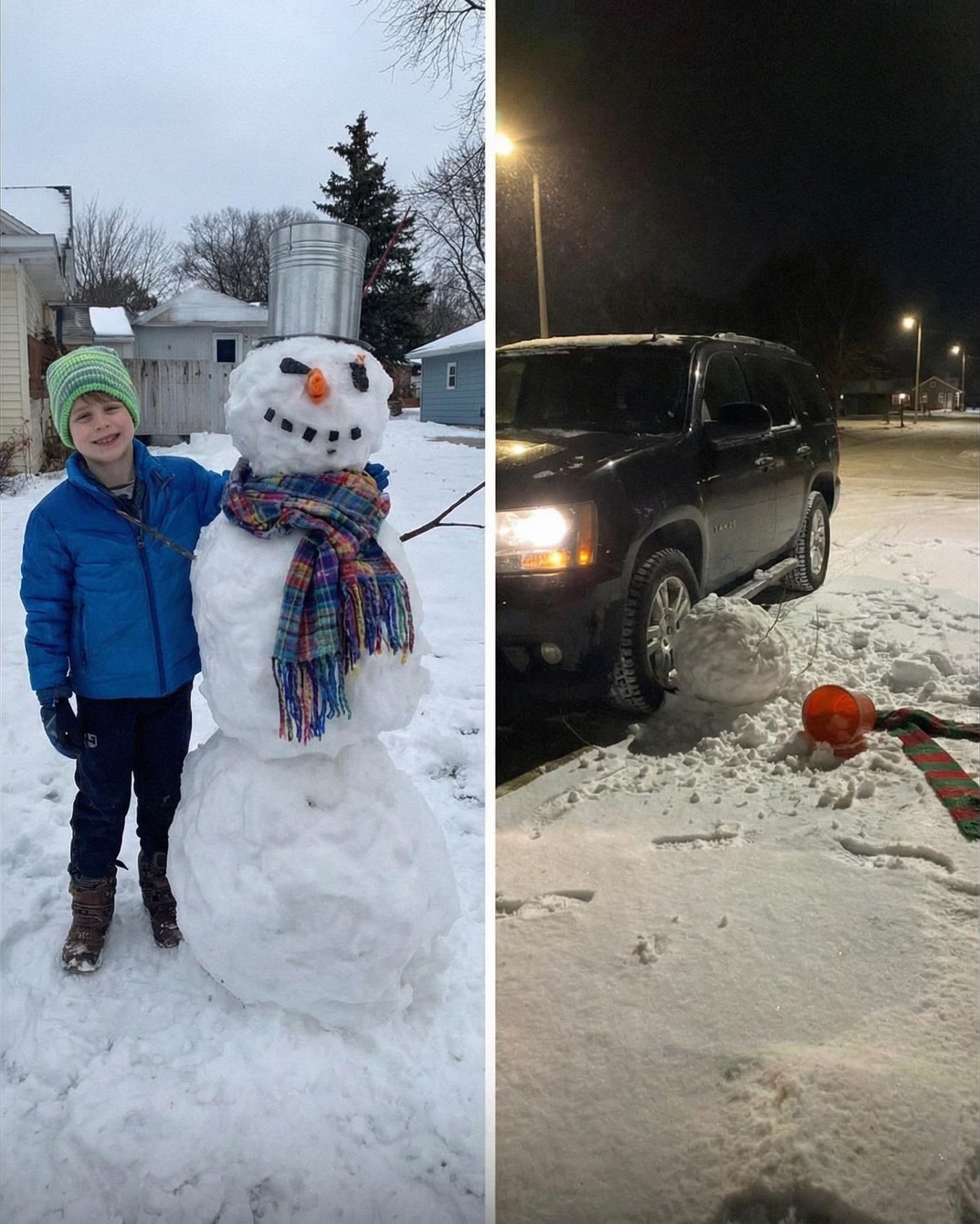
What spoiled that joy, again and again, were the tire tracks. Our neighbor routinely cut across that corner of the lawn while pulling into his driveway, flattening the snowmen without slowing down. I asked him politely to stop more than once, explaining how much it upset my child, but he brushed it off as unimportant.
To him, it was “just snow.” To my son, it was something he had created with care. After the first few incidents, my son came inside quieter than usual, holding back tears as he described another snowman destroyed. Each time, I tried to comfort him, suggesting we move the snowmen closer to the house, but he refused.
That spot mattered to him—not because it was convenient, but because it felt right. He understood, even at eight years old, that he wasn’t doing anything wrong. The repeated dismissals from an adult who wouldn’t respect our property or his feelings were harder for him to process than the broken snowmen themselves.
I tried again to reason with the neighbor, asking for basic respect, but the conversation ended the same way it always did: with indifference. Then one afternoon, my son came in calmer than I expected. He told me another snowman had been ruined, but this time he said I didn’t need to talk to the neighbor anymore.
He mentioned having a plan—nothing harmful, he assured me, just something to make the problem stop. I assumed it would be a sign or a change of location. The next day, I watched him build a particularly large snowman near the edge of the lawn, close to where the street met our grass.
I noticed flashes of red beneath the snow but didn’t think much of it. That evening, a loud crash and a shout from outside sent us both running to the window. Our neighbor’s car had struck the fire hydrant at the edge of our property, sending water spraying into the air and flooding the street.
The snowman had been built around it, clearly marking a boundary where cars weren’t meant to go. In the chaos that followed, it became obvious what had happened: once again, he had driven off the road and onto our lawn. No one was hurt, but the consequences were real.
Some melted, some leaned, some fell to the wind—but none were crushed by tires. And every time I looked at that corner of the yard, I was reminded that even gentle lessons, when thoughtfully placed, can make boundaries unmistakably clear.