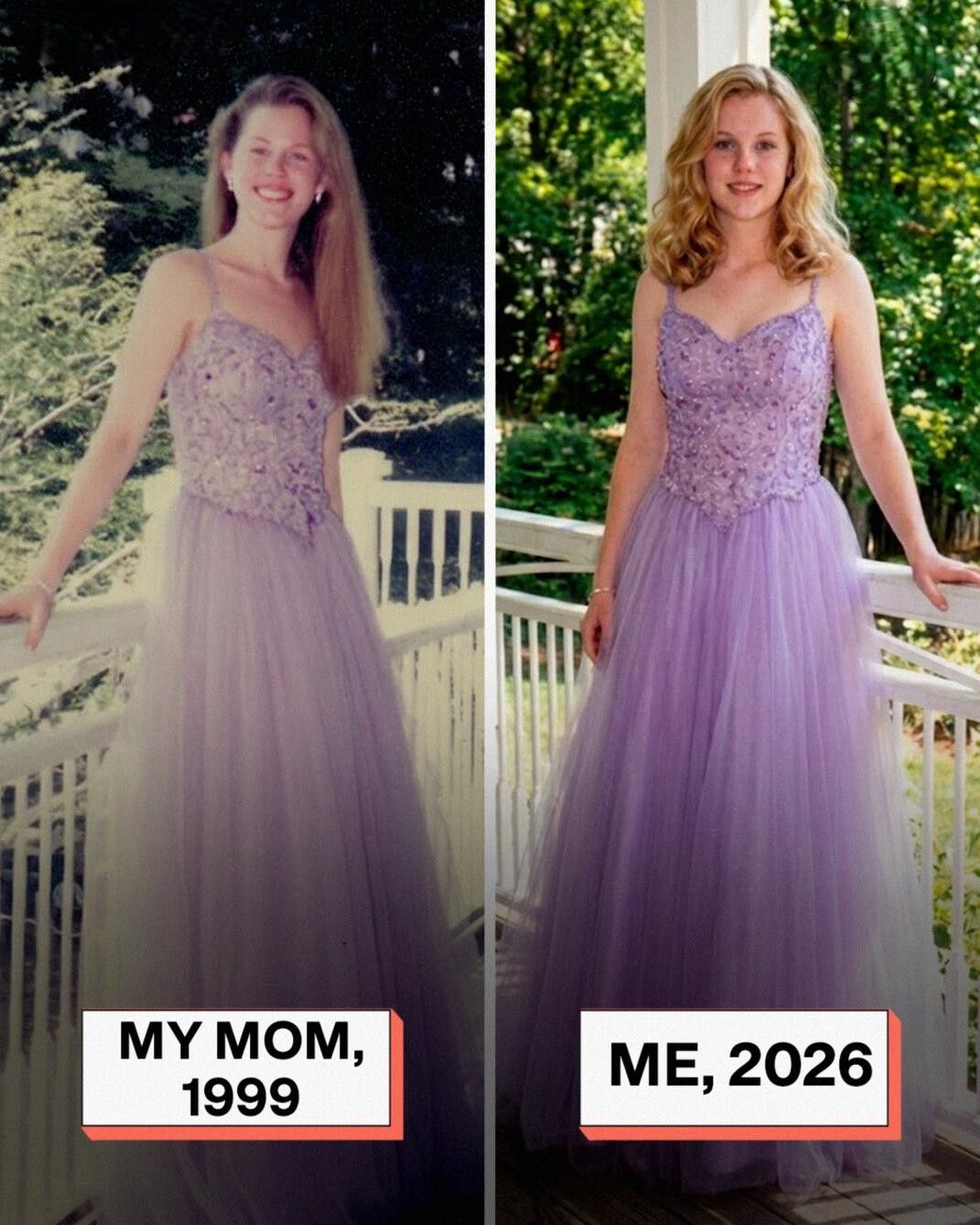
I was six when the world lost its color. My mother, a woman who carried the scent of lavender and old books, passed away, leaving a silence that no noise could fill. My father, a man of quiet strength, did his best to raise me, but the house always felt like a museum of unspoken things. The most sacred exhibit was tucked away in the back of the cedar closet: my mother’s prom dress.
It was a 1990s masterpiece—midnight blue silk with delicate hand-stitched beadwork that caught the light like fallen stars. I grew up tracing the fabric through its plastic covering, imagining the night she wore it, dancing with my father before life became complicated. It wasn’t just a dress; it was a tether to a woman I was slowly forgetting.
When I turned seventeen, my father met Brenda. She was everything my mother wasn’t: loud, performative, deeply insecure. She moved in like a conqueror, rearranging furniture and replacing my mother’s landscape paintings with “Live, Laugh, Love” signs. My father, blinded by the hope of a second chance, didn’t notice how Brenda looked at me—or at the things that had belonged to the woman before her.
The conflict came to a head three weeks before my senior prom. Months earlier, I had told my father I wanted no new dress—I wanted hers. He had wept at the request, calling it the greatest honor he could imagine. We had it professionally cleaned and altered; the silk shimmered as if it had waited ten years for this moment.
That Tuesday afternoon, I came home to a house smelling of bleach and burnt fabric. My heart pounded as I ran to my room. The garment bag was gone.
I found Brenda in the laundry room, humming a tuneless song while tossing shredded blue silk into the trash. My mother’s dress was destroyed. The beadwork was ripped away, the silk scarred with jagged bleach stains.
“What did you do?” I whispered.
Brenda didn’t flinch. She turned with a smug smile. “Honey, it was falling apart. It was holding you back. I did you a favor. I bought you a new dress—pink tulle! Much more modern.”
I didn’t scream. I didn’t cry. The grief was too cold. I simply stared at the ruins while she prattled about “moving forward.”
When my father came home, Brenda greeted him with practiced sweetness. I stayed hidden in the hallway.
“David, I had to help Evelyn with her prom dress. The old one was unsafe,” she said, her voice saccharine. “She’s overreacting.”
My father froze. No words came at first. His silence was heavier than any shout.
“You went into the cedar closet?” he asked, voice low and dangerous.
“Well, yes, to clean—”
“You destroyed the one thing she had left of her mother?”
Brenda huffed. “It was just a rag! You’re both clinging to the past. I’m your wife now. It’s just a dress.”
He looked past her, seeing me standing pale and shaking. Then he spoke, calm and crystalline:
“You’re right, Brenda. It’s just a dress. People, however, cannot be replaced.”
He walked to his study. Brenda winked at me, thinking she had won. But she didn’t know my father.
The next morning, Brenda’s sacred items were gone. Her designer handbags—Chanel, Hermès, Louis Vuitton—empty from their climate-controlled case. She screamed for my father as we sat at the kitchen table.
“They’re gone! Someone broke in!”
He sipped his coffee. “I disposed of them. They were taking up space, holding you back. I bought you a new tote—it’s on the counter. Much more practical.”
Her face turned purple. Then she realized he wasn’t joking. Her power had shifted irreversibly. He slid a legal envelope across the table.
“I didn’t destroy them,” he said. “I sold them to a luxury consignment house. Every cent goes into a trust for Evelyn’s college tuition—the inheritance her mother would have wanted.”
Brenda reached for it. He held it down.
“And these,” he said, “are the annulment papers. You have two hours to pack. You’re part of a past I’m ready to leave behind.”
Brenda screamed, but my father turned to me, hand on my shoulder. For the first time since the laundry room incident, I could breathe.
On prom night, I didn’t wear pink tulle. My father had salvaged the blue silk and beadwork and commissioned a master seamstress to create a modern jumpsuit, blending history with new life.
Standing in front of the mirror, the midnight blue shimmering against my skin, I didn’t feel like an orphan. I felt loved—by one parent who left me the silk, and another who fought to let me wear it. Brenda was gone, the signs discarded, and for the first time in years, the house felt like home.