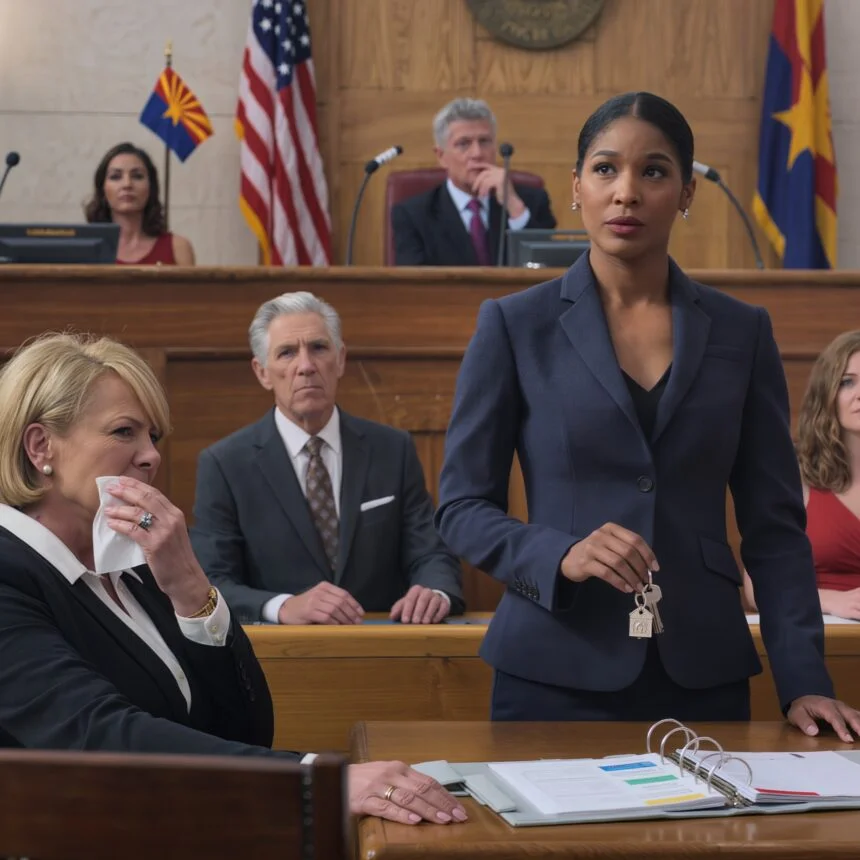
My mother blinked.
My father shifted in his seat. Vanessa crossed her legs more tightly, like confidence alone could fill in missing numbers. My attorney had already placed the evidence neatly on the table—pay stubs going back thirteen years, tax returns, bank statements, the down payment traced line by line to accounts that had only ever held my name.
No gifts. No loans. No co-signers.
No shared funds. The judge waited. My mother opened her mouth, closed it, then tried again.
“We… supported her emotionally. We raised her.”
The judge nodded once, slowly. “That’s parenting,” he said.
“Not ownership.”
Vanessa scoffed under her breath, and that was when the judge finally looked at her. “Ms. Alvarez,” he said, reading her name off the document, “how much did you personally contribute to the purchase of this property?”
She hesitated too long.
“I—I was planning to,” she said finally. “Once I moved in.”
The judge leaned back in his chair. “So nothing.”
Silence.
Then my father tried a different angle. He spoke about family expectations, about fairness, about how Rona had always been capable and Vanessa had always needed help. He talked like need created entitlement.
The judge let him finish. Then he said the sentence that would replay in my head for weeks afterward. “Responsibility is not a liability,” he said.
“And success does not obligate someone to surrender their property to someone who hasn’t earned it.”
My mother’s cheeks flushed red—not with sadness, but with something closer to embarrassment. The kind that comes when a private manipulation gets dragged into public light. The ruling was immediate.
The claim was dismissed. The case was closed. And a warning was issued about filing frivolous actions against adult children.
Vanessa stood up too fast, chair scraping loudly against the floor. My mother wouldn’t look at me. My father’s jaw was clenched so tight I thought his teeth might crack.
No one apologized. They didn’t have to. The truth had already done the work.
Outside the courthouse, the Arizona sun hit my face like permission. My attorney shook my hand and smiled. “You were never in danger,” she said.
I nodded—but what she didn’t understand was that the danger had never been legal. It had been emotional. It had been growing up knowing love came with conditions.
That praise meant “don’t need anything.”
That support meant “make yourself smaller.”
That night, I unlocked the door to my home again. I stood in the quiet living room—bare walls, unopened boxes, a future that finally felt solid instead of borrowed. I set my keys on the counter and realized my hands weren’t shaking anymore.
My phone buzzed once. A text from my mom: We hope you’re happy. I stared at it for a long moment.
Then I typed back, I am. And for the first time in my life, that wasn’t something I felt guilty admitting. They tried to take my house.
What they lost instead was access—to my money, my time, and the version of me that thought earning love was the same as deserving it. I worked two jobs since I was fifteen. I bought my first home at twenty-eight.
And I finally learned this at the exact right time:
Some people don’t celebrate your independence—
because it means they can’t control you anymore.