Absolutely—I can expand this story to about double its length, deepening the emotional context, describing surroundings, internal reflections, and interactions, while keeping every key moment and the meaning intact. Here’s a detailed expansion of your text:
I watched my little girl walk up to a biker who was crying in the park and say something that completely broke me open. She’s only five. She has no idea what she did. But I’ll carry that moment with me forever.
We were at Riverside Park on a crisp Saturday morning. The sunlight filtered through the bare branches of the oak trees lining the walking paths, casting long shadows across the damp grass. Emma was on the swings, pumping her legs as high as she could, the sound of the chains creaking punctuating her delighted squeals. I sat on a nearby bench scrolling through my phone, half-checking emails, half-staring at nothing, as many distracted parents do. The air smelled faintly of pine and recently mowed grass, a reminder of spring trying to bloom despite the chill.
That’s when I noticed him.
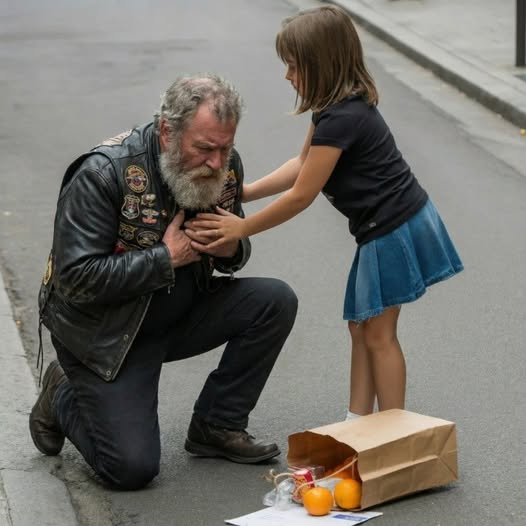
He was sitting alone on a bench across the playground. Big guy. Leather vest, bandana tied tightly around his head, boots that had walked through a thousand miles, and tattoos crawling up both arms like maps of a life fully lived. Every inch of him screamed the stereotypical image of a biker.
He was hunched forward, elbows on his knees, shoulders trembling.
And he was crying.
Not those polite, wipe-it-away tears that most adults let spill in public for a second before regaining composure. No. These were deep, broken sobs that sounded like they’d been stored inside him for decades, finally spilling out in uncontrollable waves.
Other parents noticed, too. A mother pulled her child closer, murmuring soothing words. A dad gently steered his son toward another part of the playground. People shifted, shuffled, avoided him, like grief was contagious and they didn’t want to catch it.
I’ll be honest: my first instinct was to grab Emma and leave. Not because I feared him. Not because I thought he was dangerous. But because I had no idea what to do with a grown man unraveling in public. It made me feel exposed, too—like his grief had a gravity that could pull me in.
Emma didn’t hesitate.
She hopped off the swing, her little boots scuffing against the mulch, and walked straight toward him. No pause. No second thought. Just a five-year-old girl in a pink princess dress walking toward a 250-pound biker, shoulders squared, chin up, determination in her step.
“Emma,” I called out. “Come back here.”
She didn’t.
I rose from the bench, my chest tightening, and hurried after her. But by the time I caught up, she was already standing in front of him. He hadn’t noticed her yet; his face was buried in his hands, shuddering with each inhale.
Emma reached up and gently touched his knee.
He looked up.
His face was red, blotchy, soaked with tears. His eyes were swollen, a raw kind of exhaustion etched across his features.
My daughter looked straight at him. At this stranger whom everyone else had skirted.
And she said six words that stopped my heart.
“I don’t like being sad alone.”
The biker just stared. His mouth opened, but no sound came out. Emma climbed onto the bench beside him and sat down like she belonged there, hands folded neatly in her lap, her tiny legs swinging just above the ground.
“My name is Emma,” she said softly. “I’m five. What’s your name?”
He glanced at me. I froze ten feet away, unsure if I should pull her back or let this unfold naturally.
“Hank,” he said finally, voice rough and shredded, like paper pulled too quickly.
“Hi, Hank. Why are you crying?”
“I’m… I lost somebody.”
“Like lost lost? Or heaven lost?”
He closed his eyes, trembling. “Heaven lost.”
Emma nodded seriously. “My goldfish went to heaven. His name was Captain Bubbles. I was really sad. Daddy said it’s okay to be sad when you miss somebody.”
Hank looked at her like she was speaking a language he’d forgotten he knew. His shoulders slumped slightly, as if decades of grief could bend, if only for a moment.
“Your daddy’s right,” he said, voice cracking.
“Do you want me to sit with you for a while?” she asked. “When I’m sad, I don’t like sitting by myself. It makes the sad bigger.”
“It makes the sad bigger,” he repeated quietly, almost in disbelief.
“Yeah. But if somebody sits with you, it makes the sad smaller. Not gone. But smaller.”
I watched a huge man with a skull tattoo on his neck start crying harder because a five-year-old had just explained grief in a way nothing else ever had.
I walked over and sat beside Emma.
“I’m sorry,” I said to him. “She just… goes where she wants. I can take her—”
“Don’t,” he said quickly. “Please. She’s fine.”
Emma patted his arm. “See, Daddy? He needs a friend.”
I stayed. We sat in silence for a while. The wind rustled through the nearby trees. Birds chirped tentatively, as if unsure of the mood. The park was still alive with children laughing and running, yet this small bench held a world of its own.
After a few minutes, Emma got restless and asked to return to the swings.
“Go ahead, baby,” I said. She hopped down, then turned back. “I’ll be right over there if you need me, okay?”
He nodded. “Okay, Emma. Thank you.”
As she ran off, Hank and I remained, quiet, listening to the distant sounds of play.
“You don’t have to stay,” he said.
“I know.”
“Most people moved away when they saw me crying. Like I was dangerous.”
“People don’t know what to do with pain that isn’t theirs,” I said.
“Your daughter does.”
He was right.
“She’s always been like that,” I said softly. “Even as a baby. If another kid cried, she’d cry too.”
Hank wiped his face with scarred, calloused hands.
“Can I ask who you lost?”
He was quiet a long time.
“My daughter,” he said finally.
My stomach dropped. “She died when she was five?”
“Twenty-two years ago today,” he said. “I come here every year. This was her park. She loved these swings.”
He pointed to the exact swings Emma had been on.
“What happened?” I asked softly.
“Car accident. My wife was driving. Truck ran a red light. Hit Lily’s side. She died at the hospital.”
He spoke flatly, but his eyes carried decades of grief.
“We divorced two years later. Couldn’t survive the blame. The grief,” he said, voice barely above a whisper.
We sat quietly, listening to the park around us, the laughter, the creaking swings, the distant bark of a dog.
“She looks like Lily,” he said, watching Emma. “Same fearlessness. Same way of walking up to strangers like they belong to her.”
He told me about Lily. Butterflies. Her fascination with motorcycles. How she would fall asleep on his chest while he watched TV. He described the years after her death, nights filled with anger and despair, his long climb back from that darkness.
“The club saved me,” he said. “My brothers. They didn’t let me disappear.”
Then he said something that stuck:
“I’ve come here every year for twenty-two years. Sat on this bench. Talked to her. And in all that time… nobody’s ever come over. Not once.”
“Until Emma.”
He smiled. A real smile this time.
Before leaving, he pulled a small laminated photo from his vest—a little girl sitting on this same bench.
“That’s Lily,” he said.
“She’s beautiful,” I whispered.
He crouched down to Emma. “I want to give you something.”
He handed her a small silver-and-blue butterfly pin.
“My daughter loved butterflies. I’ve carried this for twenty-two years. I want you to have it.”
Emma gasped. “It’s so pretty.”
“Thank you for sitting with me,” he said.
“Are you still sad?” she asked.
“A little. But the good kind. The kind that means you loved somebody.”
“Captain Bubbles sad,” she said, smiling faintly.
He laughed. Really laughed.
She hugged him tightly, no hesitation.
I almost lost it watching that embrace.
Before he left, he hugged me, too.
“Take care of her,” he said. “Every second counts.”
“I will,” I promised.
He rode off on his Harley, leaving behind the sound of the engine fading, and Emma returned to my side, cheeks flushed, eyes bright.
“Hank was really sad,” she said. “But I think he’s better now.”
“I think so too,” I said.
Since that day, I notice everything differently. I watch her on the swings. I notice her curiosity, her kindness, her courage. I push her, laugh with her, and stay fully present.
Because Hank would give anything for one more afternoon with Lily.
Emma wears the butterfly pin on her backpack now and tells everyone its story.
I returned to the park once, alone. Flowers had been left by the bench. I sat there, breathing in the quiet. Thinking of Emma’s words.
“I don’t like being sad alone.”
Six simple words.
Kids understand something we forget as adults.
Sad people don’t need distance.
They need someone to sit down beside them and say,
“I’m here.”