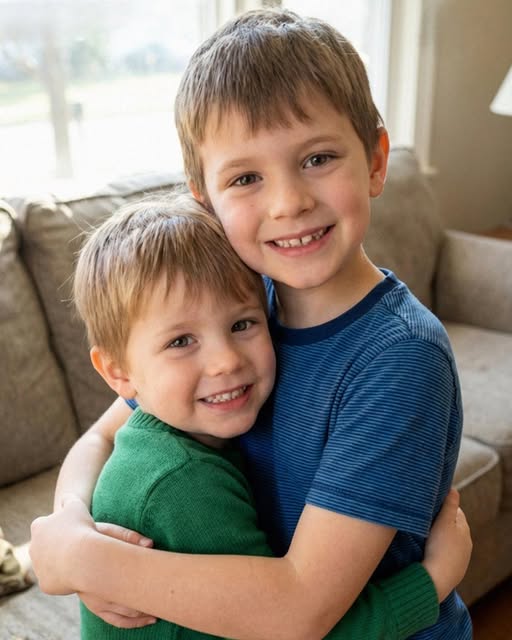
In the heavy silence that follows sudden loss, the human mind instinctively searches for some kind of bridge back to the one who is gone. For Elana, that silence had stretched across six unbearable months. It began the day a truck crossed the yellow line and ended the life of her eight-year-old son, Ethan. Her husband, Mark, survived the crash physically, but emotionally the family had shattered. Elana herself had been spared one final, painful act—identifying Ethan’s body—after a doctor decided she was “too fragile.” What was meant as protection instead left her suspended in unfinished grief, denied the closure of a final goodbye.
Life began inching forward when their younger son, five-year-old Noah, returned to kindergarten. The routine felt fragile but hopeful. Then, only a week later, that fragile balance broke.
As Noah struggled to fasten his car seat one afternoon, he spoke casually, almost cheerfully.
“Mom, Ethan came to see me today.”
The noise of the parking lot seemed to fade into nothing. Elana’s grip tightened on the steering wheel, her heart pounding, yet she forced her voice to remain calm. She told herself it was imagination—grief reshaped into comfort by a child who missed his brother desperately. But Noah insisted. Ethan hadn’t just been remembered. He had been there. Standing by the fence at school.
“He said you should stop crying,” Noah added softly.
The words struck with terrifying precision. They were too specific, too intimate to dismiss easily. Over the next several days, Noah continued describing these “visits.” He claimed Ethan spoke to him near the playground fence. He insisted Ethan wasn’t really buried in the ground. What at first felt like childlike fantasy began to feel unsettling. The atmosphere in their home grew tense, not with supernatural fear, but with something far more concrete.
Elana’s grief slowly gave way to suspicion.
One morning, she skipped the usual drop-off routine and walked straight into the principal’s office. She asked to see the playground security footage. When the video began, any thoughts of ghosts dissolved instantly.
On the screen, Noah wandered toward the edge of the schoolyard. He smiled. He waved.
“Zoom in,” Elana said firmly.
The camera tightened its frame. A man in a worn jacket and a baseball cap crouched on the other side of the fence, leaning close to whisper through the metal bars. This was no spirit. This was a living man.
The principal explained he was a contractor hired to repair exterior lights. But Elana recognized him before the explanation ended. The slouched posture. The hollow expression. She had seen that face before—in courtroom photographs she had tried to forget.
It was Raymond Keller, the truck driver responsible for Ethan’s death.
When police detained Keller and brought him into a small school conference room, the encounter felt like the collision of two broken lives. Keller looked drained, almost skeletal in his guilt. He didn’t resist. He didn’t deny.
“Why were you talking to my son?” Elana asked, her voice steady but sharp.
His confession revealed a man drowning in remorse and searching for absolution in the wrong place. He admitted he had taken the job at the school after recognizing Noah. The resemblance to Ethan haunted him. Keller had been experiencing fainting spells—syncope—but ignored medical advice to stop driving because he couldn’t afford to lose his income. His decision had cost a child’s life.
“I thought if I could help somehow,” he said quietly. “If I could tell him something to make you stop crying… maybe I could live with myself.”
Elana’s anger sharpened into clarity.
“So you used my son to ease your guilt,” she said. “You took one child from me. And then you tried to take his memory.”
The aftermath required another painful conversation at home. Elana sat Noah down and gently explained that the man by the fence was not Ethan, not a messenger, but someone who had told him something untrue. She watched heartbreak ripple across her five-year-old’s face—the loss of a magical connection that had briefly soothed him.
It felt like Ethan had been stolen twice.
Yet as the days passed, something unexpected happened. The truth, though painful, brought a clearer kind of healing. The borrowed comfort Keller had offered was replaced by honest grief—raw but real. Elana returned to the cemetery. This time she did not feel fragile. She stood before Ethan’s grave and spoke the words she had been denied months earlier. She said goodbye on her own terms.
She understood then that forgiveness was not an obligation. What mattered was protecting Noah and preserving Ethan’s memory without distortion. Mark, too, began to emerge from his own guilt, motivated by the need to safeguard the child they still had.
The story of the “brother at the fence” did not end with a miracle. It ended with clarity. Grief, Elana realized, is sacred. It cannot be repaired with lies, even well-intentioned ones. Peace only comes when truth replaces illusion.
By the end of that week, Elana walked away from the school carrying a heavier truth—but also a stronger sense of resolve.
As 2026 unfolds, the family continues rebuilding their lives with a renewed focus on safety and openness. Elana has begun advocating for stricter school security measures and better support systems for families affected by traffic tragedies. She refuses to let another parent experience the horror of wondering whether a ghost speaking to their child is, in fact, a shadow from a past that was never fully laid to rest.