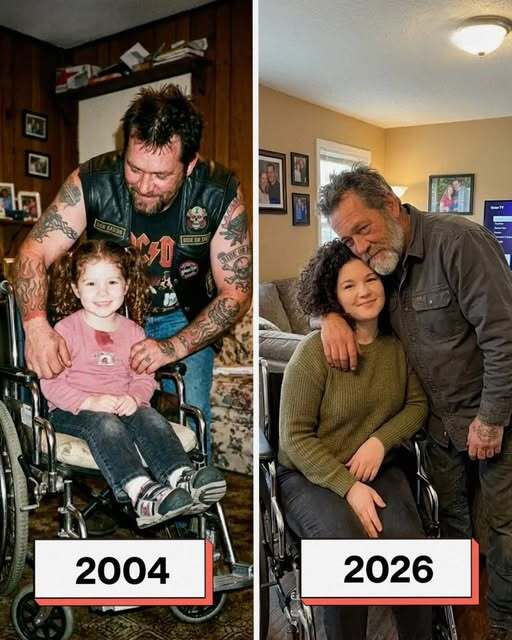
The truth detonated quietly, almost invisibly, in the hours after the funeral. One envelope, cream-colored and worn at the edges, lay waiting among the flowers and condolence cards. Eight pages, densely packed with handwriting that trembled with urgency and shame. A confession, the kind that changes everything you thought you knew about yourself, about the people you loved, and about the fragile world you inhabit. The words turned her childhood into a crime scene. The uncle who had carried her, who had bathed her, tucked her in, whispered stories into her ear when nights were long and cold, who had fought the world for her… was also a man who had helped set the night in motion that stole her parents, that stole her legs, that had shattered her family into fragments she had spent years attempting to glue back together. Love, guilt, money, secrets, and silence—every thread she had relied on had been intertwined with betrayal.
For years, she had constructed a life around a simple, almost sacred story: there was a crash, her parents died, she survived, and her uncle saved her. Grief, she had learned, had sharp edges, but at least those edges were hers to navigate. She had learned to fold her mourning into routines, to live around its weight without letting it suffocate her. But that letter cracked the clean, comforting line in half. Suddenly, the man who had woken up every two hours in the middle of the night to turn her, who had learned the delicate choreography of braiding her hair, who had battled insurance companies and navigated bureaucracies to protect her, wasn’t just her rescuer. He was also a witness to the negligence, the fatal choices, the drunk hands that had grasped car keys and let catastrophe unfold. The duality of him—savior and enabler—was a paradox that made her stomach twist and her chest tighten.
Rehab became a battlefield of its own. The harness around her torso and legs gripped her tightly, a reminder of both support and limitation. The treadmill hummed beneath her, a mechanical heartbeat that seemed to echo the pulse of memory. Each step that faltered, each leg that trembled under her weight, felt like a confrontation with the past—a debate she had no audience for. Every second she stayed upright, every footfall that carried her forward, was an argument spoken into the void: a declaration that she could move, that she could exist, that she could define herself beyond the shadows of betrayal. Forgiveness did not arrive as a grand gesture, nor as a neatly packaged epiphany. It came in fragments, almost imperceptible: in the scent of basil leaves she carefully chopped for dinner, in poorly executed braids that made her laugh despite the tension, in the small trust that had survived beneath layers of deception. Her uncle had carried his guilt with the same strength and care he had carried her. He had borne the weight of both love and responsibility, and now she had to find a way to bear the weight of knowing all of it.
Yet she moves forward. She does not erase the past, does not try to paint over the night that reshaped her life, does not deny the role her uncle played in the chain of events that nearly destroyed her. She refuses, however, to live pinned beneath it. Each day is a negotiation between memory and momentum, between mourning and movement. She walks forward with the knowledge that the complexity of love and betrayal can coexist—that a rescuer can also be flawed, that guilt can be inseparable from care, and that healing is not about absolution, but about reclaiming agency in a life that once felt stolen. Her steps are her own now, measured, determined, and defiant. Each stride says: I remember, I feel, I forgive in pieces, and I continue.
The story of her past is no longer a straight line; it is a tapestry of pain, resilience, and endurance. She stitches it together with the threads she chooses—threads of courage, of memory, of understanding, and of self-possession. In the quiet moments of a treadmill’s hum, in the deliberate movements of physical therapy, in the act of feeding herself, laughing, and braiding hair, she rebuilds a narrative that is wholly hers. The trauma remains, but it no longer dictates the rhythm of her life. Instead, she dictates it, and in doing so, she transforms a legacy of loss into a testament of survival.