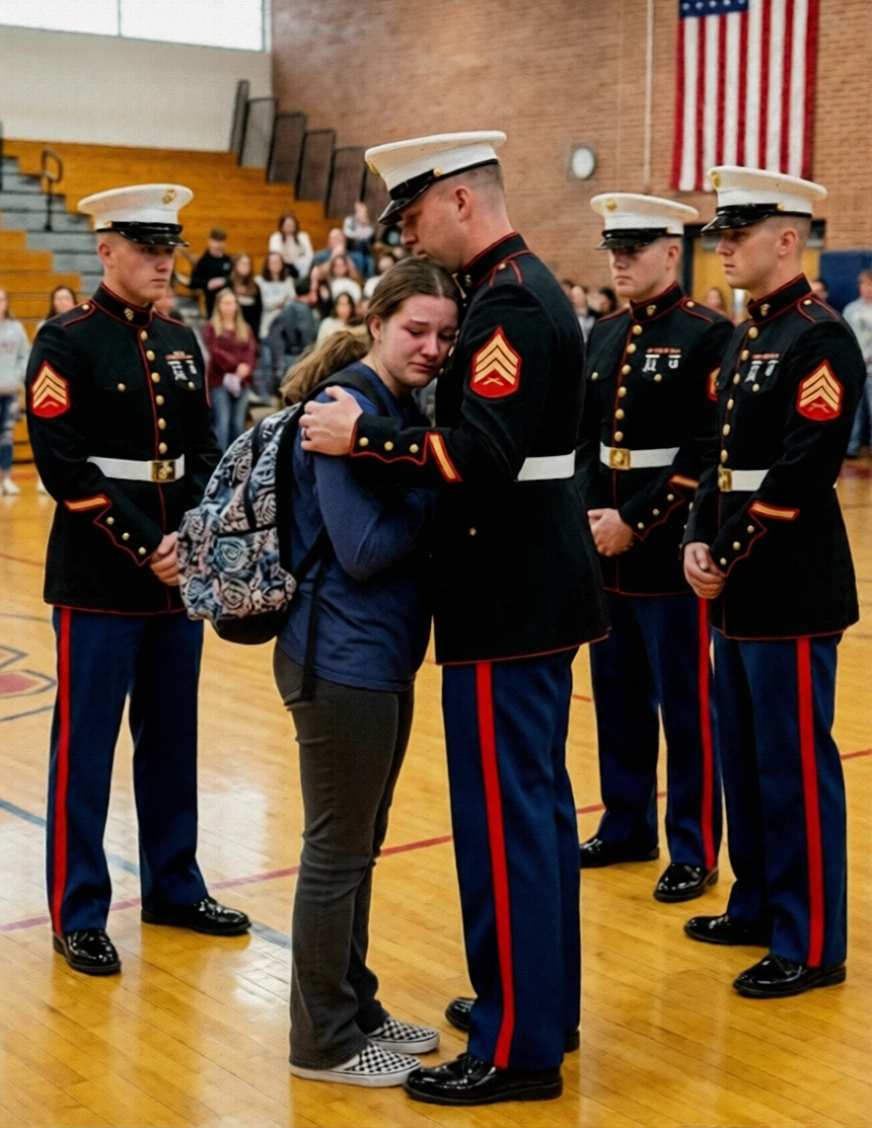
When my 14-year-old daughter Grace got detention for defending her late father in class, I thought I was heading into another school conflict. I had no idea it would uncover how deeply his memory had been disrespected.
A classmate mocked her dad, saying he “just didn’t want to come back,” and when Grace reacted, she was punished while the other student faced no equal accountability. That night she broke down, holding his dog tags, terrified she had dishonored him.
The next morning, the school called an emergency assembly. Four Marines arrived, saying they had served with her father, Staff Sergeant Daniel. They presented a bronze star, a folded flag, and explained he had been officially recognized years earlier—but due to an administrative failure, his honor was never properly delivered.
Grace finally heard what her father truly meant to the people who served with him, and for the first time, her grief turned into something closer to pride.
But the truth didn’t stop there. Later, military records revealed his mission had been compromised by ignored warnings. He died saving others, but the full story had been buried under a simplified version of “heroism.”
Over the following months, I pushed for answers and learned the reality was more complicated—bravery existed alongside serious failure in the system that sent him.
At a later school ceremony, I spoke openly: he was a hero, but also part of a story where truth had been incomplete. A Marine saluted. Others followed.
At home, Grace stopped only defending her father and started learning him—his laughter, his habits, his humanity.
She now looks at his medal beside his photo and says, “I think I know him better now.”
And for the first time, she carries his memory with understanding, not pain alone.