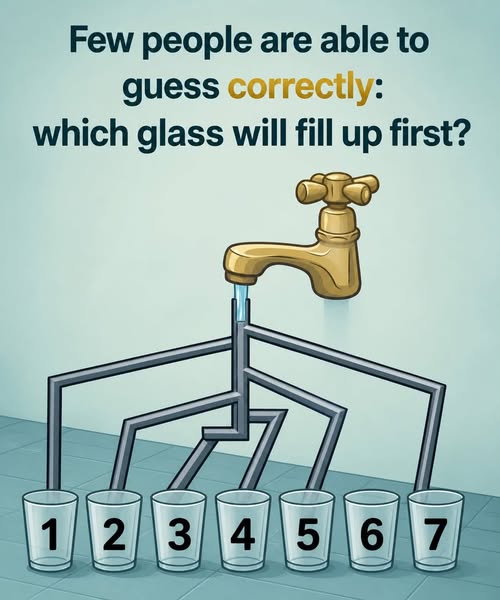
This visual puzzle looks simple at first: water seems to flow through connected pipes into seven glasses, making it feel obvious that at least one glass will fill. The design tricks the brain into assuming continuous flow and encourages quick, instinctive answers based on pattern recognition.
However, the puzzle is deceptive. Some pipes that appear connected are actually broken, blocked, or lead to dead ends. Others form misleading paths that create the illusion of a working system. Because of this visual complexity, people often misjudge the flow without careful inspection.
When each path is examined closely, there is no complete route from the water source to any of the seven glasses. Every possible path is interrupted somewhere.
The solution shows that the puzzle is less about logic and more about perception. It demonstrates how easily the human mind can be misled by visual assumptions, reminding us to slow down and analyze details before drawing conclusions.