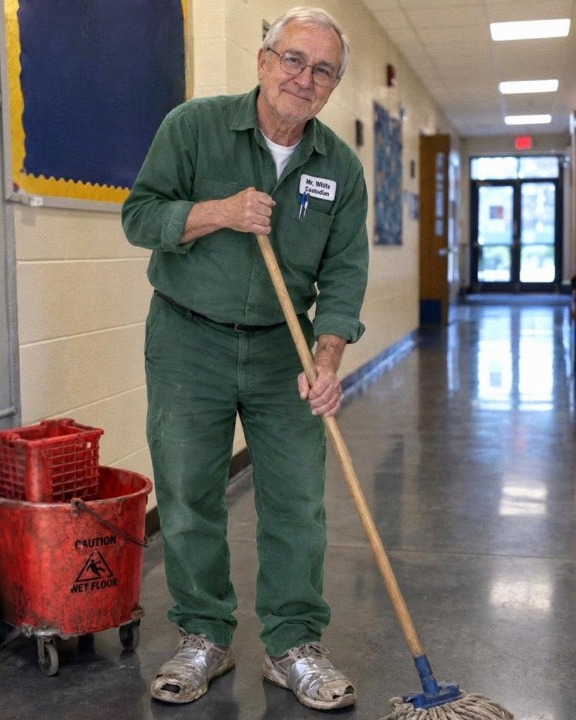
The first thing I noticed about Mr. White wasn’t his shoes.
It was the way he noticed everyone else’s.
He was 63, the new janitor at our school, the kind of man people walked past without looking twice. His shoes were held together with duct tape. His uniform was faded. But he still said, “Morning, Harry,” like the words mattered.
Most people didn’t say anything at all.
Until that Tuesday.
Three guys from my grade laughed at him near the trophy case.
“Looks like your shoes gave up,” one said.
“Janitor pay must be rough,” another added.
Mr. White just kept mopping.
But something in me snapped.
I stood up. “That’s not funny.”
They laughed at me instead.
I didn’t care.
I turned to Mr. White. “What size are you?”
“Harry, don’t—”
“What size?”
He hesitated. “Ten and a half.”
Same as me.
I took off my sneakers.
“No,” he said immediately.
But I already handed him one.
Then the other.
When he finally put them on, he just stared at his feet like he didn’t trust them to stay real.
Then he cried.
Quietly. Like he didn’t want the hallway to hear.
“My daughter is sick,” he said. “I’ll pay you back.”
“You don’t have to.”
“I will.”
I shook my head. “Then don’t.”
That night I went home in socks.
I thought that was the end of it.
I was wrong.
The next morning, the principal called me down.
Two officers were waiting.
A wooden box sat on the desk.
“Mr. White asked us to give this to you,” one said.
My hands shook as I opened it.
Inside: a key, a name tag, and a photo of a small shoe shop.
White’s Shoe Repair.
The officer spoke quietly.
“He wasn’t just a janitor.”
By the time I left that building, I understood something I didn’t have words for yet:
I didn’t give him shoes.
I reminded him he still existed.
And sometimes that is the most expensive thing you can give someone.