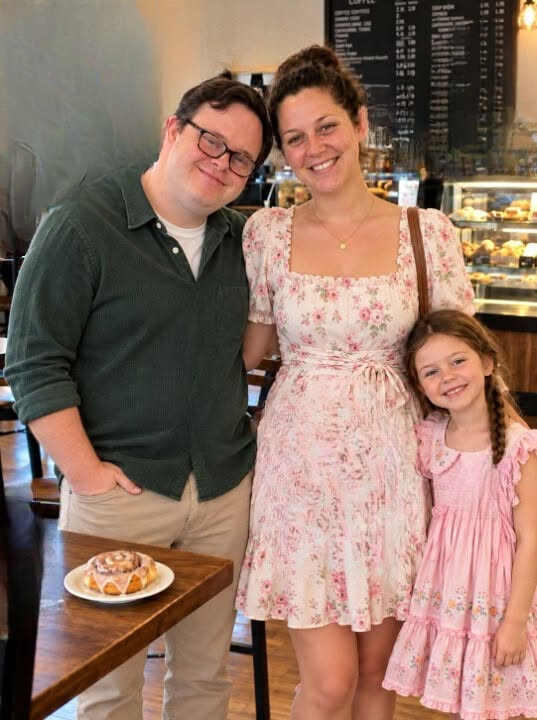
Every day, Calvin, a man with Down syndrome, visited the café where I worked and left me a five-dollar tip. Then, one week, his usual table stayed empty. When his sister finally arrived, she handed me a letter from my late husband—and a warning that changed everything.
Calvin had known my husband, Peter, long before he became my regular customer. Years earlier, Peter had defended Calvin from cruel coworkers, and the two had formed a friendship built on loyalty and kindness. Before Peter died, he asked Calvin to keep their connection a secret to protect our family.
But Peter had been hiding something far more dangerous.
While working at Hanover Distribution, he uncovered a massive financial fraud involving fake invoices, stolen money, and powerful people. With Calvin’s help, he gathered evidence. When someone threatened Peter by sending him a photograph of me and our daughter, he hid the documents and begged Calvin to protect them.
Now Calvin was gone, and a chilling message on his phone read: “You should have forgotten Peter.”
Searching Calvin’s apartment, I discovered a hidden flash drive and a note warning me not to trust the police until I learned the identity of Michael Rainer, Peter’s former supervisor.
The deeper I dug, the more terrifying the truth became. Corrupt officials, a powerful businessman, and a hidden ledger known as the Harbor Ledger were connected to a network that would do anything to bury the evidence. Even Calvin’s supposedly accidental death began to look suspicious.
Then I received a photograph of my children outside their school.
Someone was watching us.
As the investigation unfolded, Peter’s half-brother, Evan, emerged from the shadows with Peter’s final recorded message. Through tears, I heard my husband apologize for the secrets he had kept and explain why he had tried to protect our family.
His final words reminded me that, no matter what happened, I had always been his home.
Months later, the evidence helped expose the corruption, arrests followed, and Calvin’s death was reopened for investigation. Slowly, I began rebuilding our lives.
But I never forgot the man who had quietly left me five dollars every day.
At 12:30, Calvin’s favorite table remained a place of remembrance. Eventually, a young man named Tyler arrived with a note Calvin had left him, encouraging him to apply for a job. Tyler was hired, continuing Calvin’s tradition of helping people in ways that might seem small but could change a life.
I finally understood that Calvin’s greatest gift was never the money or the evidence he protected. It was his kindness, his loyalty, and his belief that every person mattered.
And whenever someone leaves five dollars beside an empty coffee cup, I remember him—and the extraordinary chain of courage and love that began with one simple act of kindness.