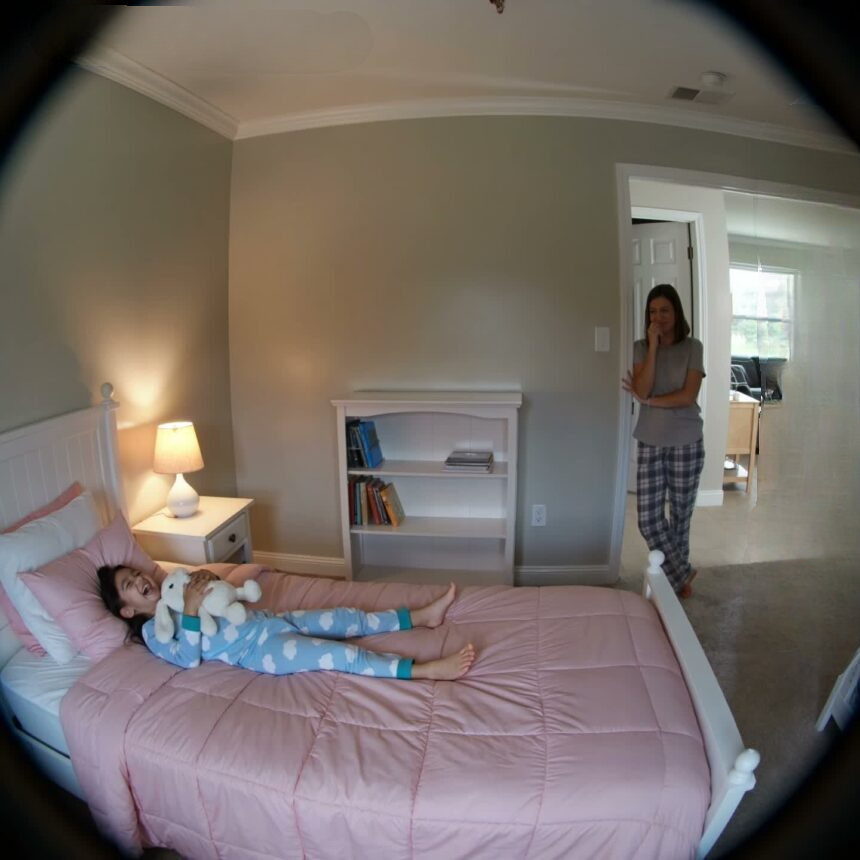
For weeks, my eight-year-old daughter, Mia, kept telling me something strange about her bed.
“Mommy, it feels too tight,” she would whisper at bedtime.
At first, I assumed she meant her blankets were tucked in too tightly or that her mattress felt uncomfortable. I adjusted her sheets, changed her pillows, and even asked whether she wanted to sleep somewhere else.
But every night, she said the same thing.
Something about her bed didn’t feel right.
I tried not to worry. Children have vivid imaginations, and I didn’t want to make her fears worse by taking them too seriously.
Then, one night at exactly 2:00 a.m., my phone buzzed with a motion alert from the camera in her bedroom.
Half asleep, I opened the app, expecting to see Mia tossing and turning.
Instead, I noticed something that made my blood run cold.
The mattress appeared to rise slightly before settling back down.
I stared at the screen, barely breathing.
A few seconds passed.
Then it happened again.
The mattress lifted by what looked like an inch, then slowly returned to its original position. Mia was asleep, and nothing appeared to be touching the bed.
I zoomed in, searching for an explanation. Perhaps it was a trick of the camera, a shifting bed frame, or some strange movement caused by the house itself.
But I couldn’t convince myself that I had imagined it.
The next morning, I kept what I had seen to myself. The last thing I wanted was to frighten Mia or make her afraid of her own bedroom.
Still, I needed answers.
That evening, after she finished getting ready for bed, I placed a small stuffed animal, a paperback book, and a toy block on different parts of the mattress.
If the bed moved again, I would have something more concrete to observe.
I barely slept that night.
At around 2:00 a.m., another motion alert appeared on my phone.
My hands trembled as I opened the live feed.
The mattress shifted again.
This time, the stuffed animal rolled slightly to one side. The book moved, and the little toy block tipped over.
I sat frozen, watching the recording repeatedly.
Whatever was happening, I couldn’t dismiss it as Mia simply imagining things.
The following day, while Mia was at school and my husband, Eric, was at work, I decided to inspect the room.
I knelt beside the bed and examined the frame, the mattress, and the floorboards. Most of the floor seemed perfectly normal, but one corner felt loose and slightly raised.
I pressed down on it.
It shifted.
My stomach tightened.
Using a screwdriver, I carefully lifted the loose section and discovered a dusty crawl space beneath the floor.
Inside were old pipes, cobwebs, and scattered pieces of paper. It looked as though the space had been forgotten for years.
Then I noticed something farther back.
An old hatch.
It appeared to lead into another section beneath the house, one I had never known existed.
I didn’t open it.
By then, my curiosity had been replaced by concern. I had a child sleeping directly above a space I knew nothing about, and I wasn’t willing to take any chances with her safety.
I arranged to have the area professionally inspected so we could determine whether there were structural problems, loose supports, or something else that might explain the strange movement.
That evening, I sat beside Mia as she got ready for bed.
“Will my bed be okay now?” she asked quietly.
I brushed her hair away from her face and promised we would make sure her room was safe.
But after she fell asleep, I found myself staring at the bedroom camera again.
I kept thinking about the mattress moving, the objects shifting, and the hidden hatch beneath the floor.
There had to be an explanation.
And until someone examined that space, I wouldn’t be able to rest easy.
Mia had been trying to tell me something was wrong long before I saw it for myself.
Now, all I could think about was one unsettling question:
What had been happening beneath my daughter’s bed while we slept just a few feet away?