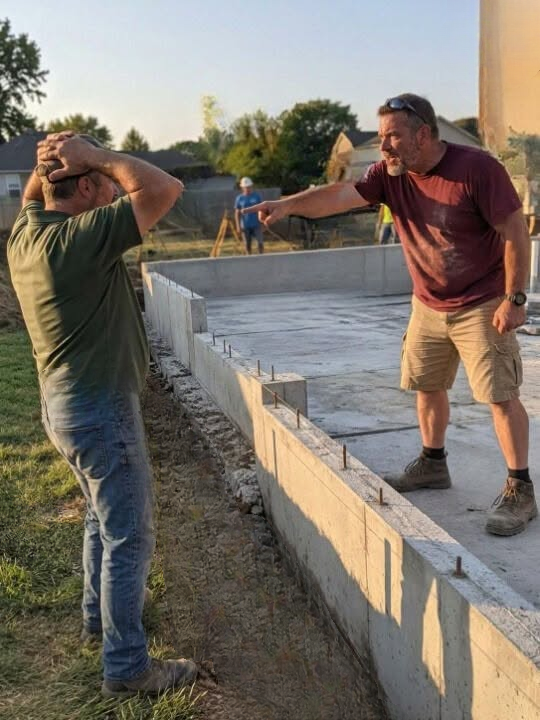
“Get off my concrete!” my neighbor shouted when I stepped onto the enormous gray foundation that had appeared on our property.
I stood there in disbelief.
My wife, Sarah, and I had been away for eleven days visiting her mother in Georgia. We returned to our quiet 22-acre property in Texas expecting everything to be exactly as we had left it. Instead, our neighbor, Victoria Voss, had built a massive foundation that extended onto our land.
My name is Cole McAllister, and Sarah and I had spent six years building a peaceful life surrounded by towering trees, open pastures, and our modest barn.
Now, Victoria was standing beside a construction project that had swallowed part of our property, behaving as though I was the one causing trouble.
When I demanded an explanation, she casually offered me $15,000 to forget the whole thing.
Victoria had recently purchased the neighboring eight-acre property and planned to turn it into a luxurious private retreat, complete with a guesthouse, swimming pool, outdoor kitchen, and entertainment areas. She was accustomed to spending enormous sums of money and seemed convinced that every problem could be solved by writing a check.
But she had made one serious mistake.
Before becoming a property owner, I had spent twelve years serving as an Army combat engineer. I knew that when something looked wrong, the first step was to examine the evidence.
And something about that foundation immediately bothered me.
Several weeks earlier, I had noticed surveyors working near our property line. At the time, I hadn’t thought much of it. Now, I contacted Pete Sandoval, the licensed surveyor who had originally established our boundaries.
His measurements confirmed my suspicions.
Approximately 2,600 square feet of Victoria’s foundation sat on our land, extending more than fourteen feet beyond the legal boundary.
But the survey wasn’t the only evidence I had.
While Sarah and I were away, our security camera had continued recording. I reviewed the footage, hoping to understand how the construction had gone so badly wrong.
What I discovered was far more disturbing than a simple surveying mistake.
The footage showed Victoria removing nine visible boundary markers shortly after we had left Texas.
Fortunately, the original iron survey pins remained buried underground. Those markers, together with our deed and the professional survey, provided strong evidence of where our property actually ended.
I confronted Victoria with the findings.
Instead of acknowledging what had happened, she insisted that the foundation was already finished and threatened legal action if I tried to interfere with her project.
She seemed convinced that her $160,000 investment gave her the upper hand. Surely, she believed, I wouldn’t want to spend a fortune fighting over land when she was offering me $15,000 to settle the matter.
But she had underestimated me.
I documented everything, contacted my attorney, and refused to negotiate based on threats or assumptions. The issue wasn’t how much money Victoria had spent. It was whether she had the right to build on land that belonged to someone else.
And she didn’t.
The dispute moved into the legal system, where the survey, property records, and security footage became important evidence. Victoria’s awareness of the boundary and the removal of the markers brought even greater scrutiny to her actions.
Meanwhile, the foundation continued to present a practical problem. Freshly poured concrete becomes increasingly difficult to remove as it cures, making every delay potentially more expensive.
Eventually, the portion of the foundation encroaching on our property was demolished, and the dispute was resolved through a court ruling.
Victoria’s original development plans were abandoned. Her husband, Garrett, eventually offered an apology, and the neighboring property was later sold.
For Sarah and me, the outcome meant far more than winning a costly property dispute.
We could finally enjoy our land again without wondering whether someone else would decide to take control of it.
Once the disputed area had been restored, we returned to a project Sarah had dreamed about for years: building a proper horse barn and paddock.
When we finally brought our horses home, we gave them two unforgettable names: Survey and Pin.
Every now and then, I remember the day Victoria stood beside that enormous foundation and offered me $15,000 to walk away.
She had looked at a man in muddy boots, driving an old pickup truck, and assumed he wouldn’t dare challenge her.
She was wrong.
The real issue had never been the $160,000 worth of concrete or the money she was willing to offer me.
It was about something much simpler.
Our land belonged to us. And no amount of money could buy my silence when someone tried to take what was ours.