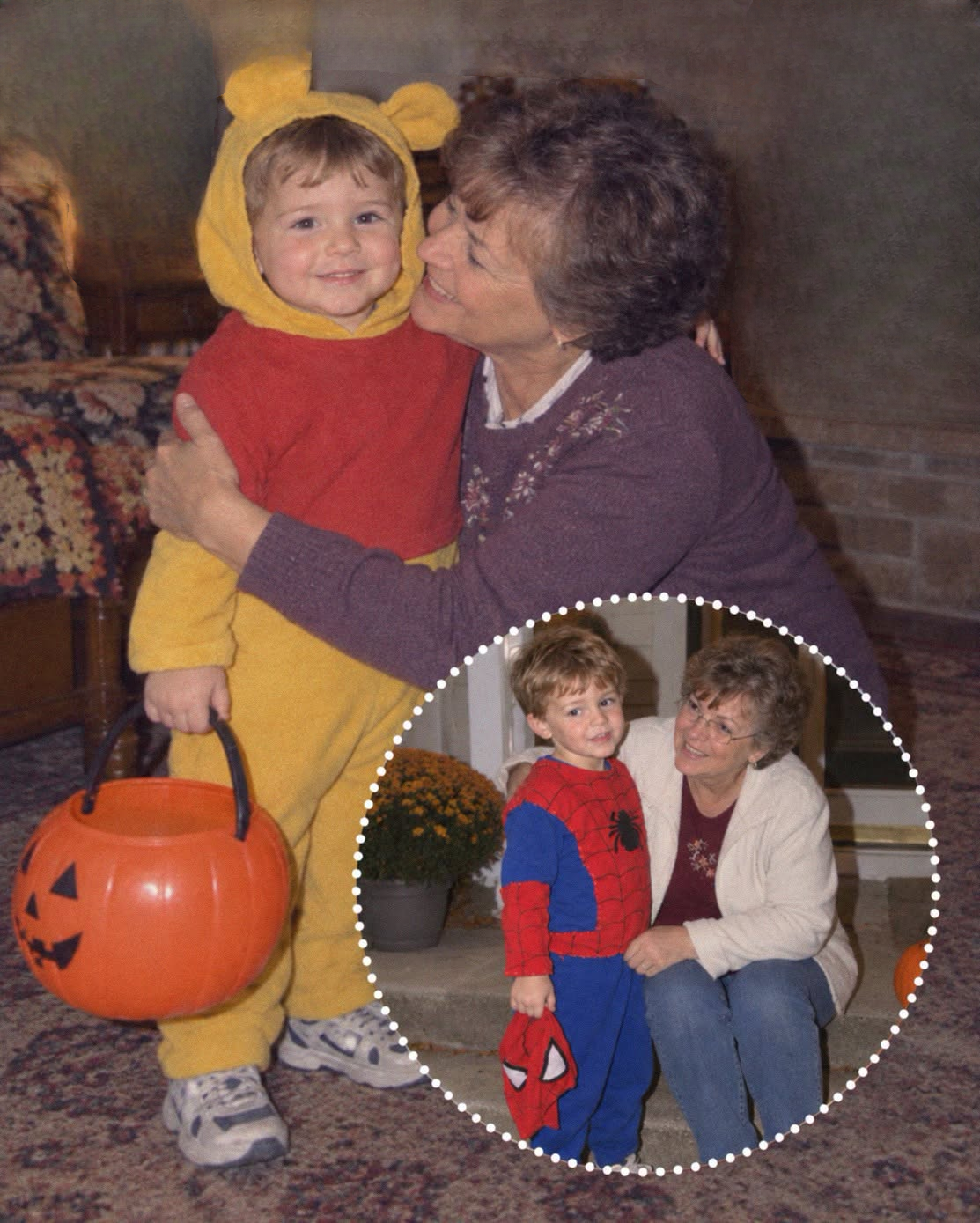
When I was growing up, my grandmother spent ten years creating Halloween costumes for me by hand. I thought she was simply being creative. I never realized she was giving me something she had been denied as a child.
I discovered the truth when my eight-year-old daughter asked Grandma Evelyn one simple question: “What did you dress up as when you were little?”
Grandma went quiet.
“I never really did,” she admitted.
I was six when my parents died in a car accident. Grandma Evelyn, then 51, took me in despite barely having enough money to support herself. She worked part-time at a bakery and cleaned offices at night. Every dollar went toward groceries, utilities, and keeping our little house running.
Yet somehow, every October, she made Halloween magical.
When I wanted to be Spider-Man, she bought a red shirt, blue sweatpants, and black fabric paint. She spent three nights drawing webs by hand.
When I wanted to be a pirate, she turned an old burgundy curtain into a coat. The following year, cardboard boxes, aluminum foil, and dryer vents transformed me into a robot.
Year after year, she created something incredible from almost nothing.
Whenever I asked why she never bought me the store-bought costumes other children wore, she smiled and said, “Because yours are one of a kind, sweetheart.”
I believed her.
I never knew she stayed up sewing after midnight. I never knew she went without things for herself. And I certainly never knew that, as a little girl, she had watched other children celebrate Halloween from behind her family’s window.
Her parents considered costumes a waste of money. When she once asked for one, her father told her she already owned clothes.
That was all she ever got.
Decades later, my wife Natalie and I brought our children, Sophie and Caleb, to visit Grandma before trick-or-treating. Grandma was 79, and arthritis had made sewing difficult.
As we looked through an old photo album filled with my homemade costumes, Sophie suddenly asked Grandma about her own childhood.
After hearing the answer, I finally understood what those ten years of costumes had really meant.
Grandma hadn’t simply been helping me celebrate Halloween.
She had been giving a little boy the childhood she had never experienced herself.
I wanted to do something for her, so I told Grandma to take the children trick-or-treating while Natalie and I prepared a surprise.
Searching for materials, I discovered an old shoebox beneath her bed. Inside were black-and-white photographs and drawings of costumes Grandma had imagined wearing as a child.
A fairy. A nurse. A movie star. A witch.
Each drawing was labeled with her name and age.
At the bottom lay a note in her handwriting: “Costumes I wanted but never got. Silly old things.”
Beneath it was a more detailed design for a dark blue dress, a cape, and a pointed hat covered in silver stars.
It was titled “Midnight Witch.”
I knew immediately what we had to do.
Natalie and I searched the house for materials. We found an old blue bedspread, silver Christmas garland, a black scarf, cardboard, and thread.
Neither of us knew how to use Grandma’s sewing machine properly. We watched a tutorial, struggled through the stitching, and improvised the rest.
The result was crooked. The stars weren’t evenly spaced, the hat leaned to one side, and the cape was far from perfect.
But it was ours.
When Grandma returned with the children, she immediately noticed the mess.
“What did you do?” she asked suspiciously.
Then she saw the shoebox.
Her expression changed.
“You found that.”
I handed her the drawing of the witch.
For a moment, she said nothing.
Natalie appeared with the blue cape and crooked hat. Grandma touched one of the silver stars, her fingers trembling.
“You made this?” she whispered.
“Yes,” I told her.
“Why?”
I could barely hold back my emotions.
“Because you gave me ten Halloweens you never had.”
Her eyes filled with tears.
“No,” she said softly. “I gave you what I could.”
“You gave me more than you could afford.”
She looked at me as if the answer were obvious.
“Because you were mine.”
Those words broke my heart in the best possible way.
Sophie insisted that Grandma put on the costume. Caleb even offered her his candy bucket.
Grandma finally slipped on the crooked hat and draped the blue cape around her shoulders.
She stood before the hallway mirror and stared at her reflection.
“I wanted one almost exactly like this,” she whispered.
“I know,” I replied.
Then she asked a question I never expected.
“Are there any houses left?”
We went back outside together.
At the first house, Grandma initially stayed at the bottom of the driveway, claiming she was only supervising. But when the homeowner offered her a piece of candy, she froze.
“Oh, no. I’m fine,” she said.
“Come on,” the woman encouraged. “It’s Halloween!”
Grandma looked at me. I smiled and shrugged.
Slowly, she walked up the steps.
The woman placed a chocolate bar in her hand.
“Happy Halloween.”
Grandma stared at it before whispering, “Thank you.”
Three houses later, she was saying “trick or treat” alongside the children.
One neighbor gave her extra candy after hearing the story. Another joked that she might be slightly past the recommended age.
Grandma smiled proudly.
“I’ve been waiting 70 years. I’m making up for lost time.”
By nine o’clock, she had a bucket full of candy and the biggest smile I’d ever seen on her face.
Back home, the children emptied their candy onto the living room floor while Grandma sat on the couch, refusing to remove her crooked witch hat.
“Good Halloween?” I asked.
She looked at the children, then at the old photographs on the table.
“The best one,” she said.
I laughed. “You used to say that every year.”
“Did I?”
“Every year.”
She leaned against me.
“Well, I meant it every year.”
Before we left, Grandma picked up one of her childhood drawings.
“I suppose part of me liked imagining,” she admitted. “But when I started making your costumes, I didn’t need them as much.”
That was when I finally understood.
Every costume she made had been a quiet answer to the little girl who once sat by the window, watching other children enjoy something she couldn’t have.
She couldn’t change her own childhood.
So she changed mine.
The following Halloween, Sophie and Caleb asked to make their costumes instead of buying them. Grandma couldn’t do every stitch anymore, but she supervised, teaching them how to reuse cardboard, pin fabric, and fix mistakes rather than throw things away.
When we asked what she planned to wear, she disappeared into her bedroom.
She returned wearing the same blue cape and crooked witch hat.
Most of the silver stars had been replaced. The stitching was straighter.
“I improved it,” she announced proudly.
I asked whether she hadn’t liked my work.
“I love you very much,” she replied.
It wasn’t exactly an answer, but it was enough.
I still have photographs of every costume Grandma made for me: the Spider-Man, the pirate, the robot, the knight, and the vampire.
But my favorite Halloween photograph isn’t of me.
It’s of Grandma at 79, wearing her blue cape and crooked witch hat, holding a candy bucket with my children standing proudly beside her.
She looks happier than I’ve ever seen her.
For almost 30 years, I believed Grandma’s costumes were special because they were one of a kind.
Now I know the truth.
They were special because every stitch carried the love of a woman who had spent her life making sure the children she loved would never have to miss out on the magic she once dreamed of experiencing herself.