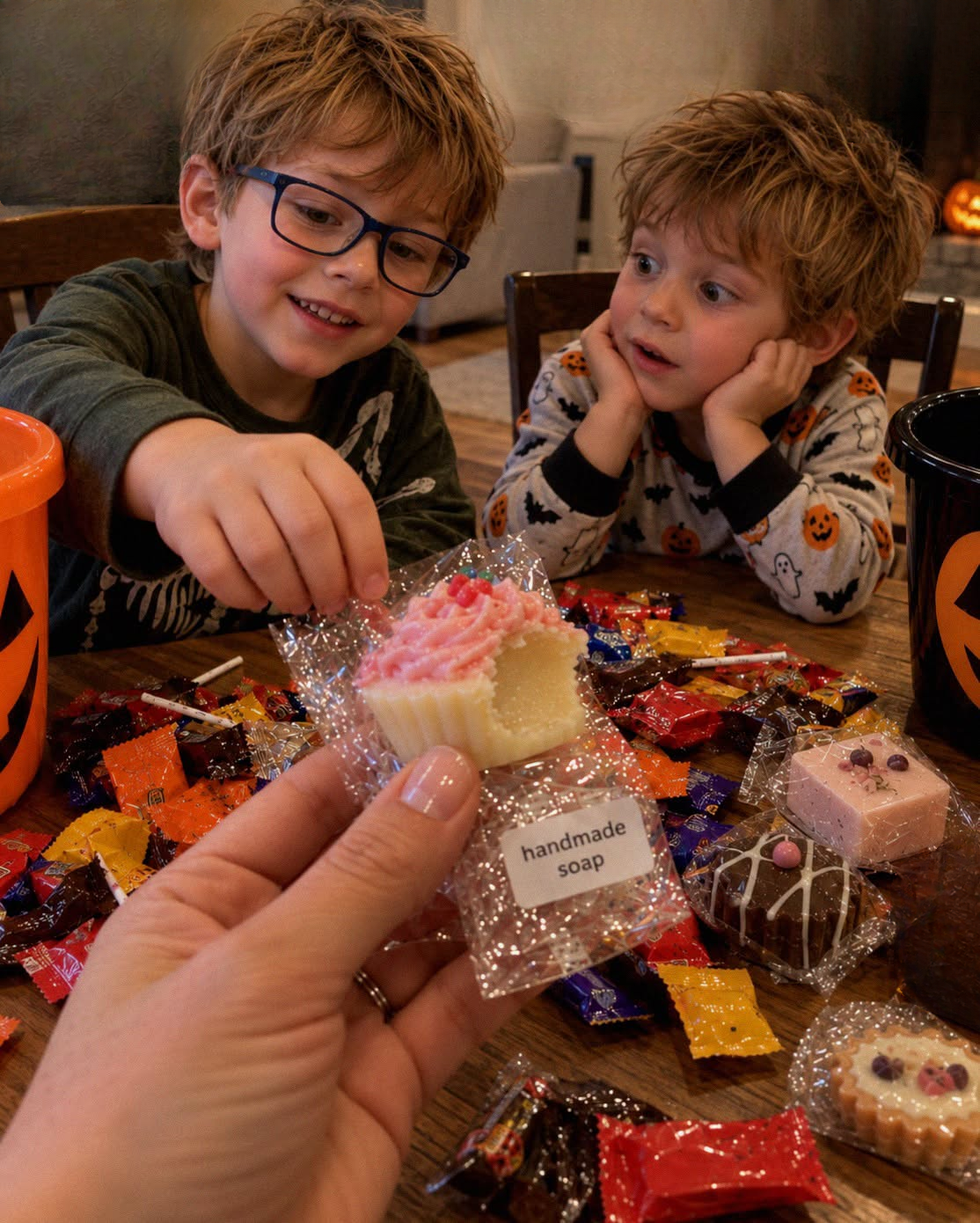
My husband had barely bitten into the tiny Halloween cupcake when he spat it into his hand and rushed to the bathroom.
“What the hell is that?” he shouted.
I followed him, holding the half-eaten treat. It had pink frosting, colorful sprinkles, and a paper wrapper. It looked exactly like something from a bakery.
But when I rubbed the broken edge between my wet fingers, it began to lather.
It was soap.
Someone had given my children soap disguised as candy.
When I asked my eight-year-old son, Noah, where he’d gotten it, his answer made my heart sink.
“From the lady next door.”
Erika.
Of course it was Erika.
My husband, Daniel, was still rinsing his mouth when I stormed into the kitchen.
“That’s it. I’m going over there!”
He stepped in front of me.
“And what will that accomplish? You’ll scream, she’ll scream back, and nothing will get solved.”
“So we’re supposed to do nothing?”
“I didn’t say that. Trust me. I’ll handle it.”
I wanted to argue, but I let him take over.
I had no idea that by the following morning, our neighbor would be pounding on our front door and screaming at us.
“Open this door right now! How dare you?”
I hurried downstairs and looked through the peephole. Erika stood on our porch, her face red with fury.
Daniel appeared beside me, looking remarkably calm.
“What did you do?” I whispered.
“Exactly what I promised.”
To understand why this happened, you need to know that Erika and I had been at odds for seven years.
When Daniel and I first moved into our house with our sons, Noah and six-year-old Ben, Erika seemed friendly. She brought cookies and offered helpful advice about the neighborhood.
But gradually, things changed.
She complained whenever the boys played outside, criticized our Halloween decorations, and returned their balls with lectures about respecting her property.
I wasn’t always polite in return. When she complained about our pumpkins, I told her she didn’t own the neighborhood.
Eventually, we stopped speaking unless absolutely necessary.
Still, I never imagined she’d involve my children in our feud.
On Halloween night, Daniel took the boys trick-or-treating while I stayed home to finish some work. They returned with overflowing buckets, excitedly describing their costumes and the decorations they’d seen.
As usual, I sat them at the kitchen table to divide their candy equally.
That’s when I discovered several miniature cupcakes, muffins, and pastries.
They looked beautiful.
“Oh my goodness!” I said. “Someone actually baked treats for the children!”
Daniel leaned over my shoulder, unwrapped a cupcake, and took a bite.
A moment later, he spat it out.
The treats were decorative soaps.
There were six of them, and none of the wrappers clearly stated that they weren’t food. One was labeled “Vanilla Cupcake,” another “Strawberry Cream.”
Daniel’s tooth hurt from biting into the hard material, but thankfully, he hadn’t suffered a serious injury. We checked the boys’ buckets carefully and made sure neither had eaten any.
Ben looked disappointed.
“I wanted the pink one,” he whispered.
I felt sick thinking about what could have happened.
I put the soaps in a bag and removed the boys’ candy until we’d checked everything.
Daniel told me he’d deal with Erika.
I assumed he’d speak to her privately.
Instead, he posted a short warning in our neighborhood’s Halloween group. He explained that he’d accidentally bitten into a decorative soap shaped like a cupcake and urged other parents to check their children’s treats.
He included a photograph but didn’t name Erika or accuse her of deliberately trying to hurt anyone.
By morning, several parents had recognized the handmade soaps. One said her daughter had received two. Another admitted her son had nearly eaten one.
Then someone asked whether Erika had made them.
That was when she came pounding on our door.
“Do you know what people are saying about me?” she demanded, holding up her phone.
Daniel remained calm.
“I imagine they’re concerned about the soaps.”
“They’re calling me irresponsible! Someone said I deliberately tried to make children sick!”
I turned to my husband.
“What did you post?”
He showed me the message.
It was factual and straightforward. He’d warned parents about the dangerous confusion without publicly accusing anyone.
Erika, however, was furious.
“Everyone knows those soaps are mine!” she snapped.
“Then perhaps you should explain why you gave them to children as Halloween treats,” I replied.
“They weren’t candy! They were Halloween favors!”
“For children carrying candy buckets?”
She insisted she’d told the children what they were, but Noah, who was listening from the stairs, spoke up.
“You said, ‘Enjoy.’ You put them in our buckets.”
Erika fell silent.
Daniel gently asked the boys to go upstairs.
Then he turned back to our neighbor.
“I’m not asking you to stop making soap. I’m asking you to make sure people know what they’re receiving, especially when children are involved.”
Erika crossed her arms and glared at me.
“This is exactly what you wanted, isn’t it? Another chance to make me look ridiculous!”
“What are you talking about?”
“You’ve been laughing at my soap for years!”
I stared at her in confusion.
Then she mentioned something that had happened seven years earlier at a neighborhood potluck.
Suddenly, I remembered.
I’d brought a photograph of some cupcakes I’d attempted to bake for a school fundraiser. They looked beautiful, but the cakes had collapsed, and the frosting was a disaster.
I’d laughed about how they looked delicious but tasted terrible.
I had been talking about my own baking.
Erika, however, had believed I was mocking her handmade soaps, which were shaped like flowers and little pastries.
“Erika,” I said slowly, “I wasn’t talking about your soap. I was talking about my own cupcakes.”
She shook her head.
“Don’t insult me.”
“I’m not. I was embarrassed about my baking. I even remember someone telling me to use a boxed mix next time.”
For the first time, Erika looked uncertain.
Daniel asked her gently whether I’d actually mentioned her soap that day.
She hesitated.
“No,” she admitted. “But she’d been looking at the basket I’d brought.”
I remembered that basket. I’d admired the little soaps when Erika first showed them to us.
“Erika, I thought they were beautiful,” I told her.
She gave a bitter laugh.
“That’s not how it sounded.”
“Then why didn’t you ask me?”
“Because I wasn’t going to beg you to be kind!”
Her words revealed something I’d never understood.
Erika’s mother had taught her to make those soaps. They’d spent afternoons together creating little flowers, fruit, and pastries from different molds.
Her mother had died the spring before we moved into the neighborhood.
The potluck had been the first time Erika had made the soaps without her.
She’d been proud of them.
Then she’d overheard my conversation and believed I was ridiculing something deeply personal.
For seven years, she’d carried that hurt without ever asking me what I’d actually meant.
“I understand why that conversation hurt you,” I said. “But I wasn’t talking about your mother or your work.”
Erika looked down.
Then Daniel asked a question that brought us back to the real problem.
“Did you give Noah and Ben more soaps than the other children?”
Her eyes flickered toward me.
“You did,” I said.
She admitted she’d given most children one, but our boys had received six.
“Why?” I asked.
She took a long breath.
“Because I wanted you to see them. I wanted you to know people liked what I made.”
“And you thought giving my children six unlabeled soaps would prove something?”
Her voice grew smaller.
“I suppose I wanted to annoy you.”
There it was.
She hadn’t necessarily intended to injure anyone, but she’d knowingly used my children to get a reaction from me.
My anger returned immediately.
“Whatever you thought I said seven years ago, Noah and Ben have nothing to do with it,” I told her. “You don’t get to involve them in our problems.”
Erika nodded.
“I know.”
“Daniel actually bit into one of those soaps. We were lucky the boys didn’t.”
She looked at my husband, who explained that his warning had been meant to prevent another child from making the same mistake.
For the first time, Erika seemed to understand why the neighborhood had reacted so strongly.
“What do you want me to do?” she asked.
“Tell the truth,” Daniel replied. “Explain that they’re decorative soaps, acknowledge that the packaging wasn’t clear, and ask parents to remove them from children’s candy.”
After a moment, Erika agreed.
Before leaving, she turned toward me.
“I really did think you were laughing at my mother’s work.”
“I believe you,” I said. “But I wasn’t.”
She nodded and walked home.
An hour later, she posted an apology in the neighborhood group. She explained what the treats were, acknowledged that the packaging hadn’t clearly identified them as soap, and asked parents to remove them from children’s candy.
That afternoon, she returned to our house. This time, she wasn’t shouting.
She held a small bag of sealed candy.
“I brought these for the boys,” she said. “And I wanted to apologize to them.”
I called Noah and Ben to the door.
Erika crouched down and spoke to them directly.
“I’m sorry I gave you something that looked like candy but wasn’t. I should have explained what it was. That wasn’t safe.”
Noah looked at the bag.
“Is that real candy?”
“Yes,” she replied. “Your mom can check it first.”
Ben frowned.
“Why did you give us soap?”
Erika glanced at me before answering.
“Because I made a bad decision.”
Ben thought about that for a moment.
“Okay.”
I checked the candy before allowing the boys to take it.
Then Erika surprised me with another question.
“Do you still have that photograph of your terrible cupcakes?”
I laughed.
“I think so.”
“Would you show me sometime?”
“Maybe,” I replied.
It wasn’t an instant friendship, and I wasn’t ready to forget what she’d done. But something had changed.
Over the following weeks, our conversations became less hostile. She stopped complaining whenever the boys played outside, and I stopped assuming every comment she made was intended as an insult.
Small things began to replace years of resentment.
Daniel never congratulated himself for his response. When I thanked him, he simply shrugged.
“I didn’t want the boys caught in another argument.”
He was right.
If I’d stormed over to Erika’s house that night, we might have spent another seven years shouting at each other without ever understanding the original misunderstanding.
His warning had protected other children while leaving room for the truth to come out.
The following Halloween, the boys went trick-or-treating with Daniel again while I stayed home to hand out candy.
Across the yard, Erika had set up a small table. One bowl held individually wrapped candy. Beside it was a basket of handmade soaps shaped like pumpkins and tiny cakes.
Above the basket was a large sign:
DECORATIVE SOAP. NOT FOOD. FOR ADULTS ONLY.
I watched her point out the sign to a parent before offering a soap.
Then she noticed me looking and lifted her hand.
I waved back.
Later that evening, the boys returned with their overflowing buckets. I spread their candy across the kitchen table and began dividing it into two equal piles.
“Mom, did we get any soap this year?” Noah asked.
“No,” I said. “Just candy.”
Ben grinned.
“Good. Soap tastes terrible.”
Daniel burst out laughing.
As I finished sorting the treats, I noticed a little card tucked beneath Noah’s bucket.
It had a cupcake drawn on the front.
Inside, Erika had written:
“Thank you for giving me a chance to explain. I hope this Halloween is sweeter than the last.”
I read it twice before placing it on the counter.
For years, Erika had believed I mocked the memory of someone she loved. I’d believed she simply enjoyed making our lives miserable.
Neither of us had stopped to ask whether our assumptions were correct.
That didn’t excuse what she’d done to my children. But it helped me understand how a misunderstanding could turn into years of bitterness.
And I learned something important that Halloween.
Protecting your children doesn’t always mean responding with the loudest voice. Sometimes, it means staying calm long enough to uncover the truth—and making sure that truth doesn’t put anyone else at risk.