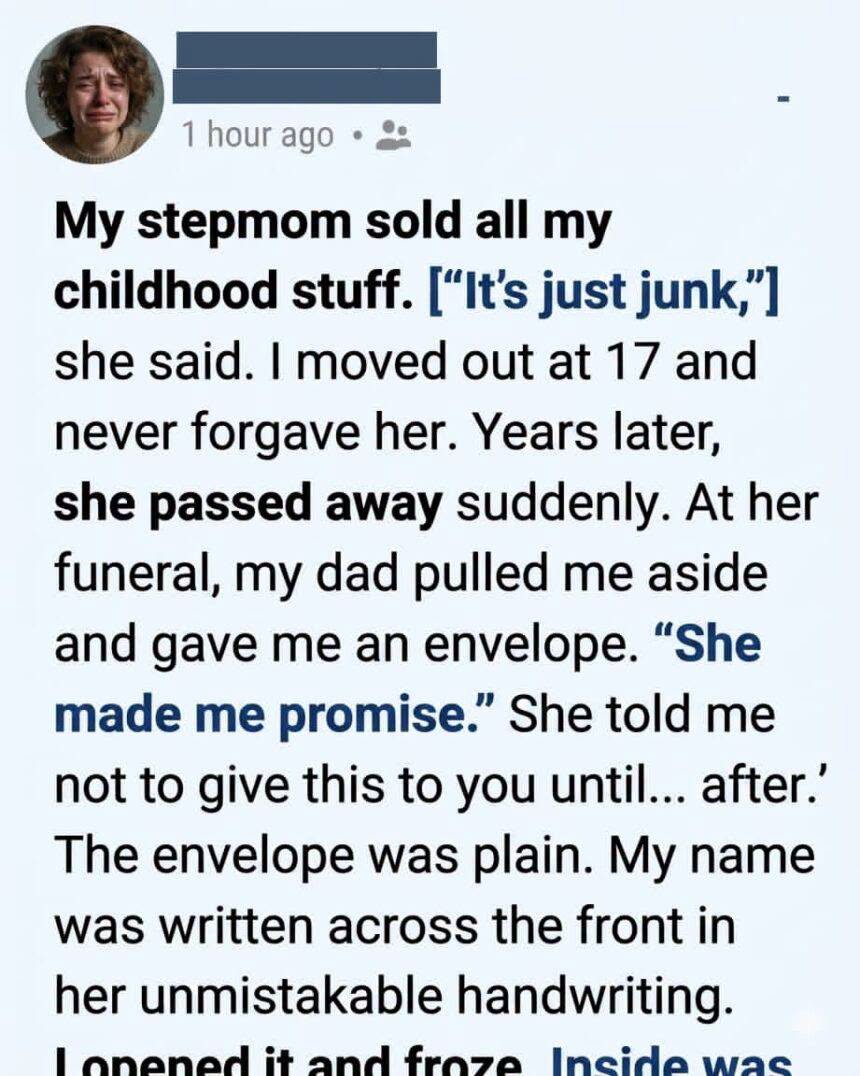
I was sixteen when my stepmother sold almost everything that reminded me of my childhood.
My comic books disappeared. So did my birthday cards, my old guitar, and even the stuffed bear my late mother had given me.
When I confronted her, hoping there had been some terrible misunderstanding, she looked at me without emotion.
“It was all junk,” she said.
Junk.
That was what she called the things I had treasured for years—the things that still made me feel close to my mother.
I was heartbroken. I was furious. And that night, I packed a bag and eventually walked away from home, carrying a resentment that would follow me for years.
Life continued, as it always does. I grew older, built my own life, and learned to live with the distance between my stepmother and me.
But I never truly forgot what she had done.
Then, one day, she died unexpectedly after suffering a stroke.
At her funeral, I stood beside my father, trying to process the complicated emotions I had carried for so long. There was grief, certainly, but there was also anger and a painful sense that some questions would never be answered.
As people began to leave, my father approached me with a small envelope.
“She left this for you,” he said quietly.
My name was written across the front in her handwriting.
I stared at it for several seconds before opening it.
Inside was a detailed list of every item she had sold from my childhood.
Beside each item was a description of where the money had gone.
My comic books. My guitar. My birthday cards. The stuffed bear my mother had given me.
According to the letter, the money had been set aside for my future. It had gone toward college savings, an emergency fund, rent deposits, and other expenses she believed I would eventually face as an adult.
I read the pages again, struggling to understand what I was seeing.
At the bottom was a personal letter.
She admitted that she had never known how to express love properly. She believed that getting rid of those belongings and putting the money toward my future would help me build a better life—even if it meant I would hate her for it.
She had made a decision for me without explaining it, apparently convinced that the outcome mattered more than the pain it caused.
I sat alone in the parking lot, holding the letter, and cried harder than I had in years.
Part of me felt relieved to finally understand what might have motivated her.
Another part was still that sixteen-year-old boy who had watched his memories disappear and been told they were worthless.
I wished she had talked to me. I wished she had trusted me enough to explain what she was trying to do.
Maybe things would have been different if she had.
I couldn’t ask her those questions anymore. I couldn’t tell her how much those belongings had meant to me, or how deeply her words had hurt.
All I had was the letter.
For the first time, though, I could see another side of the story. Her actions had hurt me, but perhaps she had been trying, in her own imperfect way, to give me something she thought I needed.
Understanding that didn’t erase the pain, and it didn’t make her choices right.
But it allowed me to see her as more than the person who had taken away my childhood treasures.
She had been a flawed person who, perhaps, had tried to love me without knowing how to show it.
And sitting there with her final words in my hands, I began to understand something I had struggled with for years.
Sometimes, people love awkwardly. Sometimes they make choices that hurt the very people they want to protect.
And sometimes, forgiveness begins not when the hurt disappears, but when we finally understand the complicated intentions that may have been hidden behind it.