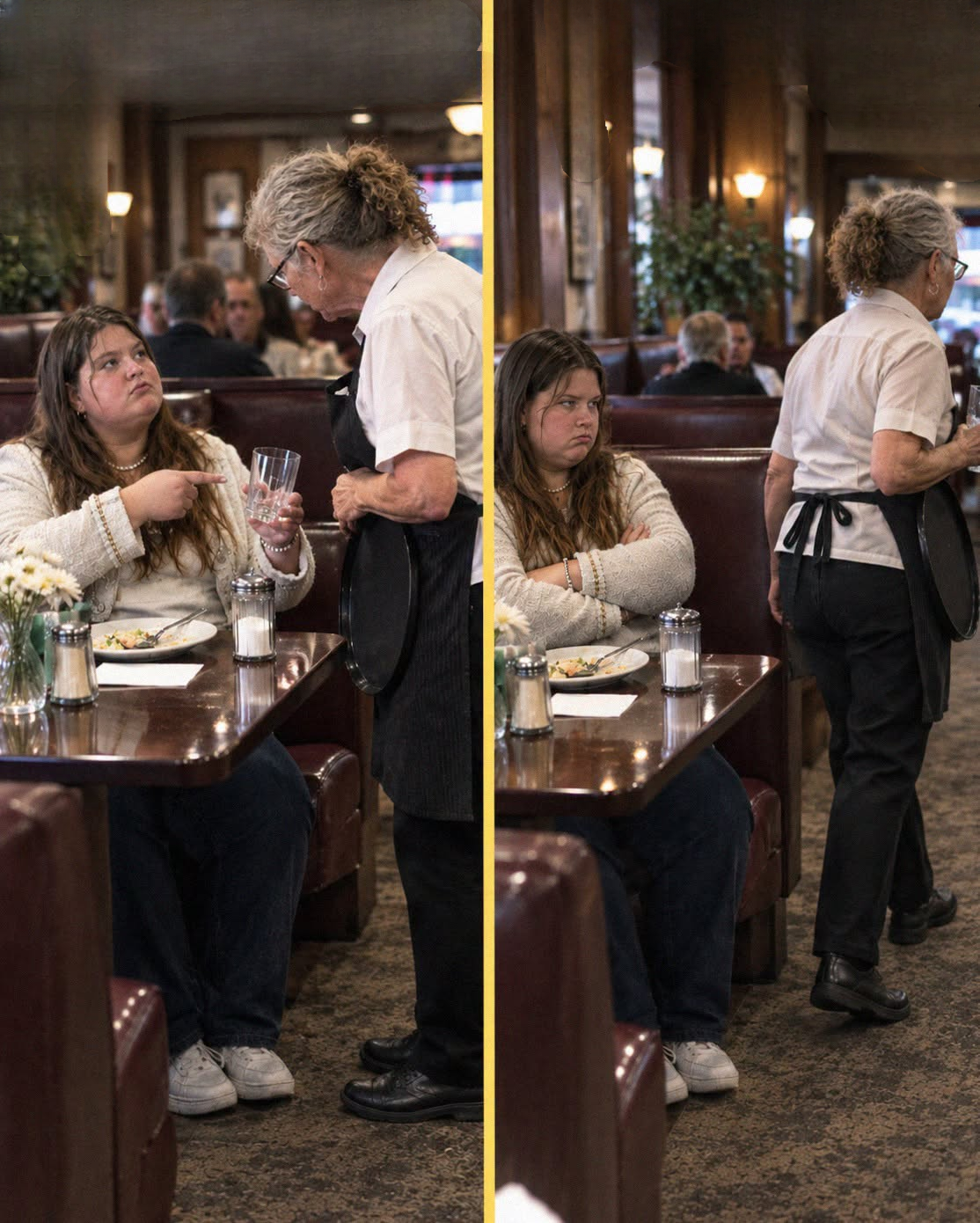
My 13-year-old daughter, Madison, used to help me clear the dinner table without being asked. But after spending two weeks in Palm Beach with her wealthy grandmother, Patricia, she suddenly acted as though even carrying her own backpack was beneath her.
The first time I noticed something was seriously wrong was at a diner.
Madison snapped her fingers at a waiter who was helping an elderly woman into her chair.
“Hello? We’re waiting.”
“Madison,” I said quietly.
“What? That’s his job.”
Before her vacation, she had never spoken to anyone that way. Now she handed me her backpack without even looking at me.
“Grandma says ladies shouldn’t carry their own bags.”
At dinner, she held out her glass toward her father.
“Dad. Water.”
Mason looked at her in disbelief. “You can get it yourself.”
She seemed genuinely confused.
The following morning, my mother, Grace, asked Madison to put her shoes away. Madison simply pointed at them.
“You’re going upstairs anyway.”
Grace had just brought over groceries and was still carrying two heavy bags. I took them from her and told Madison to pick up her shoes herself.
She muttered an apology, but it didn’t last long. An hour later, she asked me to fetch her phone from the kitchen because I was “already standing.”
Every correction seemed to disappear the moment she had another opportunity to order someone around.
Finally, I sat beside her and asked what had happened.
“Grandma says you’re basically staff in this house, Mom. You just don’t know it yet.”
Mason immediately put down his coffee.
“Your mother is not our servant.”
“Then why does she do everything?”
Neither of us had an answer ready.
That question stayed with me all day.
I had worked as a waitress throughout college, and Madison had always known how hard I worked. She used to be proud of that story. Now she spoke about restaurant workers as though their jobs made them less important.
I decided she needed to understand what those jobs actually involved.
That evening, I called Rosa, the woman who owned the diner where I used to work. She agreed to let Madison help prepare and serve our family’s Sunday brunch under supervision. It would be a learning experience, not unpaid labor or a replacement for her employees.
Patricia was already invited to Sunday brunch, so I sent her the new address.
She replied with a thumbs-up.
On Sunday morning, I handed Madison an apron.
“What’s this?”
“You’re helping me at Rosa’s today.”
She laughed.
“I’m not doing that.”
“You’ve been telling people their work is easy. Today, you’ll see what it takes.”
Rosa began by showing her how to fold napkins, arrange water glasses, and balance a serving tray.
Madison folded one napkin, complained that the task was ridiculous, and asked when we would finally eat.
“When everything is ready,” Rosa calmly replied.
We prepared the table, carried plates from the kitchen, and practiced cleaning up after everyone finished. When Madison complained that the table she had just wiped was dirty again, Rosa handed her another cloth.
“That’s what happens when people use tables.”
By noon, Madison had stopped checking her phone every few minutes. She even began asking questions.
“Do your feet always hurt after working?”
“Some days,” Rosa answered. “But I enjoy taking care of people. That doesn’t mean I enjoy being ordered around.”
At one point, Madison accidentally spilled water while filling the glasses. She looked toward Rosa, expecting to be scolded.
Instead, Rosa handed her a towel and helped her clean it up.
I noticed Madison quietly straightening the glasses afterward, making sure every place setting looked right.
Mason and Grace arrived for brunch and sat near the window. Madison brought them water without anyone asking.
Then Patricia walked in with three friends from her country club.
She wore a cream-colored suit and pearls, carrying the same confident smile Madison had started imitating.
The moment she noticed the apron, her expression changed.
“Madison? What on earth are you doing?”
“Helping me,” I answered.
Patricia looked at her granddaughter, opened her handbag, and pulled out her checkbook.
“Take that apron off, darling. I’ll give you $5,000 if you do one thing for me.”
Madison stared at her.
“What thing?”
Patricia leaned closer and whispered something into her ear.
My daughter’s eyes immediately moved toward me.
“Grandma,” Madison said nervously. “You want me to say that to my mom?”
Patricia didn’t hesitate. She slid the check across the table.
“Not just say it, darling. Say it loudly enough for everyone to hear. Then the money is yours, and so is the life I promised you.”
Madison picked up the check.
“Mom, Grandma says you don’t understand the kind of life I could have.”
I felt Mason stand beside me, but I raised my hand. I wanted to hear what my daughter had to say.
Madison looked down at her apron.
“She says I should be ashamed that you used to wait tables. She wants me to take this off, apologize to her, and say I’ll listen to her instead of you.”
“Madison,” Patricia warned.
But my daughter continued.
“She also said she’d pay for that school if I learned how to act like I belonged there.”
The diner fell silent.
“What school?” I asked.
“The private school Grandma showed me. The one with the trips and the riding program.”
Patricia reached for the check.
“I was offering her encouragement, Freya. You’re making this ugly.”
“You offered a child money to humiliate her mother in public.”
“After you dressed her like a waitress to embarrass me.”
Before I could respond, Rosa approached our table.
“You can discuss family matters without involving my customers.”
Patricia ignored her and turned toward Madison.
“Give me your hand. We’re leaving.”
Madison held the check tightly. For one frightening moment, I thought she might go with her grandmother.
“Do I still get to go to the school?” she asked.
Patricia softened her voice.
“If you prove you’re ready.”
Madison looked at the printed amount one last time. Then she placed the check beside Patricia’s cup.
“I can’t say it.”
Patricia gathered her friends and walked out without touching her food.
Grace reached across the table and gently squeezed Madison’s hand. My daughter pulled away, looking ashamed.
I wanted to hug her, but I also wanted to ask how close she had come to accepting that money. Neither conversation felt right in front of strangers.
We finished brunch quietly.
Before leaving, Madison returned to Rosa.
“I’m sorry I said your job was easy.”
Rosa nodded.
“Then remember that next time someone brings you a glass of water.”
At home, Madison went straight to her bedroom. I gave her an hour before knocking.
“Tell me about Palm Beach,” I said.
She sat on the bed, still wearing the bracelet Patricia had bought her.
“Grandma introduced me to girls who go to amazing schools. They travel everywhere. They know what to wear and what to say. I felt stupid around them.”
“Did they make you feel stupid?”
“Not really. Grandma said they could tell I wasn’t used to that world.”
I waited for her to continue.
“She said I could learn. She took me shopping and showed me this school on her phone. She said she could pay for it, plus trips and lessons, if I got serious about my future.”
“What did she mean by getting serious?”
Madison pulled at her bracelet.
“She said you were nice, but you didn’t know how successful people lived. When I carried my shopping bags, she said ladies didn’t do that. When I helped clear dishes, she told me to let the staff handle it.”
“And the waiter?”
“She told me people who work for you aren’t supposed to keep you waiting.”
Suddenly, my daughter’s behavior made more sense. Patricia had spent two weeks teaching her that treating people with kindness somehow made her inferior.
“Why didn’t you tell us about the school?”
“Grandma said we should keep it between us until I was ready. She said you’d probably feel threatened because you couldn’t afford it.”
“Did she apply for you?”
Madison shook her head.
“I don’t know.”
“Did the school accept you?”
“No. Grandma said she’d arrange a visit.”
I watched her realize that the future she had imagined wasn’t actually guaranteed.
Patricia had shown her photographs and made promises. Madison had mistaken a possibility for something already waiting for her.
“You can want that school,” I told her. “You can want every opportunity in the world. But nobody gets to charge you your mother’s dignity for it.”
Madison looked angry.
“Easy for you to say. You already got the life you wanted.”
She turned away.
That evening, I told Mason everything, including the name of the school.
He went quiet.
“Mom mentioned paying for private school a few months ago,” he finally admitted.
I stared at him.
“You knew?”
“She wanted a say in the school, the activities, everything. I told her we’d make those decisions ourselves. She dropped it.”
“And you never told me?”
“I thought it was over. I didn’t want another fight.”
I suddenly understood something I had ignored for years. Mason often defended me when Patricia openly insulted me, but he rarely challenged her quieter comments about my clothes, my work history, or our ordinary lifestyle.
He simply waited for those comments to pass.
“You knew your mother wanted control over Madison’s future, and you let her take her away for two weeks.”
“I didn’t think she’d go behind my back.”
“You didn’t think because you didn’t want to deal with her.”
He looked down.
“I should’ve told you. And I should’ve stopped this sooner.”
“Yes,” I answered. “You should have.”
The next day, Mason called Patricia and asked us to visit without Madison.
Patricia greeted us as though Sunday’s incident had been a minor misunderstanding.
“Madison was upset,” she said. “She’ll come around.”
“Did you tell her that school funding depended on rejecting me?” I asked.
“I told her opportunities require standards.”
“What standard did she meet by insulting a waitress?”
Patricia sighed.
“You put her in an apron in front of my friends. I was trying to rescue her from embarrassment.”
“You offered her money to announce that she was ashamed of me.”
“I wanted her to see how absurd your little lesson was.”
Mason leaned forward.
“Mom, why couldn’t you let her help in a diner?”
“Because she’s not being raised for that life.”
“Neither was I,” Mason replied.
Patricia stared at him.
“You had every advantage, Mason. You could have married someone who understood our world. Instead, you chose a woman who was perfectly happy making an ordinary little life. And you’ve stopped striving for anything more.”
I expected Mason to become furious.
Instead, he looked exhausted.
“I chose Freya because I love her. I like our life. That wasn’t a mistake you get to correct through my daughter.”
Patricia’s expression tightened.
“Madison has potential.”
“Of course she does,” I said. “But you were teaching her that kindness makes people inferior. You made her ashamed of the work that paid for my education.”
“That school could open doors for her.”
“Then why did she have to insult me before you’d open your checkbook?”
Patricia had no answer.
Mason finally said what I had needed him to say years earlier.
“You don’t get to make plans with Madison behind our backs. For now, visits will happen with one of us present. If you want that to change, you need to respect Freya and our decisions.”
Patricia accused us of punishing Madison for her generosity.
We left anyway.
When we told Madison what had happened, she cried.
Not because she had lost $5,000.
She cried because she had spent two weeks imagining a version of herself who belonged somewhere extraordinary, and now that future seemed out of reach.
“You don’t understand,” she said. “Grandma made me feel like I could be somebody.”
I sat beside her.
“You already are somebody.”
“That’s just what parents say.”
“Then listen to this. You can apply to good schools and work toward opportunities. Your father and I will help you explore them. But we won’t promise money we don’t have, and we won’t ask you to hurt someone to earn it.”
She wiped her eyes.
“I almost did it.”
I waited.
“At the diner, I picked up the check because I thought if I gave it back, she’d take the school away. I was going to say everything.”
That was harder to hear than her earlier insults.
“Why didn’t you?”
“Rosa kept showing me things even when I was rude. She didn’t act like she was better than me. And I remembered you saying she helped you get through college.”
Madison looked down at her hands.
“I didn’t want to say she was worthless. I didn’t want to say that about you either. But I wanted the money.”
“I believe you,” I said. “And what you nearly did hurt me. Loving you doesn’t mean pretending it didn’t.”
“I’m sorry.”
“I know. Now show me.”
We started with small changes.
Madison apologized to Grace for treating her like someone whose only purpose was to pick up her shoes. She began carrying her own belongings, clearing dishes, and speaking respectfully when she needed help.
Her phone privileges remained limited until we saw those changes becoming consistent.
Mason and I made changes, too.
One evening, he looked at the overflowing laundry basket.
“Madison asked why you do everything. I hated that I didn’t have an answer.”
“The answer was that I kept doing it,” I said, “and you let me.”
He nodded.
He started handling laundry and school transportation on his work-from-home days. We divided cooking and shopping instead of calling his contributions “help.”
Our first attempts weren’t perfect. Mason forgot towels in the washer, and Madison complained about loading the dishwasher.
But we kept correcting mistakes without treating any work as beneath us.
Patricia continued sending messages about how we had rejected her generosity.
Mason replied once.
“Madison’s education is our decision. Her relationship with us isn’t for sale.”
We didn’t cut Patricia out of our lives forever. But there were no more private promises, unsupervised trips, or pretending that Sunday’s offer hadn’t happened.
A few weeks later, I came home carrying groceries and found Madison walking up the path with her school backpack.
She paused.
For a second, I remembered the girl who had handed me that same bag without even looking at me.
Then Madison set her backpack down and took two grocery bags from my hands.
“Can we make dinner together?” she asked.
“Sure.”
As we put everything away, she told me she had been looking into scholarship information for a summer program.
“Could we check if it’s real?” she asked.
“Absolutely.”
She smiled and reached for another bag.
I had never stopped wanting a better future for my daughter.
I just wanted her to understand that becoming somebody never required treating somebody else as less.