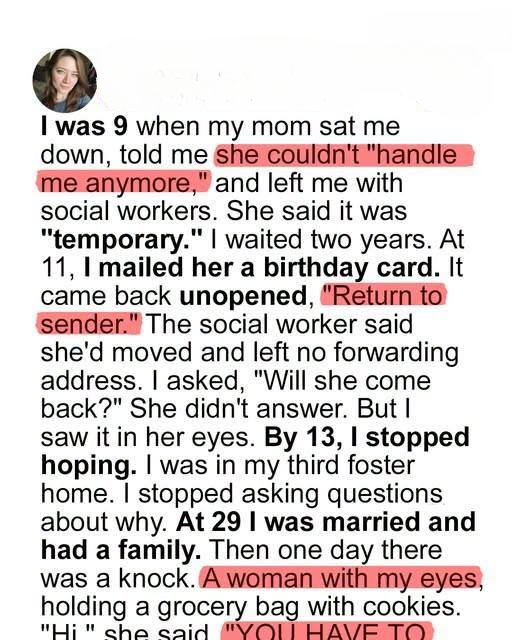
Twenty years after my mother abandoned me at just nine years old, she suddenly appeared at my doorstep with a grocery bag and one desperate demand: “You have to help me!”
My childhood was filled with unanswered questions. My father disappeared when I was a baby, and my mother, Melissa, struggled to raise me alone. But one Friday afternoon, everything changed.
I came home excited about getting a perfect score on my spelling test, only to find Mom sitting at the kitchen table.
“Stacey, I can’t take care of you anymore,” she said.
I was only nine. I begged her not to send me away, but the next morning, social services arrived. She packed my clothes into a garbage bag and promised she would come back soon.
I believed her.
For two years, I waited. I kept telling everyone my mother would return. When I turned 11, I even sent her a birthday card saying I missed her and wanted her to come get me.
Two weeks later, it came back stamped: “Return to Sender.”
That was the moment I began to understand that she wasn’t coming back.
I eventually moved through several foster homes, learned to stop expecting anything, and built a life of my own.
At 27, I became a mother myself. When I held my daughter, Emma, for the first time, I made a promise: she would never grow up feeling unwanted or abandoned.
With my husband, Jake, I built the loving family I had always dreamed of.
Then, one ordinary evening, someone knocked on my door.
When I opened it, I froze.
Standing on my porch was an older woman with gray hair and tired eyes. I recognized her immediately.
It was my mother.
“I’m homeless. I don’t have anyone else. You’re my only child. You have to help me!” she pleaded.
She didn’t ask how I was doing or what had happened during the 20 years we’d been apart. She simply expected me to take her in.
Despite everything, I let her inside.
One night turned into a week, then two. At first, she seemed grateful, but soon her old behavior returned.
She began making cruel comments about my childhood, even suggesting that I had been a difficult child who made her life miserable.
I tried to remain calm, but then something happened that changed everything.
One afternoon, I came home early and found my mother sitting beside my two-year-old daughter, Emma.
She was whispering things about me.
“Your mom was a really tough kid,” she told her. “Sometimes you have to step back from people who hurt you. Even family.”
I couldn’t believe what I was hearing.
The woman who had abandoned me was now trying to make my own daughter question me.
That night, after Emma went to sleep, I packed my mother’s belongings into a garbage bag — the same kind of bag she had used to pack my childhood clothes 20 years earlier.
“You need to leave,” I told her.
“What? I’m your mother!” she protested.
“No. You’re the woman who abandoned a nine-year-old girl and came back expecting shelter, not forgiveness.”
She asked where she was supposed to go.
I had already contacted a nearby shelter and arranged a place for her.
As she walked toward the door, she turned around and said, “You’ll regret this. Family is all you have in this world.”
I looked at her and replied:
“No. Love is all you have. And you gave up the right to mine a long time ago.”
After she left, I went into Emma’s room and watched her sleep.
I thought that was the end of the story.
But a month later, I did something unexpected.
I sent my mother a birthday card, just as I had when I was 11. This time, however, I was the one choosing the words.
Inside the blank white card, I wrote only one sentence:
“Sometimes you have to step back from people who hurt you.”
I never knew whether she understood the message.
But I finally understood something important: being a parent isn’t about what you need from your child. It’s about what you’re willing to give them.
I will give Emma everything I never had.
Including protection from anyone who might hurt her, even if they share her blood.
The cycle ends with me.