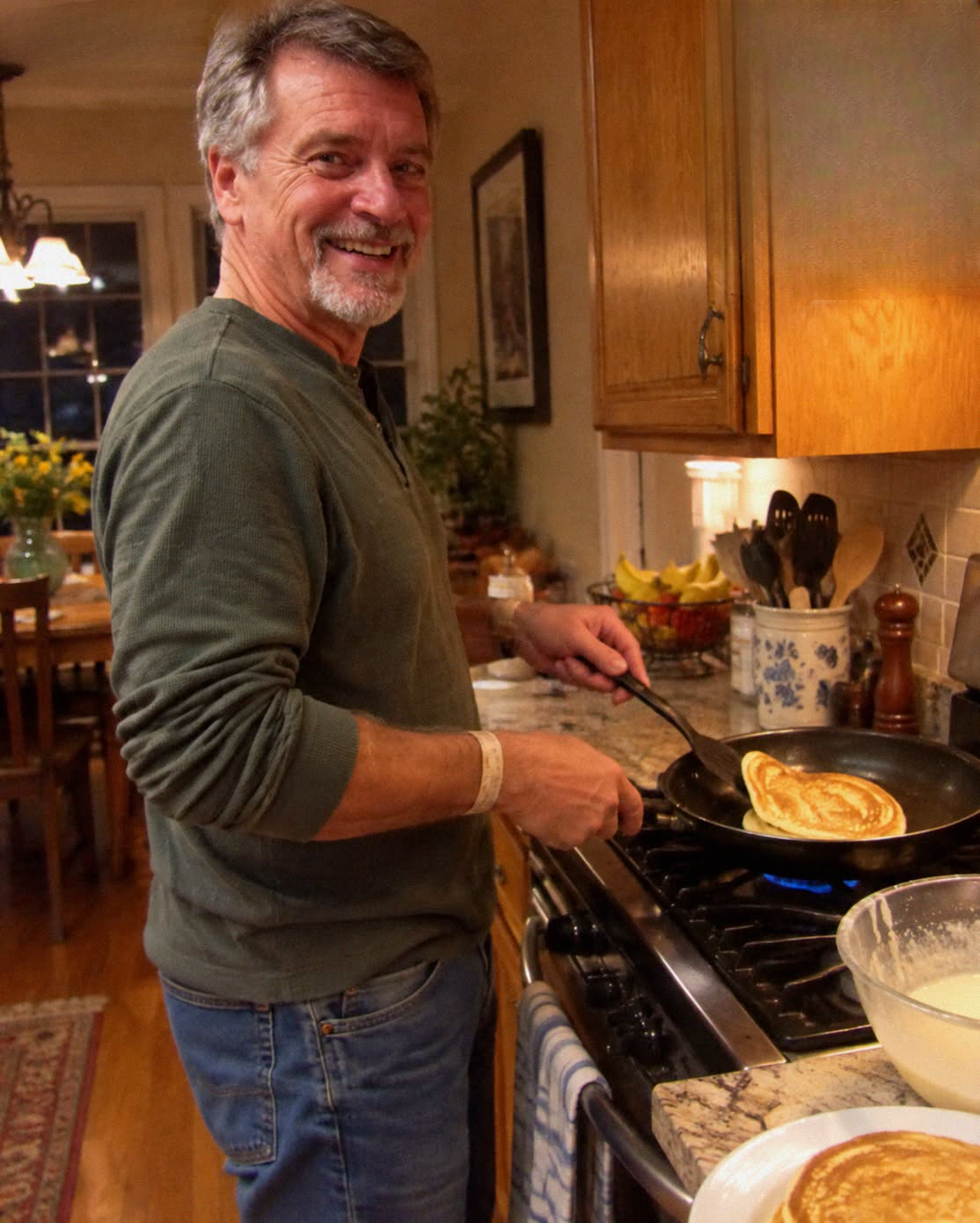
For weeks after my father died, I couldn’t bring myself to look at the last photograph I’d taken of him. He was standing in his kitchen, smiling despite looking exhausted.
One evening, I finally opened it again. As I studied his face, something near his wrist caught my attention.
I zoomed in.
Beneath his watch was a thin white hospital bracelet.
I enlarged the image and saw the date. It was the day before he died—the same day he’d told us he was away on business.
When I showed my mother, her face went pale.
“Was Dad sick?” I asked.
She admitted he’d been experiencing chest discomfort and dizziness. Hospital papers found in his drawer confirmed he’d been examined and advised to seek prompt cardiac follow-up.
But another discovery confused me even more.
Beneath the medical papers was a folded program from my daughter Ivy’s school performance—the one Dad had supposedly missed three years earlier.
I remembered that day clearly. Ivy had practiced her song for weeks and even saved Grandpa a seat. He never appeared, and afterward she asked why he’d forgotten her.
I’d been so upset that I called Mom and told her to stop Dad from making promises he couldn’t keep.
I never imagined he’d taken my words as a reason to stay away.
I asked Ivy if she remembered that performance.
Her answer left me speechless.
“Grandpa came,” she said. “He was standing near the back.”
She explained that he’d watched her sing, hugged her afterward, and told her she had done a wonderful job.
“Why didn’t he sit with us?” I asked.
“He said he wasn’t sure you wanted him there.”
I immediately went to Mom.
After some difficult questions, she finally admitted that three years earlier, she’d told Dad I didn’t want him attending school events anymore. She’d been angry about his broken promises and thought she was protecting me from disappointment.
But that wasn’t what I’d asked for.
I had only wanted him to stop making promises he couldn’t keep.
Dad had misunderstood my words, and Mom had allowed that misunderstanding to continue for three years.
Then Ivy told me one more thing.
She had told Grandpa that I’d saved him a seat.
In fact, I’d always left the chair beside me empty, even after I stopped telling Ivy he would come.
Ivy remembered Grandpa smiling when she told him.
“He said he’d talk to you that night,” she explained.
Suddenly, I remembered our last conversation. Dad had asked me to have dinner with him that weekend.
“There’s something I’ve been wanting to tell you,” he’d said.
I told him to tell me on Saturday.
But Saturday never came.
The following morning, he was found collapsed in the kitchen. He had suffered a sudden cardiac event.
I couldn’t change what happened, and the hospital papers couldn’t answer every question about his final hours.
But I finally understood something important: Dad hadn’t stopped loving us or caring about Ivy’s performances. He had believed I no longer wanted him there.
A few weeks later, Ivy had another school performance.
This time, I called Mom and invited her.
When she hesitated, I told her, “That’s why I’m asking.”
On the day of the performance, we arrived early and sat together.
There was an empty chair beside me.
I looked at Dad’s photograph and wished he could have been there.
But at least I knew that before he died, he’d learned the truth.
I had always saved him a seat.