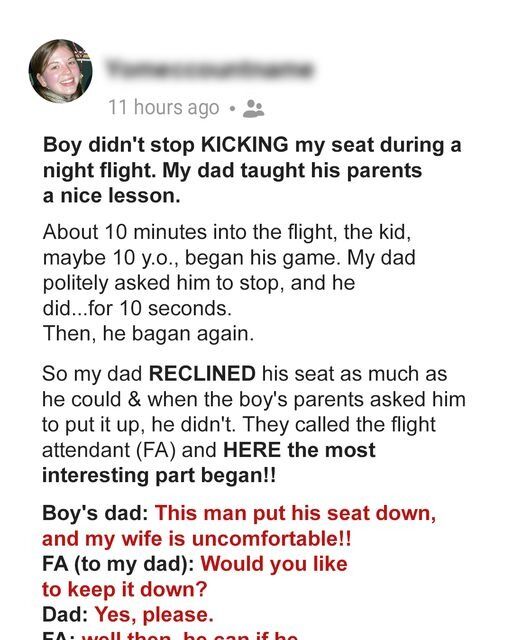
The flight home was meant to be a simple, peaceful journey—just a few quiet hours in the air, maybe a movie, some sleep. But about halfway through, that calm was disrupted by the unmistakable sound of a small foot repeatedly kicking the back of my seat. At first, it was a soft tap, the kind you try to ignore. But soon enough, it became persistent, forceful kicks, with each impact making my seat lurch. I turned around, expecting to see a restless toddler. Instead, I saw a boy about eight or nine, joyfully swinging his legs while staring intently at his tablet. His parents sat on either side, completely oblivious, as if the back of my seat were just another part of their child’s play area.
I tried to stay patient, telling myself it wasn’t worth making a scene. But after what felt like the fifth or sixth kick in less than a minute, I couldn’t ignore it anymore. I shifted in my seat, sighed, and even turned around once, hoping to communicate with a polite but firm look. But nothing changed. The boy kept kicking, absorbed in his game. That’s when my dad, who had been reading beside me, finally looked up. My father has the patience of a saint—he’s the kind of man who stays calm in traffic and responds to rudeness with a smile. But even he had reached his limit.
He leaned back slightly and, in his calm, steady voice, said, “Excuse me, could you please ask your son to stop kicking the seat?” The mother gave a distracted smile, barely lifting her eyes from her phone. “Oh, sorry about that,” she said, “He’s just restless.” The father nodded vaguely and muttered, “He’ll settle down.” For a moment, they did manage to quiet him. Peace returned, and I finally relaxed.
But just when I thought it was over, the kicking started again—this time harder, almost as if the boy were taking it personally. Thud. Thud. Thud. My dad’s jaw tightened. He didn’t say anything, but I could tell from the way his face set that he had already made up his mind.
Without warning, he pressed the recline button and tilted his seat all the way back—straight into the mother’s lap. She jolted back, her phone nearly flying from her hands. “Excuse me!” she snapped. “You can’t just push your seat back like that!” My dad turned slightly, his voice still even. “I can,” he said. “It reclines.”
The mother quickly flagged down a flight attendant, insisting my dad was being unreasonable. The attendant, a seasoned middle-aged woman, listened quietly, then gave a warm smile. “Ma’am, passengers are allowed to recline their seats if they wish.” The mother stood there, speechless. The attendant walked away, and my dad calmly returned to his book.
The next few minutes were pure silence. No more kicking, no more muttering. The boy sat still, and his parents remained quiet for the rest of the flight. It felt almost comical, the stark contrast to the chaos that had preceded it. I caught a glimpse of my dad’s face—there was a tiny grin, barely noticeable.
As we descended, he closed his book and leaned toward me. “You know,” he said, “Sometimes people only understand something when they experience it themselves.” He wasn’t gloating or seeking revenge; he had just delivered a lesson in empathy, quiet and precise.
It wasn’t payback—it was balance. He didn’t yell or argue, and he didn’t make a scene. He simply let the parents feel the same discomfort they’d ignored for the past hour. In that brief moment, they learned more from the reclined seat than any lecture could have taught them. And I learned something about composure and subtlety that no parenting book could ever convey.
As we walked through the airport, I couldn’t stop thinking about that flight. My younger self might have wanted to shout at the parents, demand respect, make a scene. But that’s not how my dad operates. He believes that real lessons don’t come from shouting—they come from clarity. He had turned a small annoyance into a moment of reflection, all without breaking a sweat.
That’s the thing about my dad: he doesn’t teach through words—he teaches through actions. Quiet, decisive actions, often laced with a bit of humor. I’ve seen him do this countless times, whether dealing with a rude customer service rep, a pushy driver, or an impatient neighbor. He has an unshakeable belief that people aren’t bad at their core; they just don’t always see beyond their own perspective. His way of handling things is simple: make them see it for themselves.
It’s easy to lose your temper when someone’s inconsiderate. In today’s world, patience feels like a lost art, and we’re all so quick to react to irritation. But that flight reminded me that calm strength often speaks louder than confrontation. My dad didn’t try to prove he was right—he simply let reality do the talking.
When I tell this story, people always laugh at the part where the mother gets upset, only for the flight attendant to back my dad up. It’s one of those moments that feels cinematic—like something out of a feel-good movie. But beneath the humor, there’s a deeper truth: empathy can’t be forced, but it can be demonstrated.
That day, I learned something that I’ve carried with me ever since: sometimes the smartest way to handle inconsiderate people is not to argue, but to quietly show them what they’ve been doing. Not to humiliate them, but to make them aware.
By the time we disembarked, I was smiling. My dad, as usual, looked like he hadn’t given it a second thought. For him, it was just another small lesson in a lifetime of teaching others what decency looks like.
Now, every time I’m on a plane and see someone losing their patience—whether it’s snapping at a flight attendant, talking too loudly on the phone, or reclining too far—I think of that flight. I think of my dad, calm and collected, reclining his seat not out of spite, but out of quiet wisdom.
He never said it directly, but the message was clear: the best lessons don’t require noise. Sometimes, they’re delivered 30,000 feet up, with nothing more than a smile, a steady hand, and the right push of a button.