I was seventeen when the pregnancy test turned positive.
In that instant, my childhood ended.
My stepmom didn’t cry.
She didn’t ask how I felt.
She didn’t ask if I was scared.
She folded her arms, looked at my belly like it was a stain on her spotless house, and said:
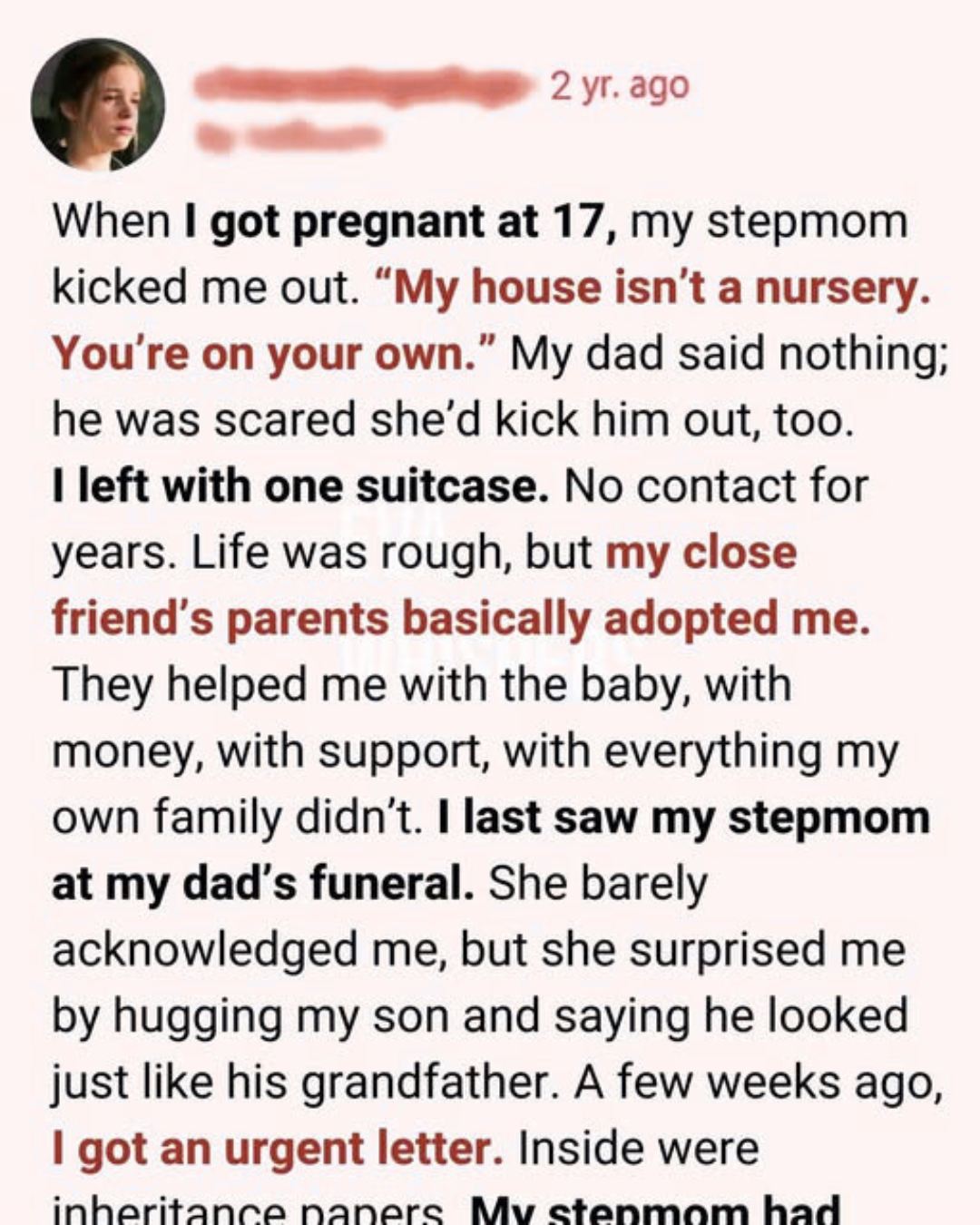
“My house isn’t a nursery. You’re on your own.”
My dad stood behind her, silent.
He wouldn’t meet my eyes.
I knew why—he was terrified she’d kick him out too.
That silence hurt more than her words.
That night, I packed one suitcase.
Just clothes.
A few photos.
The things I couldn’t bear to leave behind.
When I closed the door, I didn’t know where I was going.
I only knew I couldn’t stay.
For years, there was nothing.
No calls.
No birthday cards.
No holidays.
Life was hard in ways I wouldn’t wish on anyone.
I was still a kid trying to raise a kid.
I worked whatever jobs I could find, studied late into the night, and learned how to survive on very little.
What saved me were my best friend’s parents.
They didn’t have to help me—but they did.
They gave me a couch when I had nowhere else to go.
They taught me how to budget.
How to calm a crying baby at 3 a.m.
How to believe I wasn’t ruined just because my life didn’t follow a perfect plan.
They became the family I lost.
Slowly, painfully, I built a life.
A steady job.
A routine.
A sense that tomorrow wouldn’t always be an emergency.
My son grew—curious, kind, bright in ways that made everything worth it.
I didn’t see my stepmom again until my dad’s funeral.
She looked older. Smaller somehow.
She barely acknowledged me, like I was a distant acquaintance instead of the girl she’d raised for years.
But then she knelt down in front of my son, studied his face, and hugged him.
“He looks just like his grandfather,” she said softly.
That was all.
No apology.
No explanation.
We didn’t speak again.
A few weeks later, an official-looking letter arrived marked URGENT.
I almost didn’t open it.
When I did, my hands started shaking.
Inheritance papers.
My stepmom had passed away.
And she had left her house to me.
I read it twice, certain I was misunderstanding.
Then I saw the second document—and that’s when I broke down.
She had left all of her savings to my son, locked in a fund he can’t touch until he turns sixteen, specifically marked for his education.
I sat at my kitchen table and cried in a way I hadn’t cried in years.
This was the woman who had thrown me out.
Who had been cold, strict, sometimes cruel.
Who never once said she was proud of me.
Who never told me she was sorry.
And yet—quietly, without a word—she made sure my child would have opportunities I never did.
I’ll never know what changed in her heart.
Maybe guilt.
Maybe regret.
Maybe love she never learned how to show.
What I do know is this:
She never gave me comfort while she was alive.
But in her final act, she gave my child a future—
and gave me a memory that no longer hurts to hold.