The moment I crossed the threshold of my in-laws’ house and felt that heavy, unnatural silence settle around me, I knew something was wrong. Not the ordinary kind of wrong, like forgetting to turn on a lamp or stepping into a house while someone naps. This was deeper, thicker—like the air itself was holding its breath. I couldn’t have known then that this visit, meant to be brief and kind, would crack open a truth that had been buried for years and force all of us to face something far darker than family disagreements or hurt feelings.
I went to my in-laws’ place alone that weekend, and I’ve replayed that decision in my head more times than I can count. If I’d turned around, if I’d decided to wait, things might have unfolded differently. But then again, maybe the truth would have stayed hidden. What I found that day still sends a chill through me, because it felt less like stepping into a family home and more like wandering into the opening scene of a nightmare.
The plan had been simple. My husband, Owen, and I were supposed to visit his parents together on Saturday afternoon. We’d talked about it all week—how his mother, Margaret, would insist on feeding us even though we’d just eaten, how she’d press leftovers into our hands as we left, smiling like she’d just given us a gift rather than last night’s casserole. But on Friday evening, Owen called me from work, his voice tired and apologetic. Something had gone wrong at the office, and he wouldn’t be able to get away.
“Go without me,” he said. “You know Mom will love that. Just don’t stay too long.”
I hesitated. Visiting alone hadn’t been the original plan, but I’d always had a warm relationship with Margaret. She was gentle, thoughtful, the kind of person who remembered birthdays without reminders and sent handwritten notes just because she’d been thinking of you. The night before, I’d baked a batch of oatmeal cookies—her favorite—imagining the way her face would light up when I showed up unexpectedly.
So I went.
The drive over was uneventful, the sky overcast but calm. When I pulled into the driveway, though, a strange unease crept over me. The house looked… dormant. No lights on inside, no movement behind the curtains. Margaret usually kept the front lamp glowing, even during the day, and she had a habit of opening the door before you’d even finished knocking. That didn’t happen this time.
I told myself not to overthink it. Maybe she and Harold—my father-in-law—had stepped out together. Maybe they’d gone for lunch or errands. Balancing the plate of cookies in one hand, I knocked and waited. Silence. I knocked again, listening hard. Still nothing.
After a moment, I tried the door. It opened easily.
“Margaret?” I called out as I stepped inside. “It’s Lena. I brought you something.”
My voice echoed back at me, hollow and unanswered. The house felt colder than usual, stripped of its familiar warmth. There was no smell of coffee, no soft radio playing in the background. I set the cookies down on the entry table and took a few steps farther in, my unease growing with every second.
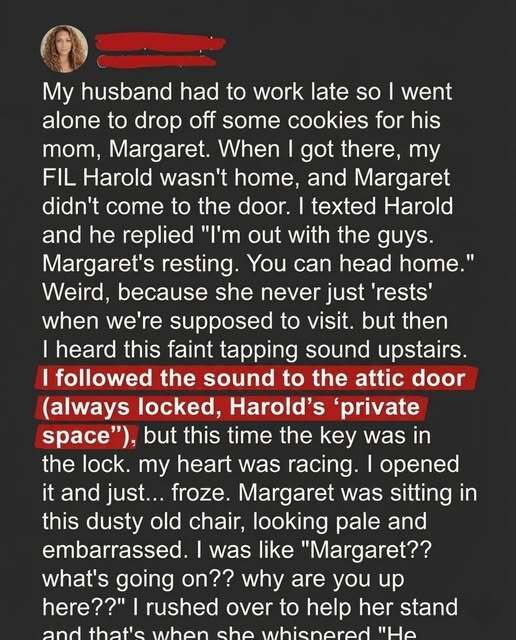
I pulled out my phone and sent Harold a quick message, trying to sound casual.
Hi, I’m at the house. Are you and Margaret out?
His reply came almost immediately.
Out with some friends. Margaret’s resting. You don’t have to wait around.
Resting. The word didn’t sit right. Margaret didn’t “rest” during the day unless she was ill, and even then she usually insisted on at least saying hello. A faint knot formed in my stomach. I typed back a polite response, then slipped my phone into my pocket and started through the house.
“Margaret?” I called again, louder this time.
That’s when I heard it—a soft, irregular tapping sound, like fingernails against wood. It was faint, but unmistakable, and it was coming from upstairs.
My heart began to pound as I climbed the steps, each one creaking beneath my feet. The tapping continued, then stopped abruptly as I reached the top of the stairs. The hallway was dim, the doors to the bedrooms closed. At the end of the hall stood the narrow door to the attic.
That door was always locked.
Harold had made that clear years ago. The attic was his domain—storage, tools, personal projects. Margaret herself had once laughed and told me she didn’t even bother asking what was up there anymore. So when I saw the key sitting in the lock, my breath caught in my throat.
“Margaret?” I whispered, my hand hovering near the doorknob.
There was a pause, then a faint sound from inside. A chair scraping slightly. I turned the key and pushed the door open.
The attic was dim, lit only by a small window and a single exposed bulb. In the center of the space sat Margaret, perched stiffly on an old wooden chair. She looked smaller somehow, her shoulders slumped, her usually bright eyes dulled with exhaustion. When she saw me, she flinched, then let out a shaky breath.
“Lena,” she whispered. “You’re here.”
I rushed to her side, my mind racing. “What are you doing up here? Are you okay?”
She stood slowly, as if her legs weren’t quite steady, and glanced toward the door before meeting my eyes. Her voice dropped to barely more than a breath. “Harold locked me in.”
For a moment, I couldn’t process the words. “Locked you in?” I repeated, certain I’d misunderstood.
She nodded, pressing her lips together. “I moved some things downstairs. His workspace was a mess, and I thought it would be nice to organize it for him. When he came home, he got angry. Very angry. He said I needed time to think about my mistake.”
My hands clenched at my sides as anger surged through me. This wasn’t a misunderstanding or a harmless argument. This was control. This was cruelty.
“He can’t do that,” I said, my voice shaking. “You’re his wife, not a child.”
Margaret gave a small, weary shrug. “He didn’t mean for it to be so serious. He just needed space to cool down.”
The way she said it—so practiced, so resigned—broke something inside me. I realized then that this wasn’t the first time she’d excused his behavior. It was just the first time it had gone this far.
“We’re leaving,” I said firmly. “Right now.”
She hesitated, fear flickering across her face. “If I leave without permission, he’ll be furious.”
I took her hands in mine. “Margaret, listen to me. This isn’t your fault. You don’t deserve this. And you’re not staying here.”
After a long moment, she nodded. The decision seemed to drain what little strength she had left, but there was relief there too, faint but real.
We packed a small bag quickly, my ears straining for the sound of a car in the driveway. When we finally stepped outside, Margaret paused on the porch, inhaling deeply as if the air itself was different out there. Maybe it was.
The drive back to my house was quiet at first. Then she spoke, her voice barely above a whisper. “I don’t know what happens now.”
“You don’t have to decide everything today,” I said. “You just have to be safe.”
That evening, after she settled into the guest room, my phone buzzed relentlessly. Harold’s name lit up the screen, over and over again, followed by messages demanding her return. When Owen came home, I told him everything.
“She was locked in the attic,” I said, tears finally spilling over. “Your father did that to her.”
Owen’s face went pale, then flushed with anger. He called Harold immediately, his voice rising as the conversation escalated. I’d never heard him speak to his father like that before.
“You don’t get to punish her,” he said. “You don’t get to control her life.”
The next morning, Harold showed up at our door, furious and unrepentant. But this time, Margaret stood her ground. She told him she wasn’t coming back. That she was done.
The weeks that followed were hard, but they were also transformative. Margaret filed for divorce, moved into a small apartment nearby, and slowly began to reclaim parts of herself she’d buried for years. She laughed more. She slept better. She signed up for a painting class she’d always talked about but never dared to try.
Owen supported her every step of the way, even when it meant severing ties with his father. It wasn’t easy, but it was necessary.
In the end, Harold lost the family he tried so desperately to control. Margaret gained her freedom. And I learned that sometimes, stepping into an unsettling silence is exactly what it takes to finally hear the truth.