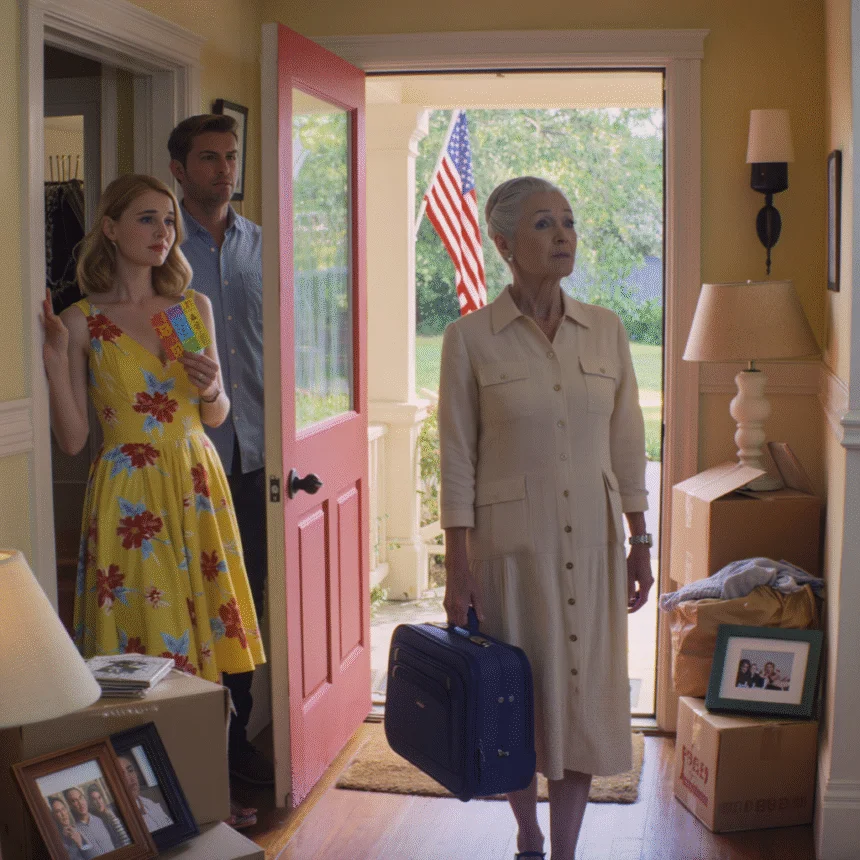
To the outside world we probably looked like a regular American family in a quiet neighborhood—kids’ bikes in the driveway, a flag on the front porch, the distant sound of lawnmowers on Saturday mornings. But inside, what started as refuge slowly turned into something else. It all cracked open on that lottery morning.
That day, I got up early as usual. I padded across the wood floors in my worn slippers, put on a pot of coffee, and whisked together batter for pancakes shaped like hearts for the little ones—Ava, eight, and Micah, five. Normally I’d hear their small feet thumping down the stairs and their sleepy voices arguing over which cartoon to watch.
Instead, a scream tore through the house from downstairs. “Mason, get up. Get up now!”
Belle’s shrill voice rang up the stairwell, bursting with something I couldn’t place—excitement, panic, almost mania.
My hands stopped mid-pour over the pancake griddle. I knew her temper well, but this was different. The wooden stairs shuddered as Mason ran down, his footsteps shaking the old banister Arthur and I had sanded and stained together one sticky summer.
I stayed at the top landing, one hand on the rail, holding my breath. For a moment, there was silence. Then shouts exploded through the hallway.
“No way. Oh my God. No way!” Mason yelled.
“We won, Mason,” Belle screamed. “Eighty-five million. Eighty-five million dollars!”
I moved down a few steps until I could see them.
Belle was clutching a lottery ticket in a death grip, her hands trembling. Mason wrapped his arms around her, laughing and repeating, “I can’t believe it. I can’t believe it,” like a prayer turned into a chant.
They jumped up and down in my little front hallway, tears streaking their young, hungry faces. And I, the one who had bought that very ticket the night before with the numbers I’d used for twenty years—each one a family birthday—stood frozen on the stairs. My heart sank, not because of the money, but because not one of them turned to ask, “Mom, is that your ticket?”
I stepped down halfway, about to speak, when Belle spun around.
Her eyes were wild and bright, like someone who had just dug up buried treasure in her own backyard. “We’re rich, Mason. Finally, we don’t have to live in this old house anymore.”
She said it like the walls disgusted her, then pressed her lips against the ticket as if it were a trophy.
I stopped cold. “This old house” went through me like a blade. This was the home Arthur and I had built with every saved dollar, every extra shift, every can of paint we rolled on ourselves.
I remembered the summer heat, the way his Navy ball cap had a line of white sweat across the brim as he brushed stain onto the porch, humming an old Lynyrd Skynyrd song under his breath. I opened my mouth to say, “I was the one who bought that ticket at Benny’s Corner Mart last night,” but the words caught in my throat. I looked at Mason—my only son—hoping he would sense something, remember how many times he’d watched me play those same numbers.
He didn’t say a thing. He just stood there, letting Belle call every shot like he always did. I turned quietly and went back up to my little attic room.
The space had once been storage, but three years earlier Belle had persuaded me to move up there so she could use my old bedroom as a “home office.” That decision, I see now, moved me out of the center of my own house and into the role of quiet boarder. I brewed a cup of tea, but my hands shook so badly I spilled water across the small table by the dormer window. For the first time in years, I felt like a stranger in my own home.
About an hour later, engines rumbled in front of the house. Cars pulled up along the curb, tires hissing over the wet pavement. Nosy neighbors, drawn like moths to the word “jackpot,” started dropping by.
Laughter floated up from the yard, car doors slammed, glasses clinked against each other. I looked out my attic window and saw Belle on the front lawn, waving the ticket in the air for everyone to see, her voice carrying up the street. Mason was beside her, smiling awkwardly.
Someone had already hung a cheap gold “CONGRATS” banner from our front porch, just below the little metal American flag wind chime I’d bought at a craft fair years ago. By noon, there was a hard knock at my door. Belle stood there, arms folded across her chest, lips curled into a practiced smile that didn’t reach her eyes.
Mason hovered behind her, hands shoved deep in his pockets. “Start packing,” she said. “We’re moving, and we don’t need any dead weight coming along.”
I blinked.
“Dead weight?” I repeated quietly. She gave an exaggerated sigh. “We’re buying a mansion.
It wouldn’t make sense for you to come. At your age, it’s better to find a decent nursing home. They’ll take care of you there.”
I met her eyes.
“This is my house, Belle.”
“Used to be,” she said, hitting each word like a slap. “Lorraine, we have a new life now, and you’re not part of it.”
Then she yanked open my closet door and started grabbing things. Dresses, my wedding photo, a pottery vase I’d made in a class at the community center when I was twenty-two—she hurled them toward the window and out into the yard.
Down below, I heard glass breaking against the driveway and neighbors murmuring. It was a quiet American street, the kind with tidy lawns and porch swings, never designed for scenes like this. I stood there in silence.
Mason hovered in the doorway, his face pale. “Belle, stop,” he muttered, but he didn’t move to help me. He didn’t take anything from her hands.
“We don’t need to do charity for you anymore,” she shouted loudly, making sure the words flew straight across the cul-de-sac to every listening porch. “You’ve been living off us long enough.”
The words sliced through me, sharper than any broken porcelain. I went downstairs, stepped out onto the lawn, and quietly bent to pick up what I could salvage.
A neighbor from across the street—Penelope Banks, who’d lived there almost as long as we had—hurried over with a worried look. Her flag waved lazily behind her in the humid air. “Lorraine, let me help you,” she said.
“Thank you,” I answered. “But I can manage.”
I gathered a few changes of clothes that hadn’t been ripped, the rescued wedding photo with its glass shattered, and a small box that held Arthur’s ring. When a beat-up yellow cab finally pulled up to the curb, I straightened my shoulders and turned to my son.
“You’re not going to say anything?” I asked, my voice calm and firm. He stared down at the concrete. “Belle just went a little too far, Mom,” he mumbled.
“No, Mason,” I said softly. “This isn’t ‘a little too far.’ This is the choice you made.”
I walked toward the gate, then stopped. Belle stood there with her arms crossed, still wearing that victorious smile.
The neighbors watched from their porches, some pretending not to look. “Did you read the name on the back of the ticket?” I asked her again, this time clear and steady. For a heartbeat, that smile faltered.
Something flickered in her eyes—doubt, or maybe fear—before she recovered and rolled her eyes. “I have no idea what you’re talking about,” she said. “It’s our ticket now.”
I didn’t argue.
I merely nodded, opened the cab door, put my small suitcase in the trunk, and told the driver quietly, “Anywhere nearby with the cheapest rooms.”
As the car pulled away, I looked back through the rearview mirror. Mason stood frozen on the front steps. The two kids were pressed to the upstairs window, their faces pale and eyes red.
Belle turned away, phone to her ear, but even from that distance I could see the tightness in her shoulders. The room I found sat above a Chinese restaurant in a worn-down part of town not far from the Savannah River. It barely fit a twin bed, a wobbly wooden table, and a single window that stuck halfway when you tried to open it.
The smell of frying oil drifted up through the floorboards and into my clothes. I sat on the edge of the bed, opened my bag, and took out a folded slip of paper: the purchase receipt from Benny’s Corner Mart. In the box for the buyer’s name, there it was—my name in my own hand, written the same way I’d signed school forms and mortgage checks for decades.
I ran my finger over the ink and heard Arthur’s voice in my mind as clearly as if he were standing beside me. “Always put your name where it matters, Lorraine. People can forget a lot of things, but handwriting doesn’t lie.”
I smiled faintly.
Outside, I could hear traffic and the distant honk of a tugboat on the river. In that tiny, greasy room, I felt a strange, settling peace. They thought they’d won, but really, the game had only just begun.
After Arthur was laid to rest almost ten years earlier, the house had gone painfully quiet. At night I could hear the clock ticking in the living room, each second another reminder of how empty the king-size bed felt. I missed him—the tall, slender frame in old flannel shirts, the way he grumbled when I added too much salt to the stew, that raspy morning laugh when the coffee was still brewing.
Widowhood at fifty-six taught me two things: speak less, and keep small rituals so you don’t dissolve. I poured two cups of coffee every morning, still set his favorite armchair by the fireplace straight, sometimes whispered into the quiet, “I’m okay, Arthur,” just to convince myself. One February night, rain pounding like drumsticks on the roof, Mason had shown up on that same porch with Belle heavy with child and fear.
I let them in because that’s what mothers do. From then on, the pattern grew. I gave them the big downstairs bedroom—Arthur’s old favorite—because it caught the morning light from the east.
“The sunlight will be good for the baby,” I said. Mason squeezed my hand and smiled. “Thanks, Mom.
I’ll pay you back soon.”
But “soon” never came. After Ava was born and then Micah came two years later, Belle never went back to work. Mason bounced from job to job—contracting, temp engineering, odd office positions.
Some months he brought home nothing. I covered the electricity, water, groceries, property insurance, and whatever else came due with my teacher’s pension and the last of Arthur’s savings. I didn’t resent it.
I believed in a kind of family arithmetic: love given would one day be love returned. I remembered Arthur’s last clear words before the medication blurred his sentences. “If you can, don’t let our kid know hunger, Lorraine,” he’d said.
“Make sure he always has a warm place to come home to.”
So I did. Mornings, I woke at five, made breakfast for everyone, packed Mason’s lunch, and walked Ava to preschool, passing the same row of mailboxes with their little flags and football-team stickers. Afternoons, I did laundry, cooked dinner, and rocked Micah to sleep while the evening news hummed in the background.
The house ran like a clock I wound with my own hands. Then came the first shift. “Mom, I need a quiet place to work,” Belle told me one afternoon, leaning against the fridge.
“My old company’s offering me some consulting from home. Maybe you could move up to the attic. I’ll turn your room into a home office.
It’ll be more private for you up there too. You can rest without the kids making noise.”
Her tone was syrupy sweet, but it slid right over a hard edge. I hesitated.
The attic was cramped, hot in summer, drafty in winter. But I smiled and said, “If it’s more convenient for you, do it.”
I didn’t realize that moving upstairs didn’t just change my room, it changed my position in my own family. From then on, I was “Miss Lorraine upstairs,” not Mom at the kitchen table.
Belle reorganized the cabinets, sliding my tea to a top corner with a label. “That shelf can be yours,” she said. “The kids’ snacks go down here.
Mason’s pantry stuff on this side.”
She started hosting “adults only” dinners with friends and potential clients. I still did most of the cooking and set the long dining table, the one Arthur had built in the garage. But when guests arrived, Belle would turn to me with a bright smile and say, “I saved you a plate in the kitchen, Mom.
We need to talk business in here.”
So I’d retreat to the kitchen with my plate and close the door behind me, eating alone under the yellow overhead light while laughter and clinking glasses drifted in from the dining room. I kept telling myself, “They’re young. They have their own lives.
Just stay quiet.”
But silence, when it lasts long enough, turns into shackles. When Ava started talking, Belle coached her to call me “Miss Lorraine” instead of Grandma. “‘Grandma’ sounds old-fashioned and heavy,” she said, stirring her almond milk latte at the breakfast bar.
“Miss Lorraine is younger, more polite.”
I laughed along at the time, said something like, “Whatever you like, honey,” then cried in the bathroom that night where no one could hear me. The next morning, I still warmed Ava’s milk and braided her hair before school as if nothing had happened. By the third year, Mason had taken a part-time engineering job.
When I asked about his pay, he avoided my eyes. “Enough to get by, Mom.”
I knew it wasn’t true, but I let it pass. When your child looks down out of shame, a mother often pretends not to see.
I kept paying the bills and sometimes slipped extra into Ava’s school account to cover field trips and supplies. By the fourth year, Belle started setting rules the way some people collect scented candles. “Mom, no sweets for the kids at night.”
“Mom, the house needs to be spotless, guests are coming.”
“Mom, towels should be folded this way, not the old way.”
Each request was small.
Together, they were a thousand little cuts. Once, I made Arthur’s favorite stew—beef slow-cooked with potatoes and carrots, the smell filling the kitchen like a memory of Sunday afternoons when the kids were little and the TV played football in the background. Mason breathed in deeply and closed his eyes.
“Man, it’s been a while,” he said. Belle frowned. “Red meat is packed with cholesterol, Mason.
You don’t want to die young like your dad, do you?”
The table went silent. I looked down at my plate and murmured, “Your dad ate this up to eighty-five and was still healthy.”
She smirked. “Different times, Mom.”
After that, I understood: in that kitchen, I was no longer allowed to cook from my memories.
When I confided to Mason, he sighed. “She’s under a lot of pressure, Mom. I’m gone all day, she’s here with two kids and taking care of the whole house.”
I wanted to say, “And what am I doing?” but the words stayed behind my teeth.
Sometimes I overheard her on the phone with friends. “I’m living with my mother-in-law,” she’d complain. “It’s so hard.
She interferes in everything.”
Every time, I wondered who she was talking about, because at that point I hardly interfered at all. I just cleaned, did laundry, and quietly noted expenses in a little notebook I kept in my bedside drawer. One spring morning while I was hanging laundry on the backyard line, I heard Belle’s voice through the kitchen window.
“You know how people see us?” she said, her tone sharp. “A married couple living off his old mother. I want our own place, but she pays the homeowner’s insurance and everything.
Selling isn’t simple. We need her to sign things over. She doesn’t need a big house anyway.”
I stood behind the curtain, heart pounding—not from fear, but from the realization that I had given them so much, piece by piece, that they’d forgotten it had been mine in the first place.
That summer, I started journaling. Every night I opened a weathered leather notebook and wrote the same first line: “Day of patience.” Some nights that was all I wrote. Other nights I added small notes—Belle nagged about towels, Mason forgot to pick up Ava, Micah had a fever and I stayed up until dawn.
The lines were tiny and crooked, like someone slowly fading from her own life. Even so, one thing in me refused to die: tenderness. I loved Mason, the boy who used to pedal his bike in wobbly circles around our front yard and burn his knees on the driveway.
I loved the two little ones who giggled every time we baked cookies. I even loved Belle in a way, because I believed people could change, that someday she’d realize I did it all out of love. But patience has limits.
What broke mine wasn’t a blow-out argument. It was a bicycle. Ava’s tenth birthday fell on a bright April day.
The yard smelled lightly of azaleas and the wind that blew in from the marshes. Every afternoon that month, when we passed the sporting goods store near the strip mall with the big American flag fluttering on its pole, Ava would press her nose to the glass. There, parked in the front display, was a turquoise bicycle with a white wicker basket and shimmering handlebar streamers that danced in the breeze.
“Grandma, if I had that bike, I’d never be late for school again,” she said, eyes shining. “I’d ride all the way down the street and wave at you from the mailbox.”
I knew the price: two hundred dollars. Almost everything left after paying that month’s bills.
I hesitated, then decided to do it anyway. She would only turn ten once. Sometimes one gift can hold up an entire childhood like a bright nail in the wall.
Three days before her birthday, I walked to the store. The teenage clerk helped me wheel that exact turquoise bike to the register. I asked him to wrap it in silver paper with sunflowers and tie it with a white bow that glowed faintly under the fluorescent lights.
When the sun hit the wrapping paper outside, I smiled, picturing Ava’s face. I hid the bike in the garage under an old sheet. That night I couldn’t sleep, replaying the moment she’d see it.
Arthur would’ve laughed and said, “You’re spoiling her,” then helped me adjust the seat. On the morning of Ava’s birthday, I got up earlier than usual. I made heart-shaped pancakes dusted with powdered sugar and strawberries.
The kitchen smelled of butter and warmth. I hung a few balloons by the window and put a vase of white roses—Arthur’s least favorite flower but Ava’s favorite—in the center of the table. Ava ran down the stairs, blonde pigtails bouncing.
“It’s my birthday!” she squealed. “You remembered, Grandma!”
“Of course I did,” I said, pulling her into a hug. “I have a surprise for you later.”
I hadn’t finished the sentence when Belle walked in, hair pinned up, still in her expensive pajamas, frowning at the balloons and whipped cream.
“Mom, what is all this?”
“It’s just breakfast for Ava,” I answered gently. “It didn’t cost much.”
She pulled orange juice from the stainless-steel fridge and took a sip before speaking. “You know Mason and I agreed to teach her about saving this year.
No expensive gifts. We want her to understand the value of money.”
I glanced at Ava and saw her smile dim. “Don’t worry,” I said.
“I only got a small present. Nothing extravagant.”
Belle raised an eyebrow. “Small, huh?”
“You’ll see tonight,” I said, still smiling.
She said nothing else, but her eyes were wary. Belle didn’t like me doing anything that might make her look smaller in front of the kids. That afternoon, when Mason brought the kids home from school, I took the garage key from my apron pocket.
“Ava, come here with Grandma,” I called. She ran after me. I lifted the old sheet with a flourish, and the turquoise bike gleamed in the afternoon light.
“Oh my gosh, it’s beautiful!” she gasped. “Is it really mine, Grandma?”
I nodded. “Happy birthday, my little angel.”
She threw her arms around me, laughing and crying all at once.
It was the happiest I’d seen her in months. The moment lasted exactly six seconds. “What is this?” Belle’s voice sliced through the air.
She stalked across the garage, eyes raking over the bicycle, then locking onto me. “I told you—no expensive gifts,” she said coldly. “It’s just a bike, Belle,” I said, forcing my voice to stay steady.
“She’s dreamed about it all year.”
“That’s not the point.” Her voice dropped low but sharp. “The point is, you’re breaking our parenting rules.”
“Rules?” I gave a small smile. “I don’t recall love having rules.”
She stepped closer, lowering her voice so only I could hear.
“You did this just to prove to the kids you’re better than me, didn’t you?”
“Belle, don’t be ridiculous,” I began. Mason tried to intervene. “Come on, it’s her birthday—”
But his voice trailed off when Belle shot him a look.
Ava clutched my hand. “Mom, please,” she sobbed. “I’ll take care of it myself.
I won’t ask for anything else.”
Belle knelt to her eye level. “Sweetie, we just want you to learn to appreciate things. This bike isn’t right.
Grandma will return it, and then you’ll understand why adults have to save.”
Ava broke down in tears. I held her close, feeling her little heart bang against my chest. “That’s enough, Belle,” I said, my voice tight.
“If you want to teach a lesson, use your own money. Not her joy.”
Belle straightened, pulled out her phone, and said through clenched teeth, “Mom, return the bike or I will. I’m not joking.”
That afternoon, I walked the bike back to the store, pushing it alongside me.
The white bow fluttered in the wind like a small, embarrassed flag. At the counter, the same teenage clerk asked, “Are you sure you want to return it? It was the last one.”
“Yes,” I said softly.
“The little girl changed her mind.”
When I signed for the refund, my hand shook so much the ink blurred. I folded the receipt and tucked it into my wallet. Stepping back outside, I felt the first cold raindrops hit my cheeks.
That night, there was no birthday cake with candles, just the TV murmuring in the living room. I set out a simple vanilla butter cake I’d already bought, placed a card beside it that read “Happy birthday, Ava. Love you always, Grandma,” and lit a tiny candle that burned down quietly as I watched.
The flame reflected in Arthur’s framed photo on the wall. “Do you see this?” I whispered. “Our granddaughter isn’t allowed to keep a bicycle because of a lesson on saving.
I don’t have any say in my own house anymore.”
I put on my coat and stepped into the chilly April night. The corner store cast a dim glow across the parking lot, the same one where I usually bought milk and lottery tickets as an old habit. I didn’t have a plan.
I just needed air. Inside, the owner—a friendly Italian gentleman who’d been there since our twenties—nodded. “Cold night, Miss Lorraine.
Coffee?”
I shook my head. My eyes drifted to the lottery counter. A small sign read, “Jackpot tomorrow night: $85,000,000.”
I gave a tired, wry smile.
“One ticket, please,” I said. “With these numbers.”
I read them off carefully: 10, 14, 21, 25, 30, 41, 47. Birthdays for Arthur, me, Mason, and the kids.
The numbers I’d played for twenty years. I pulled out a pen and signed my full name on the back, the way Arthur had always insisted for anything important. He used to say, “Always write your name where it counts, Lorraine.
People can argue a lot of things, but they can’t fake your hand.”
I smiled at the store owner, slid both the ticket and the receipt into my coat pocket, and headed home. On the walk back, I glanced up at the lit windows in the houses I passed, wondering how many people inside were as tired as I was and still trying to believe in goodness, even when it hurt. I wasn’t asking for wealth that night.
I was asking for a way out. When I got home, I placed the ticket and receipt on the kitchen table, right where anyone could see them, as if laying down a quiet prayer. Then I went up to the attic and listened to the rain tapping on the roof, the sound that had always put Arthur to sleep.
The next morning, just as the first pale light slipped through the attic window, Belle shrieked downstairs. “Mason, wake up now! We won!”
Rushed footsteps, laughter, the scrape of a chair, the clink of a glass.
“Eighty-five million. Oh my God, we won eighty-five million.”
I didn’t need to look to know which ticket they were holding. I stepped out onto the stairs and looked down at the scene.
Belle clung to Mason, tears of joy streaking her pretty face. The ticket was held high between them. “Can you believe it?” she shouted.
“Who would’ve thought—just picked it up off the table and our lives changed! Maybe someone forgot it, but it’s ours now.”
She laughed, exhilarated. Mason laughed with her.
I stood on the staircase and watched the two people I’d supported for seven years dance around my kitchen like fate had delivered them a reward for good behavior. I closed my eyes and told myself, “Stay quiet, Lorraine. Let them think they’ve won.
Watch what they do with what doesn’t belong to them.”
I wanted to see how far their greed would carry them—and whether, anywhere along that road, they’d find enough conscience to admit the truth. They didn’t. Three days after they announced themselves as millionaires, my cell phone rang at seven in the morning in that little room above the Chinese restaurant.
I fumbled for it, expecting it to be Mason or a wrong number. “This is Grant Halloway, counsel for the Georgia State Lottery Commission,” a calm baritone said. “We need to verify a few details about the winning ticket registered to a Ms.
Lorraine Whitmore. Is now a good time?”
I paused, heart beating faster. “Yes,” I said.
“I’m the one who bought that ticket.”
I heard papers rustling on his end. “We’ve matched the handwriting on the back, the serial number, and our system records,” he said. “The ticket was registered under the name Lorraine Whitmore, former Savannah address, correct?”
“Correct,” I answered.
“Then congratulations,” he said. “You’re the grand prize winner. Eighty-five million dollars.”
I was quiet for a few seconds, not from shock, but because it felt like watching a storm you’d seen coming from miles away finally arrive overhead.
“There’s one more thing,” he continued, his tone turning more serious. “I should inform you that third parties have contacted the commission claiming to be the rightful owners of the ticket. A woman named Belle Carter-Whitmore.”
I closed my eyes and smiled slightly.
“I’m guessing she didn’t forget to use the hyphen.”
“No,” he answered, surprised at my composure. “She’s claiming the ticket was purchased with marital funds and that you are no longer capable of managing assets.”
I let out a small laugh. Steady.
“They haven’t changed,” I said. “When they can’t take something honestly, they try to convince others I’m not smart enough to keep it.”
He cleared his throat. “Could you confirm a few items so we can protect your rights?
The name written on the back of the ticket, your ID, and proof of purchase time.”
I opened my wallet and pulled out the receipt I’d slipped into a little plastic sleeve. “I have the receipt from Benny’s Corner Mart,” I said. “Purchase time 7:43 p.m., Friday, April twelfth.
The serial number matches. I also have copies of my ID, and the store’s camera will show it was me.”
He was quiet for a second; then his voice softened. “That’s more than enough to establish you as the legal owner.
I should warn you, though—these people seem prepared to cause trouble. They may try to spread rumors or even fabricate medical records.”
“I’ve lived long enough with labels,” I replied. “Weak, stubborn, old-fashioned.
One more won’t matter.”
There was a short silence. “You’re the calmest person I’ve ever told they’ve won eighty-five million dollars,” he said. “To me, the real prize isn’t the money,” I answered.
“It’s the truth.”
He reminded me the claim window was ten days and offered to arrange security or independent financial advice. I thanked him and said, “Give me a few days. I want to see how far their performance goes.”
After the call, I sat for a long time on the edge of the bed.
Morning light slanted in through the grimy window and painted a pale rectangle across the peeling wall. On one side of my life, I was sitting on an old plastic chair in a room that smelled of fryer oil. On the other side, people who’d thrown me out of my home were parading around as lottery royalty with my ticket.
I opened my leather notebook and wrote:
“Day one after the win. I’m still poor, but richer than they are in one way. I still have my self-respect.”
Then I dialed Penelope.
“Lorraine, good Lord,” she said as soon as she heard my voice. “Where are you? The whole neighborhood’s talking.
That girl said you went on vacation.”
“Yes,” I said dryly. “A very exotic vacation—no air-conditioning, no view, and extra frying oil in the air.”
She snorted. “I knew something was off.”
“Penn, I need a favor,” I said.
“Keep an eye on the house for a few days. Note the cars, the moving trucks, any visitors. I want to see how fast they burn through money they don’t have yet.”
Penelope was quiet for a moment, then asked in a softer voice, “What are you going to do, Lorraine?”
“Nothing,” I said lightly.
“I just want the truth to surface at the right time, in the right place.”
That afternoon, I went to First Southern Bank downtown and rented a small safe-deposit box. The young teller, a polite woman with a U.S. flag pin on her blazer, asked what I’d be storing.
“My future,” I said, sliding the receipt, a photocopy of the ticket, and a copy of my ID into the box. I also saved scanned copies on my phone. I’ve learned justice sometimes needs more than one drawer.
As I left the bank, I caught my reflection in the glass doors. An older woman with silver hair, a gray cardigan, and eyes that, despite everything, looked oddly steady. Arthur used to tell me, “You’re gentle, but when pushed, you turn to ice, Lorraine.”
Standing there on that busy Savannah sidewalk, I finally understood what he meant.
The next day, I stopped at a small sidewalk café near the river. I ordered a black coffee, pulled my notebook out, and wrote:
“Saturday, 10:00 a.m. They still think I’m weak.
They don’t know the ticket has already spoken for me. I’m not running. I’m preparing.
Every lie is a trap; all I have to do is wait for the snap.”
That evening, my phone buzzed with a text from Mason. “Mom, we want to talk. Belle is stressed.
Don’t believe what the papers are saying.”
“The papers?”
I opened a local news site. A small article read: “Savannah couple wins jackpot—elderly mother gifts ticket, then disappears.”
I laughed out loud. “Congratulations, Belle,” I murmured.
“You just publicly admitted I bought it.”
I texted Mason back: “Don’t worry. I’m not missing. I’m just seeing clearly who’s genuine and who isn’t.”
Then I turned my phone off and lay back on the bed, listening to the rain against the window.
Somewhere, they were probably touring mansions or ordering a new SUV. The rules had changed, whether they knew it or not. From the moment my name went on that ticket, they could lie, they could threaten, but they couldn’t erase the truth.
Over the next few days, Belle reinvented herself on social media. She created a flashy account called “The Lucky Whitmore” and started doing live streams in an ivory silk dress with a glass of wine in hand, framed carefully in front of our front door where a little American flag plant stake leaned in the flower bed. “Life can be very fair,” she cooed into the camera.
“When you do the right thing, the universe rewards you.”
I watched one of her videos on my old phone in the rented room, half amused, half heartsick. Under the sugary words, she was drawing a picture of me as a confused old woman who’d “gifted” her a fortune and vanished. “My mother-in-law insisted we have the ticket,” she said to thousands of viewers.
“We didn’t want to accept, but she pushed.”
In the comments, strangers wrote:
“So lucky to have such a generous mother-in-law.”
“Hope the old lady doesn’t try to take it back.”
They didn’t know. They hadn’t inched past my attic door when my things were thrown out, hadn’t heard the words “dead weight” hurled at a woman in her own living room. That morning, Penelope called again.
“Lorraine, you won’t believe it. The whole street’s buzzing. Furniture trucks, flower deliveries, even a brand-new SUV parked out front.
The dealer sticker’s still on.”
“I believe it,” I said. “Black with a silver sheen? Sporty model?”
She gasped.
“Exactly. You psychic now?”
“With Belle, the bigger and shinier, the better,” I said. “As long as someone’s watching.”
By noon, Penelope texted me a photo.
Belle stood in front of my house, smiling with a bouquet of white roses next to a sign that read “The Whitmore Residence” in big script. Mason stood beside her, forcing a smile. The kids were dressed like little catalog models.
That afternoon, my phone rang again. This time, it was Belle. “Miss Lorraine,” she said, her voice dripping honey.
“I just want to talk. We’re family, right?”
I stayed quiet. “About the ticket,” she continued.
“There’s probably a tiny mix-up. I just need you to sign a short confirmation that it isn’t yours. It’ll help the bank process things faster.”
I gave a small laugh.
“Belle,” I asked gently, “when did you read the name on the back of the ticket?”
Silence crackled over the line. My question may have sounded soft, but it was the sharpest thing I’d said in years. If you’ve ever been misunderstood or looked down on the way I was, would you stay silent or speak up?
Tell me below how you think you’d react. Sometimes one honest comment is enough to give someone else courage. On the phone, the pause stretched so long I could hear Belle’s breathing quicken.
“People online are saying you’re not in a stable situation,” she said finally. “I’m just worried someone might take advantage of you.”
“Thank you for the concern,” I cut in, “but the only person who’s ever taken advantage of me is the one on this call.”
I hung up. Outside, rain began to tap against the glass again, each drop like a countdown.
The next night, an email arrived from Attorney Halloway. “Miss Whitmore, we have received a letter from the law office of Carter-Whitmore Family Holdings,” it read. “It alleges you lack the mental and financial capacity to manage assets and requests that guardianship of the prize be transferred to your son, Mr.
Mason Whitmore.”
I wasn’t surprised. Belle was playing her last card—the senile-mother story she’d been planting in the background. I called Halloway.
“What do you think?” I asked. He gave a short, dry laugh. “I think it’s a bad move on their part.
Your documentation is clean. The more they push this, the more they’re exposing themselves.”
“Let them,” I said. “The farther they walk, the more footprints they leave.”
The next day, Penelope called again, voice lowered.
“I’ve heard them arguing all afternoon,” she said. “Mason yelled, ‘Stop it, this is my mother.’ Belle snapped, ‘If you don’t take my side, you lose everything.’”
I closed my eyes and pictured my son. Once a little boy riding a red bike with training wheels, now a grown man squeezed between greed and guilt.
I lit a small candle in my rented room and set it in front of Arthur’s photo. The flame wobbled in the draft but didn’t go out. “Do you see this, Arthur?” I whispered.
“I did what you asked. I’m not bowing my head anymore.”
I sat for a long time watching that little flame. In it, I saw myself—flickering, maybe, but still standing.
A few days later, the phone rang again. This time it was Mason. “Mom, we already put deposits down,” he said miserably.
“The cars, the house on Tybee Island, furniture, even a Europe trip. They say the money will arrive soon, but—”
“So you spent money you didn’t have,” I said quietly. Silence stretched.
“Who paid the electricity bill these last seven years, Mason?” I asked. “The water? The insurance?
The kids’ schooling?”
I could hear him breathing, hear his hand run through his hair the way he’d done as a teenager when he’d been caught out. “Who?” I repeated. “You,” he said finally, voice breaking.
“You did.”
“That’s right,” I replied. “The woman you threw out of her own house. The one your wife calls a freeloader.
The one you said was living off you.”
“I didn’t know Belle would go that far,” he stammered. “She said you wouldn’t try to take it back.”
“She doesn’t understand me,” I said. “I can forgive being poor.
I can’t forgive deception.”
He was silent. “You want to talk?” I said. “Fine.
Come to where I am. Today. Two o’clock.
No gifts, no speeches. Just the truth.”
“Mom… I’ll come,” he said. “Good,” I replied.
“And bring your courage with you. You’re going to need it.”
After I hung up, I looked around my small room. It wasn’t much—a crooked table, a single bed—but it was mine.
I wiped the dust off the other chair, straightened the legs, opened the stuck window as far as it would go, and let in the mix of fryer oil and coffee from downstairs. The smell used to annoy me, but that day it smelled like real life. A little before two, the phone rang again.
It was Halloway. “Miss Whitmore, I’ve scheduled your identity verification and prize claim for three o’clock tomorrow at the main office,” he said. “Please arrive fifteen minutes early.”
“Thank you, Grant,” I replied.
“It’s almost over.”
“Do you want us to alert the press?” he asked. “Cases like yours draw attention.”
“Not yet,” I said. “I want a few people to know the truth before the rest of the world hears it.”
I brewed a pot of peppermint tea.
The fresh smell cut through the grease in the air. I set two cups on the table, a small plate of cookies between them, wiped the surface one last time, and looked at the old family photo on the wall—me, Arthur, and five-year-old Mason standing in front of our first little house, sunlight on our faces. “Arthur,” I whispered.
“If you were here, what would you do? Would you forgive him?”
Maybe he would have. I wasn’t sure I could.
At two o’clock sharp, there was a knock on the door. I opened it to see Mason standing there, eyes hollow, shirt wrinkled. He looked around the shabby room—the stained ceiling, the crooked blinds, the tiny bed—and winced.
“I’m sorry, Mom,” he said. Just four words. But I knew what it had cost him to say them.
I didn’t answer right away. I gestured to the chair. “Sit,” I said.
“This room isn’t pretty, but at least it’s honest.”
He sat, shoulders hunched. Not five minutes later, another set of footsteps came clacking up the metal stairs. The knock this time was sharp, impatient.
Before I could answer, the door flew open. Belle swept in, drenched in perfume, heels clicking on the old floor. She looked around with a smirk.
“Cozy,” she said. “It’s warm,” I replied, “because there are no lies in here.”
She shrugged and perched on the edge of the bed, pulling out her phone like she was at a board meeting. I decided not to waste time.
“I’ll be brief,” I said. “This morning, the lottery lawyer confirmed what we already knew. The name attached to that ticket is mine.
The payout account is set. The money will land in less than twenty-four hours.”
The room went very still. “So you plan to keep it all,” Belle said finally, forcing a laugh.
“I plan to keep what’s mine,” I answered. “Mom, I didn’t come here to fight,” Mason said, rubbing his forehead. “I just thought maybe we could make a deal, like a family agreement.
That way no one has to go to court.”
“A deal?” I repeated. “Mason, I’ve been making ‘deals’ for seven years. I kept the lights on when you couldn’t.
I watched your kids so you could work. I let myself be moved to the attic. I stayed silent while your wife called me dead weight.
I even said nothing when my clothes were thrown out the window.”
He bowed his head. Belle let out a brittle little laugh. “You want a medal?
Everyone sacrifices for family. Look, I just think if we cooperate, everyone wins. We could buy a big house.
You could live with us, have your own private suite—your own little kitchen, your own bathroom, every comfort.”
I looked at her, then shook my head. “That doesn’t sound like a home,” I said quietly. “It sounds like a dog kennel behind the main house.”
Her cheeks flushed.
“Before we talk about ‘cooperating,’ I need answers,” I continued. “Short ones.”
I opened the drawer and took out my folded expense log, worn from years of use. “First question,” I said, my eyes on Belle.
“Who threw my things out the window that morning?”
She rolled her eyes. “You know I just lost my temper a little.”
“So you admit it,” I cut in. “Second question: Who called me a freeloader and dead weight?”
She gave a bitter smile.
“What do you want, an apology?”
“I want the truth,” I said. “And if you need a reminder, Mason was standing right there.”
I turned to my son. “Mason?”
He swallowed.
“Yes, Mom,” he said. “She said those things. I heard all of it.”
Belle whipped around to face him, eyes blazing.
“What are you doing?”
“I’m telling the truth,” he said quietly. For the first time in years, his voice carried a trace of backbone. “Thank you,” I told him.
“You finally said what you should have said seven years ago.”
I unfolded my paper and read off the numbers calmly. “Electricity—about one hundred eighteen dollars a month, seven years. Water—around forty-two.
Roof repair in 2018—just over a thousand. Ava and Micah’s school expenses, eighteen thousand six hundred in total. Groceries, medicine, household needs—too many receipts to count.”
I set the paper down.
“I’m not enumerating this to collect anything,” I said. “I’m reminding you that these numbers are records of kindness, not obligations. You mistook generosity for weakness.”
Belle was fraying.
“You think you’re a saint?” she snapped. “You give and now you’re keeping score. If you don’t sign over the prize, I’ll sue for fraud.”
Mason flinched.
“Belle, stop—”
I stood up, oddly calm. I pointed toward the door, which was still halfway open. “You’re free to leave, Belle,” I said.
“No threats, no theatrics. The courthouse is downtown. Let life teach you whatever I no longer have the energy to.”
She shot to her feet.
“You’ll regret this,” she hissed. “I’ll make sure you lose everything.”
“No,” I replied. “You’re the one who’s losing.
Because you’ve thrown away the single thing money can’t buy. Respect.”
Her mouth opened, but no sound came out. Her face drained from red to white.
Then she spun around, her heels hammering down the metal stairs. The door slammed like a judge’s gavel. Silence settled again.
Mason sat there, eyes wet. “Mom, I don’t know what to say,” he whispered. “I let it all go too far.”
I looked at my son.
The face I’d once kissed goodnight a thousand times now drawn and exhausted. “Just remember,” I said softly. “Every mistake has a price.
The only price I want from you is the truth.”
“Can you forgive me?” he asked. “Forgiveness isn’t forgetting,” I replied. “It’s remembering and choosing not to take revenge.”
I touched his shoulder.
“Go home,” I told him. “Take care of your children. Tomorrow I’ll claim the money.
After that, if you still want a mother, we’ll figure out what that looks like.”
He squeezed my hand and left. When the door clicked shut, I looked at the two teacups on the table—one still warm, one cooling fast. They looked like a before and after, a line drawn through my life.
That evening, he came back without Belle. The shirt was the same, but his shoulders had shifted. He sat across from me at the same little table.
“You don’t have to explain anything else,” I told him. “I understand. Now I want to talk about the future—and the conditions for it to exist.”
He nodded, hands clasped.
“I’ll help you,” I began. “But not for you—for Ava and Micah. You put deposits on cars, a house, and luxuries I’ve never needed.
I can cover what’s necessary, mostly so the kids aren’t standing under the rubble when your choices collapse. But every bit of help comes with rules.”
He swallowed. “What rules?”
“First,” I said, “you end this toxic marriage.
No half measures, no stalling. If you choose to let Belle drag you down, I pull back. I won’t fund a man who chooses mud.”
A muscle jumped in his jaw, but he didn’t argue.
“Second,” I went on, “you apologize publicly—on the front steps, in front of the neighbors who watched you let your wife humiliate me. Not because I need a show, but because you need to learn that responsibility isn’t words in private, it’s actions in daylight.”
He nodded slowly, shame burning across his face. “Third,” I said, “you join a support group or counseling for single fathers.
Not because you’re weak, but because Ava and Micah need better than a man who stays silent while their mother is torn down. They need an example, not a ghost.”
The air felt heavy. After a long moment, he let out a breath.
“And Belle?” he managed. “She’ll do what people like her usually do,” I said. “Scream, blame, threaten.
If she wants a fight, I’m ready.”
Right on cue, there was a hard knock on the door. It swung open before I could move. Belle stood there again, still beautiful, but her eyes were clouded under the mascara.
“Perfect,” she said. “Mommy and son plotting.”
“Belle,” Mason said. “I told you to stay home.”
“So you can let her brainwash you?” she snapped.
She turned that familiar contemptuous smile on me. “What are you doing, teaching him ‘conscience’? Or just guilt tripping him for money?”
“I’m setting the terms for forgiveness,” I said calmly.
“You’re not on the list.”
“Oh, really?” she hissed. “You think you can control my husband forever? I’ll take full custody of the kids and half of everything.
I have rights.”
“Then go ahead and sue,” I said evenly. “Just don’t pay your lawyer with my prize.”
Her mouth opened and closed. For the first time, she seemed to realize the ground under her heels wasn’t as solid as she’d thought.
Mason rose, placed one hand on my shoulder, and spoke, voice hoarse. “Mom,” he said. “I choose you.
And the kids.”
I didn’t hug him or cry. I simply nodded once. Arthur’s words floated through my mind:
“A man grows up when he faces the cost of what he’s done.”
Belle stared at him like he’d stabbed her.
“You’ll regret this,” she said, her voice cracking. “You’ll lose everything.”
He didn’t answer. His silence was the only answer that mattered.
“You’re the ones who lost something,” I said quietly. “Because you treated a mother like furniture.”
She straightened her shoulders. “We’ll see you in court,” she spat.
“Good,” I answered. “Then the light can finally hit every corner.”
Her heels hammered down the stairs one last time, echoing like a countdown. The next afternoon, the Savannah air finally cleared after days of rain.
The sky over the Georgia Lottery headquarters was a clear, bright blue, reflected in the glass façade of the building. Halloway met me at the entrance. He opened the car door with the kind of courtesy you don’t see much anymore.
“Ready, Lorraine?” he asked. “I’ve been ready for seven years,” I said. “Today I’m just signing what’s already mine.”
We walked through the automatic doors, past a lobby with flags and framed photos of smiling winners.
They led us to a private room, where a woman in a gray suit introduced herself as the prize records manager. “Are you the owner of ticket number 78-something-4539?” she asked. “Yes,” I said, sliding the ticket from its plastic sleeve onto the table.
She examined it under special light, checked it against the system, and then pulled up footage from Benny’s Corner Mart. On the screen, I saw myself—a silver-haired woman in a brown coat, signing the back of the ticket near a rack of potato chips and a small lottery poster. No zoom needed.
I knew those hands. “The handwriting matches,” she said. “The ticket is valid.
Congratulations, Ms. Whitmore.”
After verification, they walked me through payout options. I listened carefully, then said, “I want a portion for immediate needs, but the majority goes into a trust named the Arthur and Lorraine Whitmore Trust.”
“You want to set up a trust now?” she asked, surprised.
“Yes,” I said. “I lost an honest husband and gave my life to our family. This is how I keep the best parts of that life intact.”
Halloway smiled.
“We can make it private. No public names, no media access.”
“Exactly,” I said. “I’ve had enough noise.”
We signed papers.
When it was done, the manager handed me a receipt. On the line marked “Recipient” was my name, all twelve letters, clear and unshakable. On the ride back, Halloway asked, “Any plans for the first transfer?”
“I want an education trust for Ava and Micah,” I said.
“They can access it at eighteen with proof they’re in school or training. No one, not even Mason, touches it early. Not even me.”
He nodded slowly.
“You know, very few winners come in with a plan like that.”
“I’ve lived long enough to know money only matters when it’s placed where it should go,” I replied. That evening, I signed a lease on a small house near Seabrook Bay, not far from the coast. It had a front porch facing the water and a tiny patch of land out back.
I asked the contractor to redo the kitchen and add a trellis for climbing roses. “What color?” he asked, pen ready. “Deep red, the kind that smells like summer,” I said.
“I want to open the door every morning and remember my husband by fragrance, not pain.”
Later that night, back in my rented room, an email came through from Belle. The subject line read: “Legal notice and health warning.”
Inside was a long paragraph and an attachment—a medical report forged with my name, claiming I had serious memory issues and couldn’t manage finances. I forwarded it straight to Halloway.
“She’s just made a serious mistake,” he said when he called. “That’s defamation with fabricated records. We’ll send a formal notice.
If she keeps going, we’ll sue under the state’s reputation protection laws.”
“Quietly,” I replied. “People only lie this hard when they’re terrified of the truth.”
The next morning, I woke to find the official court notice. Belle had filed suit, seeking guardianship of Ava and Micah and challenging my control over the prize.
The complaint was nearly a hundred pages, accusing me of manipulating Mason with the winnings, psychologically influencing him to “break up the family,” and lacking capacity. I read every line, half amused, half saddened. Even faced with the truth, she’d chosen the old pattern: switch victim and culprit.
“Her problem,” Halloway said, flipping through the file in his office, “is that she forgets every lie leaves a trail. This won’t just fail. It’ll expose her completely.”
“I don’t need a flashy victory,” I answered.
“I just want everything brought into the light.”
Two weeks later, we walked into a small courtroom in downtown Savannah. A flag hung behind the judge’s bench, and the air smelled faintly of old paper and coffee. The judge, Meredith Shaw, a woman in her fifties with sharp eyes, took the bench.
She looked at me not with pity, but with a quiet kind of respect. Belle sat across the aisle in a pristine white dress, makeup perfect. She held Mason’s hand in a tight grip.
He stared at the floor. Judge Shaw began with reports on living conditions. The social worker testified that my rented room had been modest but safe, and that my new Seabrook home was clean, comfortable, and suitable for children to visit.
Mason’s current apartment was basic but stable. Belle’s new residence, however, was under an unpaid mortgage and had already generated several noise complaints. “I only work from home,” Belle tried to argue.
“He can’t raise the kids alone.”
“You’ll have your turn,” Judge Shaw said, raising a hand. Neighbors testified next. Penelope took the stand with her little notebook, voice steady as she recounted how she’d seen me quietly hauling trash, paying bills, and how she’d watched my belongings hurled from my own window.
When the judge asked why she remembered it so well, Penelope said, “Because I watched a woman hold a family together with kindness and then get pushed out. You don’t forget something like that.”
Two other neighbors spoke. The corner store owner confirmed I’d bought the ticket and kept the receipt.
Then Halloway played a short video from Penelope’s porch camera: Belle throwing my things out into the yard, shouting, “Go die in a nursing home.”
You could have heard a pin drop. Belle’s shoulders sagged. Mason covered his face.
“Miss Carter-Whitmore,” Judge Shaw said firmly, “verbal abuse, control, and defamation of an elder, even without physical harm, still constitute serious psychological abuse.”
“I was just stressed,” Belle cried. “I didn’t mean—”
“Stress doesn’t excuse humiliation,” the judge cut in. When it was Mason’s turn, he described his plans as a single father—work schedule, school routines, counseling.
He looked the judge in the eye when she asked if he had the means to care for both children. “Yes, Your Honor,” he said. “My mother created an education trust for them, but she doesn’t interfere in my personal life.”
When the judge asked if I had anything to say about custody, I stood, hands clasped.
“I didn’t come here to win or lose,” I said slowly. “I only want my grandchildren to live in a home without fear. Whichever parent can give them that, that’s who I support.”
The room was quiet for a long moment.
Judge Shaw nodded once, her eyes softer. After two days of hearings, the ruling came. The court granted primary custody to Mason, with Belle having supervised visitation after completing a counseling program for controlling behavior.
Her suit over the lottery prize was dismissed in its entirety, and she was formally reprimanded for defamation and manipulating medical information. “The court recognizes Ms. Lorraine Whitmore as the lawful owner of the winning ticket and as a victim of defamation,” Judge Shaw read.
“Truth does not need a defender. It only needs time. Time has done its work.”
Belle bowed her head; the color had drained from her face.
Mason gripped my hand as we stepped out into the sunlight. The wind off Seabrook Bay carried the smell of salt and rain. My silver hair whipped across my face, and for once I didn’t smooth it down.
I let the wind do whatever it wanted. “You just won two cases at once,” Halloway said, smiling. “People will want to write about this.”
“That’s all right,” I replied.
“I asked for anonymity. I don’t need anyone to know I won. I just need the kids to know truth won.”
Penelope hurried up the courthouse steps and wrapped me in a hug.
“Told you,” she said. “Justice may be late, but it never loses the address.”
“Thanks, Penn,” I said, looking toward the distant water. “I just want to go home and plant those roses.
The trellis is waiting.”
Mason stood beside me, eyes red but clearer than I’d seen them in years. “Mom,” he said quietly, “I’d like to move closer to Seabrook. Not into your house—nearby.
So Ava and Micah can come over whenever they want.”
I nodded. One tear slipped from the corner of my eye—not sadness, just release. That night, I sat on the porch of my new house, looking out over the bay.
The waves tapped the shore in a steady rhythm that sounded a lot like my own heartbeat. I opened my notebook and wrote:
“Today, the court didn’t just rule on Belle. It ruled on my seven years of silence.
The price of deceit is losing trust. The reward of resolve is peace.”
I looked up and saw a single star break through the gray sky. “See, Arthur,” I whispered.
“In the end, justice found its way home.”
I moved into the little Seabrook house on a gentle June morning. The sea outside was a soft blue, the kitchen still smelled faintly of cinnamon and fresh paint. I chose cream walls, set lavender pots on the windowsill so I could sip tea every morning and watch the waves hit the rocks.
The house was small but enough—one bright living room, a warm kitchen, a bedroom facing the bay. I rehung old photos: Arthur’s smile, little Mason with a kite, Ava and Micah in my lap. Each picture felt like another stitch pulling the torn parts of my life back together.
On the first weekend, Mason called. “Mom, can I bring the kids over?” he asked. “The door’s always open,” I said.
“But bring your dad’s chowder recipe.”
Saturday afternoon, bathed in golden light, Mason and the kids pulled up. Ava and Micah spilled out of the car, their laughter ringing across the yard. We made clam chowder in my new kitchen, Mason trying to remember the right ratios while I moved more slowly now but with the memory of Arthur’s hands guiding mine.
“Dad never measured,” I told him. “He cooked by feel. And love.”
That evening, I took Ava outside.
She wore a pale blue dress, cheeks pink from ice cream. I opened a small storage shed and rolled out a turquoise bicycle, the one dream that had been interrupted years before but never forgotten. “Grandma, really?” she gasped.
“This is for me?”
“Yes,” I said, eyes stinging. “But there’s a condition.”
“What is it?”
“You have to promise you’ll never let anyone convince you you don’t deserve good things.”
She hugged me, then hopped on, pedaling across the yard. Her laughter rang into the afternoon like a bell, washing years of bitterness away.
Inside, Micah sat at the wooden table Arthur had once sanded in our old garage, building towers from Legos. “Look, Grandma,” he said, running over with each new structure. “I matched the picture.”
I patted his head.
“Arthur,” I thought, “do you see? The kids still have your clever hands.”
Over the next weeks, Mason started attending a support group for single fathers. Most evenings, he’d call or tell me on the porch,
“They’re teaching me how to set boundaries, how to say no without guilt, and how to say yes when it’s about responsibility,” he said.
“That’s what your father tried to show you his whole life,” I told him. “Being a good man doesn’t mean being loud. It means knowing right from wrong and walking it.”
Mason changed slowly.
The tightness around his mouth eased. When he came to pick up the kids, he’d say things like, “Don’t let Grandma lift anything heavy. Clean up before you leave.”
I set clear financial boundaries too.
“Any help from me,” I told him plainly, “needs a purpose, receipts, and a clear plan. I’m done using money to paper over mistakes.”
He nodded. At last, my son was really growing up.
In the fall, I started a small project called “Hands for Home,” helping older adults who’d been exploited or pushed aside by their families find temporary shelter. The idea came after I read a letter from a woman in another state whose son had drained her savings. I asked Penelope to join me.
She showed up the next morning with a box of paint and brushes. “Where do we start?” she asked. We repainted an old dining table she donated.
A new coat of warm stain covered the scratches, leaving it worn but welcoming. “This will be the first table where anyone can sit and eat without being insulted,” I said. “Sounds like our table,” she laughed.
“Just with more chairs.”
As the months passed, that table became our gathering place. On weekends, Ava and Micah did homework or colored there, Mason swapped recipes, and Penelope caught us up on neighborhood gossip. One quiet night, I sat alone at that table with Arthur’s old fountain pen and wrote a letter to myself.
“Lorraine,” I wrote, “forgiveness doesn’t mean erasing. It means moving forward without letting the past drag your feet. People can change, but not everyone gets to move close again.
Your son is learning to be a father. You are learning to be yourself.”
I folded the letter and slipped it into a drawer, addressed to “The woman in the mirror who made it through the storm.”
Later, I stepped out onto the porch. The bay breeze carried the scent of salt and roses.
I clipped a single red rose from my trellis and set it in front of Arthur’s photo. “I put myself first,” I whispered. “Just like you told me to.
And I kept my name where it counted.”
Sometimes healing isn’t going back. It’s choosing where you stand now—and who you let stand beside you. One afternoon, a sudden downpour hammered the porch roof.
I was brewing mint tea when I heard footsteps at the gate. When I opened the door, Belle stood there holding a frayed umbrella. Her eyes were bruised with exhaustion.
The confident posture was gone. “What do you need, Belle?” I asked calmly. She hesitated, then said, barely audible, “I need help.”
I invited her onto the porch but kept the front door mostly closed.
Boundaries, I’d learned, are as much about latches as they are about decisions. Rain poured off the roof, streaking the concrete. She sat on the wooden chair Penelope had painted, hands trembling.
“Creditors are after me,” she said. “I lost my job. I don’t know where to start.”
“You want a quick fix?” I asked.
She nodded, tears gathering. “There are no shortcuts,” I said, pouring tea. “Only responsibility and repair.”
From a drawer on the porch table, I took out a small envelope.
Inside was no money, only a neat list of job centers and counseling groups for people struggling with controlling behavior and rebuilding their lives. “These are resources,” I said, sliding it across. “They’ll help if you’re serious about starting over.”
She stared at it, then looked up.
“Can I see the kids?” she asked. “The court was clear,” I replied. “If you complete your sessions, you may have supervised visits.
Mason won’t block you. Neither will I.”
She nodded, tears spilling over. “I’m sorry, Lorraine,” she whispered.
I looked at her for a long moment. “I hear you,” I said finally. “I’ll accept it in my own way.”
She left when the rain thinned, her shoulders hunched against the wind.
I watched her walk down the speckled road until she disappeared. That night, Mason and the kids came over for chowder. We sat around the table as the sky outside turned a deep coastal blue.
Mason talked about helping another single father at his group find work. Ava told me how she’d fallen off her bike, scraped her knee, and got back up without crying. “I remembered what you said,” she told me proudly.
“No one stays down if they remember how to stand.”
Micah sat with his hands folded, eyes closed. “I’m praying my mom gets better,” he said. “So she can come to my soccer game like a nice mom.”
The room fell quiet.
The smell of cinnamon and chowder hung in the air. After they left, I stood on the porch and watched Seabrook Bay turn red under the setting sun. Ripples of light looked like broken glass—beautiful and sharp all at once, proof that things can shine even after they’ve been shattered.
“If Arthur were here,” I thought, “he’d probably say, ‘In the end, we’re just the sum of our choices.’”
I had chosen self-respect, clear boundaries, and love that didn’t require me to disappear. Mason was choosing responsibility. Maybe, somewhere down the line, Belle would choose humility.
That night, I wrote my last entry in the notebook I started all those years ago. “No one can begin a new chapter by rereading the old one forever,” I wrote. “Today, I closed the old book—not to end it, but to begin again.”
I set my pen down and looked up.
The rain had stopped. In the distance, I could see the soft glow of Mason’s porch light, steady and warm. Ava and Micah were probably asleep in their beds.
Belle, wherever she was, might be learning how not to repeat the same story. I lit a small candle in front of Arthur’s photo. “Love,” I whispered, “I’ve gone farther than the pain.
And I’ve come back to myself. Thank you for sitting beside me all the way to this moment.”
If you’re still here, you’ve walked with me through storms and quiet places only the heart really hears. What city are you reading from?
I’d love to know how far this story has traveled, and who’s listening with me. If anything in this story touched you—self-respect, resilience, or simply the idea of loving with limits—leave a comment and share your thoughts. Wherever you are, your presence warms this kitchen more than any flame ever could.