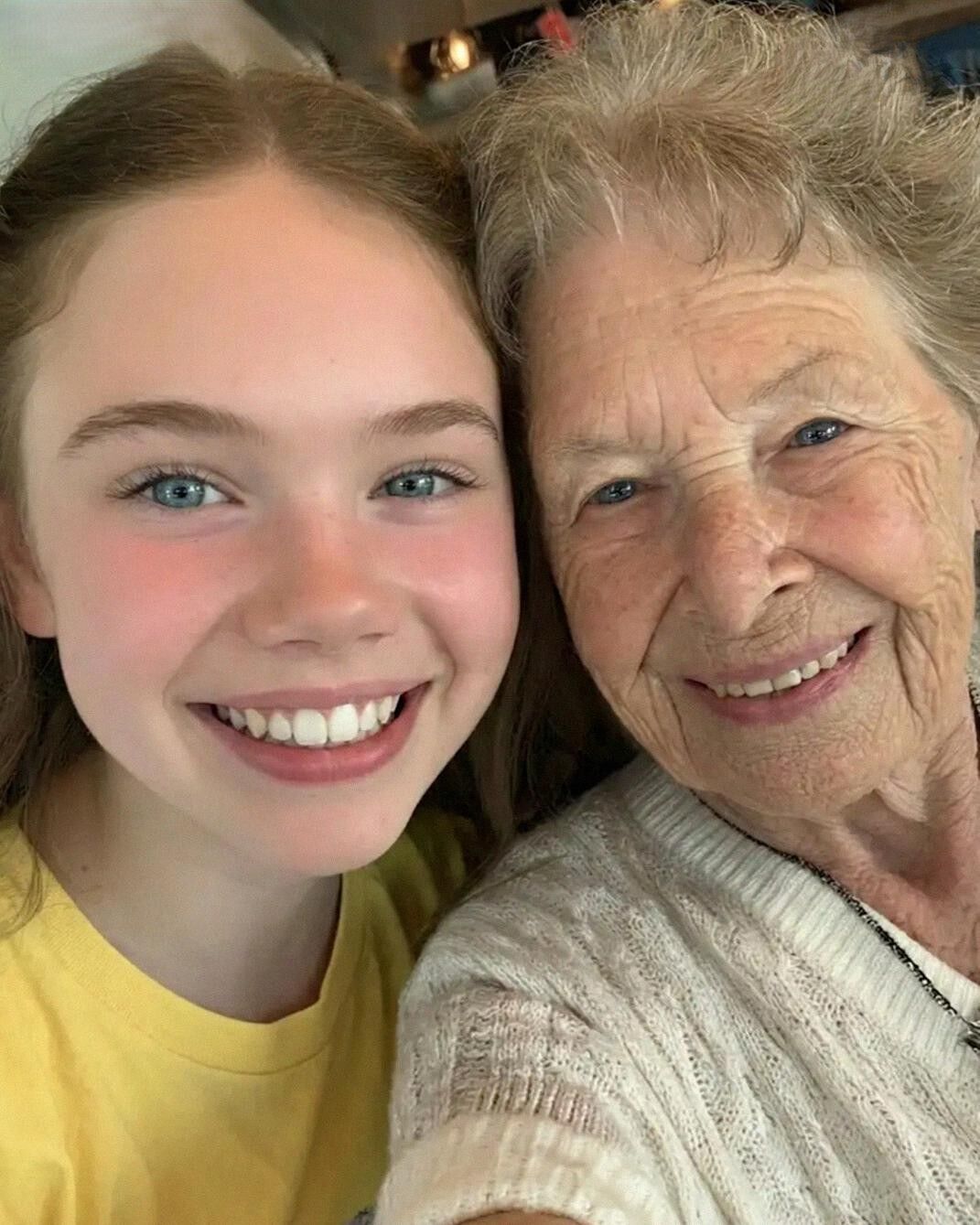
I was thirty-two when I understood that I had spent my entire life mourning people who were still alive. Until then, I believed I was a child shaped by pure tragedy—a girl whose parents had been taken by a wet road and bad luck. I believed my grandmother was a woman with barely enough, surviving on stubbornness and diluted soap just to keep me fed and warm.
The truth reached me three days after her funeral.
The house had fallen into that hollow silence left behind when someone who defined a space is suddenly gone. I sat at the kitchen table, its cracked vinyl surface marked by years of homework and shared cups of tea. Her cardigan still hung over the chair, one sleeve drooping as if it were searching for the arm that would never return. Without thinking, I put the kettle on and set out two mugs—only to remember there was no one left for the second.
An envelope lay on the table, my name written in her steady, familiar handwriting. I stared at it as steam curled upward like a ghost. When I finally opened it, the first line struck me like a blow.
“My girl. If you’re reading this, my stubborn heart finally gave up. I’m sorry to leave you alone again.”
Again.
The word pulled me backward in time. I was six years old, standing on a thin carpet while a social worker spoke in soft, professional tones. My parents were gone, she said. Instant. No pain. I remembered my grandmother kneeling in front of me, solid and steady like an old oak.
“You ready to come home with me?”
“Where’s home?” I asked.
“With me,” she replied. “That’s all that matters.”
Life with her was built on quiet sacrifice. She worked mornings at the laundromat and cleaned offices at night. She hemmed jeans at the kitchen table until her fingers hardened. At the grocery store, she studied price tags carefully, putting back the things she wanted so my school trips were paid for and my birthday cakes always carried my name in thick frosting. Sundays meant tea with too much sugar and trips to the library, where she pretended to browse for herself but always ended up beside me in the children’s aisle.
Then I turned fifteen, and the world sharpened. In high school, value was measured by the car you drove. I was tired of being the girl on the bus, the girl in patched jeans. One night, as she sorted bills into careful stacks, I exploded.
“I need a car. Everyone else has one.”
“The car can wait,” she said gently.
“You’re just cheap,” I snapped. “You never spend money on anything. You don’t understand.”
She didn’t raise her voice. Her mouth tightened, and something unreadable crossed her face—deep sadness mixed with unbreakable resolve.
“We’ll talk when you’re not trying to hurt me,” she said.
I slammed my door. I stayed at a friend’s house the next night. When I came home, the house was too quiet. I found her in her bedroom, still in her work clothes, her hand already cold. The doctors said it was a sudden heart attack. They said she didn’t feel a thing.
Seventeen years later, the letter in my hands finally told me the rest.
“Go to my closet,” it said. “Top shelf. Behind the blue shoebox.”
There I found a thick folder—savings accounts, a college fund, a life insurance policy. Amounts that made no sense for the life we lived. A sticky note rested on top: For your education. And maybe a small, sensible car if I’m not around to argue.
Then I turned the page, and the room tilted.
“You were six when they told you your parents died in a car accident. They did not. They went to prison—fraud, forgery, assault. They chose money over you. I had a choice: tell you the truth and let its shame shape you before you had a chance to know yourself, or tell you they were gone and that none of it was your fault. I chose the version that let you sleep. You were never an orphan, bug. You were protected.”
I sank to the floor of her closet as the truth settled over me. She hadn’t been cheap—she had been shielding me. The duct-taped shoes and watered-down soap weren’t signs of poverty; they were bricks in a fortress she built for my future. She let me resent her restraint so I wouldn’t resent my parents’ abandonment. She absorbed my teenage anger to preserve a lie that kept me whole.
Years later, I stood in the dressing room of a regional theater, the air thick with greasepaint and old velvet. I had just won a small award—nothing grand, but it was a life earned on my own terms. I looked at my reflection, then at the letter I carried like a talisman.
That was when I realized my grandmother was the greatest actress I would ever know. She had played the role of the struggling woman so convincingly that I never thought to look behind the curtain. She performed stability for decades to mute the chaos of the truth.
I never searched for my biological parents. I didn’t need to. An orphan is someone without a home—and my grandmother made sure I never lacked one for a single second. She lied about her comfort, her wealth, even about love itself, all so I could grow unburdened.
“I understand now, Grandma,” I whispered to the empty room. “I forgive you.”
She didn’t give me a car at sixteen, and she didn’t give me the truth at six. Instead, she gave me something far greater—a childhood free from inherited shame. Her lie was the ground I grew from. Her sacrifice was the light that guided me upward. I wasn’t the orphan of a car crash.
I was the daughter of a woman who loved me enough to rewrite the world so I could find my place in it.