The trust is locked down tight. She doesn’t even know it exists.”
My heart stopped. The word hung in the air between them, sharp and impossible.
Trust? “I’m just saying,” Vicki continued, her voice lowering but still audible in the quiet house, “maybe we should slow down. The last withdrawal was pretty large.
What if someone notices? What if there’s an audit?”
“Who’s going to notice?” Lester’s laugh was short and bitter. “The court checks in maybe once every five years, and we’ve got all the receipts we need.
Orthodontia, tutoring, school supplies—it’s all documented. Nobody’s going to question us for giving our daughter a comfortable life.”
Our daughter. The phrase sat wrong in my chest, bitter and strange, like swallowing something that didn’t want to go down.
“Still,” Vicki said, and I could hear the worry threading through her words, “seventeen thousand dollars in one month—”
“Was necessary,” Lester cut her off sharply. “Knox needed that elite hockey camp if he’s going to get recruited, and the Range Rover wasn’t going to pay for itself. Besides, there’s plenty left.
The old man set up that trust with over three hundred grand. Even after all these years, there’s still enough to keep us comfortable for a long time.”
The world tilted sideways. I pressed my back against the wall, textbook clutched against my chest so hard I felt the spine digging into my ribs, trying to process what I was hearing.
A trust. Three hundred thousand dollars. Money that was supposed to be mine, being spent on Range Rovers and hockey camps for a brother who got everything while I wore thrift store jeans with holes in the knees and worked weekend shifts at the grocery store just to afford school supplies and the occasional coffee with friends.
I should have stormed down those stairs. I should have demanded explanations, confronted them with what I’d heard, forced them to look me in the eye and admit what they’d done. But something in my gut—maybe instinct, maybe survival—told me that confrontation wasn’t the answer.
Not yet. Not when they held all the cards and I held nothing but overheard words and growing suspicion. So instead, I crept back outside as quietly as I’d come in.
I walked around the block three times, my breath coming in sharp gasps that had nothing to do with the October cold, trying to calm my racing heart and organize my scattered thoughts. Then I came home again, louder this time, calling out as I opened the door that study group had been cancelled and I was back early. Vicki appeared from the kitchen within seconds, her smile bright and practiced, the worry I’d heard in her voice completely erased from her expression.
“Oh, honey, I thought you had study group?”
“Cancelled,” I said, watching her face carefully, searching for any crack in the performance. “I’m going to do homework in my room.”
“That’s nice, dear. Dinner’s at six.
We’re having chicken.”
I climbed the stairs to my mothball-scented room and sat on the edge of my narrow bed, staring at the water-stained ceiling, trying to piece together a puzzle I hadn’t known existed. My mother had died in a car accident on black ice when I was four years old. I remembered her in fragments—the smell of her perfume, something floral and sweet, the sound of her laugh that was more feeling than memory, the way she used to call me “little bird.” After she died, Lester had raised me with the help of his sister Vicki, who moved into our house and never left, taking over the cooking and cleaning and the day-to-day raising of a grieving child.
Growing up, I’d accepted that we didn’t have much money. Lester worked in insurance sales, and Vicki did bookkeeping from home. We weren’t poor—we had a house, food on the table, heat in winter—but we weren’t comfortable either.
Or so I’d been told. Meanwhile, Knox—Lester’s son from his first marriage to a woman who’d left when Knox was a baby—seemed to live in an entirely different economic reality. New clothes when the seasons changed.
Top-of-the-line hockey gear replaced every year. Summer camps that cost thousands. A car when he turned sixteen—a decent used sedan, but still.
When I asked why things were different, Lester always said the same thing: “Knox’s mother pays child support. Good money too. You think money grows on trees?
We do the best we can for you, Charity, but we have limited resources.”
I’d believed him. More than that, I’d felt guilty for wanting things, guilty for noticing the difference, guilty for being a burden on people who’d taken me in when I had nowhere else to go. I’d worked my weekend job at the grocery store and saved every dollar, trying not to ask for anything, trying to be grateful for what I had.
Now, sitting on my bed with the truth burning in my chest, I understood that the guilt had been the point. Keep me small. Keep me grateful.
Keep me from asking the questions that might unravel their careful lies. That night, after everyone went to bed, I started searching. The house was old, Victorian-era with additions tacked on over the decades, full of creaking floorboards and accumulated spaces that had collected fifteen years of forgotten things.
I started in the basement, moving as quietly as I could through boxes of old tax returns and files that smelled like mildew and dust and time. I found it three hours later, tucked inside a banker’s box labeled “2008 Misc.” in Vicki’s neat handwriting. A manila folder, yellowed at the edges, containing documents that changed everything I thought I knew about my life.
The first was a trust agreement dated two months before my mother died, establishing a fund for “Charity Margaret Chen” in the amount of three hundred twenty-five thousand dollars. The trustee listed was Lester James Frost. The beneficiary was me.
The funds were designated for my education, health, and general welfare until age twenty-five, at which point any remaining balance would be distributed to me directly. The language was clear and specific, mentioning college tuition, medical expenses, clothing, enrichment activities—all the things I’d never had. My hands shook as I read the name of the grantor: Reed Thomas Lawson.
Not Frost. Lawson. The second document was a death certificate.
Reed Thomas Lawson, died six months after my mother in a construction accident when a crane cable snapped on a job site in Tacoma. Age thirty-two. No other family listed.
Estate to be settled according to existing will and trust documents. The third document made my vision blur with tears I refused to let fall: a DNA paternity test, dated three weeks before the trust was established. Probability of paternity: 99.97%.
Father: Reed Thomas Lawson. Child: Charity Margaret Chen. I sat on the cold basement floor, surrounded by boxes and fifteen years of carefully constructed lies, and understood with crystalline clarity that Lester wasn’t my father.
He’d married my mother when I was two—I’d seen the wedding photos, me in a white flower girl dress I didn’t remember wearing, clutching a basket of petals and looking confused. He’d raised me after she died. He’d put his name on my school forms and amended my birth certificate when he adopted me.
He’d been the only father I’d ever known. And he’d been stealing from me ever since my real father died and left me a future. The rest of the box contained bank statements, and each one I unfolded felt like another punch to the gut.
Withdrawals, regular and large, for things that had nothing to do with my education or welfare. A boat purchase—twenty-two thousand dollars—that Lester sold three years later at a loss. Vicki’s new car when I was twelve.
Knox’s hockey expenses, season after season of elite camps and private coaching. Furniture for the living room remodel. Family vacations to Disneyland and Hawaii and Colorado ski resorts, trips I’d never been invited on because “someone needed to stay home and watch the house.” The Range Rover that sat in our driveway while I took the bus to school in all weather because driving lessons were “too expensive.”
My hands shook so badly I could barely hold my phone as I photographed everything, some of the images coming out blurred but most of them clear enough.
Then I carefully returned everything to the box exactly as I’d found it, smoothing out every wrinkle, making sure the dust patterns matched. Everything except one document I slipped into my backpack: my mother’s death certificate, which listed her maiden name as Chen and her next of kin as “Reed Lawson, domestic partner.”
Over the next three weeks, I became someone I didn’t recognize in the mirror. During the day, I was the same quiet Charity who worked her grocery store shifts scanning items and bagging produce, who did her homework at the kitchen table and didn’t cause trouble.
At night, I researched. I learned about trust law and fiduciary duty and embezzlement. I learned that what Lester had done wasn’t just wrong—it was criminal.
I found legal aid clinics and websites about financial exploitation of minors. I printed articles in the school library and hid them in the bottom of my gym locker, the one place I knew no one from my house would ever look. And I made copies of everything in that basement box, storing them in a locked filing cabinet at the public library where I volunteered on Saturdays, filing books and helping elderly patrons with the computers.
The head librarian, Mrs. Chen—no relation, just another person with my mother’s maiden name—had given me a key when I asked if I could store some personal documents somewhere safe, somewhere away from home. She hadn’t asked questions, just handed me the key with a look that said she understood more than I was saying.
Three days before my birthday, I called the only lawyer whose number I could find in my mother’s old address book, a worn leather book I’d kept hidden in my room since I was ten. A woman named Holly Brennan who’d apparently handled my mother’s estate and had written a note in the margin: “Call if you ever need anything. —H”
“Brennan Law,” a crisp voice answered on the second ring.
“I’m calling about a trust,” I said, my voice steadier than I felt, years of keeping quiet teaching me how to control my emotions. “A trust that was set up for me by my biological father, and I think the trustee has been stealing from it for fifteen years.”
There was a long pause on the other end, and I could hear papers rustling, a chair creaking. “How old are you?”
“I’ll be sixteen on Friday.”
“And what’s your name?”
“Charity Frost,” I said.
Then, softer, testing the words in my mouth, “Or maybe Lawson. I’m not sure anymore.”
Another pause, longer this time, heavy with recognition. When she spoke again, her voice had changed completely, sharpened with focus and something that might have been anger.
“Charity, I’m going to need you to tell me everything from the beginning. And I need you to tell me if you’re safe right now. Are you in danger?”
“I’m at the library,” I said, looking around at the familiar stacks, the comfortable chairs, the world of books that had been my refuge for years.
“I’m safe for now. But on Friday, I don’t think I will be anymore.”
I told her everything. The overheard conversation that had started it all.
The documents in the basement that proved fifteen years of systematic theft. The clearance-rack birthdays while Knox got everything new. The trust that was supposed to give me a future, disappearing into Range Rovers and hockey camps and vacations I was never invited on.
I told her about working weekends to afford school supplies while Lester complained about how expensive I was, about wearing jeans with holes in the knees while Knox got a new wardrobe every season. When I finished, Holly was quiet for a long moment, and I could hear her breathing, could almost feel her thinking through the phone line. “Charity,” she said finally, her voice careful and controlled, “what you’re describing is embezzlement and breach of fiduciary duty.
Those are crimes. Serious crimes. If everything you’ve found is accurate—and I have no reason to doubt you—Lester could face criminal charges, prison time.
And you would have grounds for a civil suit to recover what’s been taken, plus damages and interest.”
“How long would that take?”
“Months. Maybe years. Courts move slowly, especially when minors and trusts are involved.
There are procedures, hearings, investigations.”
“I don’t have months,” I said, my voice breaking slightly despite my best efforts. “I’m turning sixteen in three days, and I think… I think he’s going to kick me out. I heard him tell Vicki last week that I’m too expensive now that I’m asking questions, that maybe it’s time I learned to stand on my own two feet.”
“He can’t legally kick out a minor,” Holly said sharply, and I could hear protective anger threading through her professional tone.
“That’s abandonment.”
“Maybe not legally,” I said. “But he can make my life miserable enough that leaving feels like the only option. He’s good at that.
I need to know what happens if I confront him. I need to know my options.”
“Charity—”
“Please,” I interrupted. “Just tell me what I can do.”
She sighed, and I heard papers rustling again, the sound of someone pulling up files on a computer.
“Okay. If you have documentation—real, solid documentation—and if you’re willing to go on record with what you know, I can file for emergency removal of Lester as your trustee and guardian. But that means courts, judges, testifying about everything that’s happened.
It means your life becomes public. And it means you’ll need somewhere safe to go while this plays out, because he’s not going to react well.”
“What if…” I hesitated, the question feeling dangerous even though I was alone in the library reference section. “What if there’s family I don’t know about?
From my biological father’s side?”
“Reed Lawson’s family?” Holly’s voice sharpened with interest, and I heard keyboard clicking. “I handled his estate when he died. He didn’t have much family left—his parents had both passed before he did, no siblings from his mother.
But he had a half-brother. Older, maybe fifteen years older, different mother. They weren’t close growing up, but the half-brother helped settle Reed’s affairs when he died.
Decent guy. Sad situation.”
“Do you still have his contact information?”
“I… yes. In my archived files.
Charity, what are you planning?”
“I’m planning to survive my sixteenth birthday,” I said, surprised by how calm I sounded. “And I’m planning to make sure Lester understands that I know exactly what he is and what he’s done. Can you call Reed’s brother?
Can you tell him what’s happening and ask if he’d be willing to meet me?”
“Charity, you need to understand—he’s a stranger. You don’t know him. He might not want to get involved.”
“I know,” I said.
“But he’s the only family I have left who isn’t stealing from me. That’s worth a phone call, isn’t it?”
Holly was quiet for a moment, then sighed. “Yeah.
Yeah, it is. I’ll call him tonight. But Charity?
Whether he says yes or no, you’re not going through this alone. I’ll make sure of that.”
My birthday fell on a Friday, and I woke before dawn with the envelope in my backpack and a plan that felt both terrifying and inevitable. Lester made a show of cooking breakfast—pancakes, my supposed favorite, though I’d never actually told him I liked pancakes.
Vicki sat at the table with her coffee, wearing her smile like armor. Knox shuffled in late, still half-asleep in his expensive practice gear, grabbed food without sitting down. “Happy birthday, sis,” he mumbled around a mouthful of pancake, and I felt a pang of something that might have been grief.
Knox wasn’t a bad kid. He was just a kid who’d been given everything and never thought to question why his sister had nothing. He’d grown up believing the lies because they benefited him, and maybe that wasn’t entirely his fault.
“Thanks, Knox,” I said. Lester slid a small wrapped box across the table with a smile that didn’t reach his eyes. “For the birthday girl.”
I opened it slowly, my hands steady despite the adrenaline coursing through me.
Inside was a cheap bracelet from the discount store downtown, the kind that turned your wrist green after a week of wear. The price tag was still stuck to the bottom of the box: $8.99. “Thanks,” I said, my voice carefully neutral.
Vicki cleared her throat, her smile tightening at the corners. “We thought you might like something practical this year. You’re getting older, after all.
Sixteen is a big milestone. Time to start thinking seriously about your future, about being independent.”
“My future,” I repeated, setting the bracelet box down carefully. “That’s actually what I wanted to talk about.”
“College, career, that sort of thing,” Lester said, loading his plate with more pancakes like this was just another normal breakfast.
“You’ll need to get serious about scholarships, Charity. Start applying early. We can’t afford to send you anywhere fancy.
State school will have to do.”
The irony was so thick I could taste it, bitter on my tongue. Three hundred thousand dollars—most of it gone now, stolen piece by piece—and he was sitting there telling me I needed scholarships to afford community college. “Actually,” I said, setting down my fork with deliberate care, “I wanted to ask you about money.
About my mother’s estate.”
The kitchen went quiet. Lester’s jaw tightened almost imperceptibly. Vicki’s coffee cup clinked against her saucer as she set it down too hard.
“What about it?” Lester’s voice was carefully controlled, but I could hear the warning underneath. “Did she leave anything when she died? Insurance, savings, inheritance from her parents?
Anything like that?”
“Your mother died broke,” Lester said flatly, his eyes hard. “She was always terrible with money, spent everything she earned on clothes and restaurants. Everything she had went to pay off her credit card debts.
There was nothing left.”
“What about my biological father?” I asked, watching his face carefully, seeing the exact moment the color drained from his cheeks then flooded back in angry red. “Did Reed Lawson leave anything when he died?”
Vicki’s intake of breath was sharp. Knox stopped mid-chew, looking between us with confused alarm.
“Where did you hear about that?” Lester’s voice was dangerous now, low and controlled in a way that would have terrified me a month ago. “It doesn’t matter where I heard it,” I said, keeping my voice steady. “What matters is whether it’s true.
Did my biological father leave me anything?”
“Your biological father,” Lester spat the words like they tasted rotten, “was a deadbeat construction worker who knocked up your mother and then had the decency to die in an accident before he could disappoint you personally. He left nothing. Nothing but debt and a bastard child that I had to raise when nobody else wanted you.
I’m the one who stepped up, Charity. I’m the one who put a roof over your head and food in your mouth. I’m the one who made you part of this family when you had nowhere else to go.”
“Is that what you tell yourself?” I asked quietly, and something in my calm seemed to enrage him more than shouting would have.
“When you’re spending money from the trust he set up for me, when you’re buying Range Rovers and sending Knox to elite hockey camps with my college fund, do you tell yourself that Reed left nothing? Do you tell yourself you’re the hero of this story?”
The explosion was immediate and devastating. Lester surged to his feet, his chair clattering backward onto the tile floor.
“You ungrateful little—I have given you everything! A home, food, clothes, an education—”
“Clearance rack clothes,” I interrupted, my voice cutting through his rage with surgical precision. “While Knox gets everything new.
While you drive a car bought with money that was supposed to be mine. While you take vacations I’m never invited on because someone needs to watch the house.”
“How dare you—”
“I found the documents,” I said, and the words landed like grenades in the middle of the kitchen. “In the basement, in a box labeled ‘2008 Misc.’ The trust agreement.
The bank statements showing every withdrawal. I know about the three hundred twenty-five thousand dollars Reed Lawson left for my education. I know you’ve been stealing from it since I was four years old, spending my future on your present.”
The kitchen went completely silent except for the hum of the refrigerator and Knox’s sharp intake of breath.
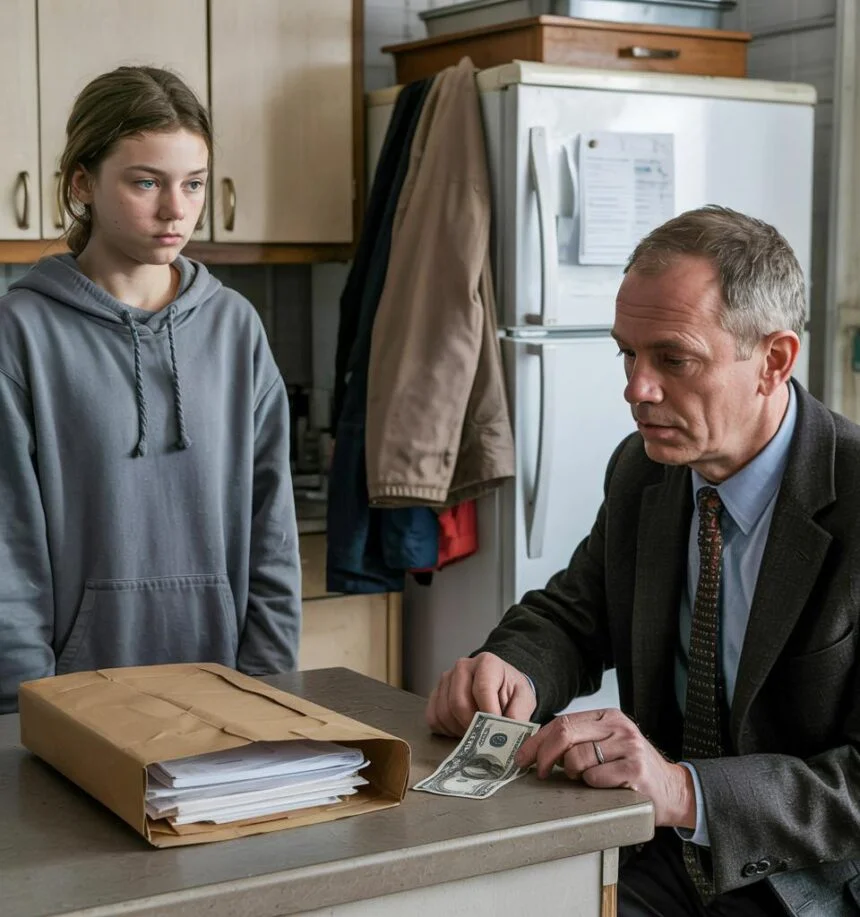
Lester’s face twisted into something ugly, something I’d never seen before but had probably always been there under the mask. He reached into his wallet, pulled out a ten-dollar bill with shaking hands, and threw it on the table so hard it slid across the surface and hit my water glass, knocking it over. “There,” he snarled, his voice shaking with rage and something that might have been fear.
“That’s all you’re worth to this family. That’s all you’ve ever been worth. Take it and go.
I’m done. I’m done paying for someone else’s mistake.”
The words should have destroyed me. They were designed to destroy me.
But instead, I felt something cold and clear settle in my chest, sharp as broken glass and just as dangerous. I picked up the ten-dollar bill, water dripping from its edges. I folded it carefully, precisely, and slipped it into my pocket.
Then I reached into my backpack and pulled out the envelope I’d been carrying for three weeks, the envelope that contained copies of everything I’d found, plus a letter I’d written explaining exactly what I knew and what I intended to do about it. “Before I go,” I said quietly, sliding the envelope across the table, “I thought you should have this.”
Lester stared at it like it might explode. Vicki’s face had gone pale.
“What is it?” she asked, her voice thin and frightened. “Copies,” I said, standing up and slinging my backpack over my shoulder. “Of everything I found.
The trust agreement. The bank statements. The DNA test proving Reed Lawson was my biological father.
Receipts for the boat, the cars, Knox’s hockey camps—all bought with money that was supposed to be mine. And a letter explaining exactly what you’ve done and what I intend to do about it.”
“You wouldn’t,” Lester breathed. “I already did,” I said.
“I filed a complaint with the probate court yesterday afternoon. My lawyer contacted them two days ago. Her name is Holly Brennan—you might remember her from when you had to settle Reed’s estate and set up the trust you’ve been looting.
She’s been waiting fifteen years for someone to ask where my money went, and she’s very interested in helping me get it back.”
“Your lawyer?” Lester’s laugh was harsh and desperate. “You’re sixteen years old. You don’t have a lawyer.”
“Actually, I do,” I said calmly.
“And by Monday, you’ll be removed as both my trustee and my guardian. The only question is whether you cooperate with the investigation or whether this becomes a criminal prosecution. Holly suggested you might want to get your own lawyer.
A good one. You’re going to need it.”
I walked toward the front door, my legs steadier than I’d expected, everything I truly cared about already packed in a bag I’d hidden at Mrs. Chen’s house.
Behind me, I heard Vicki saying something in a panic, heard Knox asking what the hell was happening, heard Lester’s heavy footsteps following me. “You walk out that door, you’re on your own,” Lester shouted, his voice cracking with fury and fear. “Don’t come crawling back when you realize how good you had it here, when you’re sleeping on the street and wishing you’d kept your mouth shut.”
I opened the door and stepped onto the porch.
The October air was cold and sharp, smelling like fallen leaves and the first hint of winter. And that’s when I saw him. A black SUV sat at the curb, engine running, exhaust curling in the morning cold.
As I stood there, backpack over my shoulder, the driver’s door opened and a man stepped out. He was tall, maybe fifty, with dark hair graying at the temples and eyes the exact same shade of brown as mine—a shade I’d never seen reflected in Lester’s pale blue or Vicki’s hazel. He wore a charcoal coat and moved with the careful purpose of someone who’d driven a long way and wasn’t sure of his welcome.
“Charity?” he said, his voice uncertain but warm, hopeful in a way that made my throat tight. I stared at him, my brain trying to process what I was seeing. Behind me, I heard Lester step onto the porch.
“Who the hell are you?” Lester demanded, but his voice had lost its certainty. The man’s eyes moved past me to Lester, and something in his expression hardened into steel. “My name is David Lawson,” he said clearly.
“I’m Charity’s uncle. Her father was my half-brother Reed. And I’m here to take her home.”
The silence that followed was broken only by the sound of the wind and Vicki’s gasp from inside the house.
“Holly Brennan called me two days ago,” David continued, his eyes still on Lester. “She told me about the trust Reed set up, about how you’ve been stealing from it for fifteen years, spending my niece’s inheritance on yourself and your son while she wore secondhand clothes and worked weekends just to afford school supplies.”
“You’re supposed to be—” Lester started, then stopped. “You’re thinking of my brother,” David said quietly.
“Easy mistake. We had different mothers, different last names. But we were brothers, and when Reed died, I made sure his daughter’s trust was properly established and protected.
Or I thought I did.” His jaw tightened. “Imagine my surprise when Holly called to tell me the trustee had been embezzling for fifteen years, and Reed’s daughter was about to be thrown out on her sixteenth birthday.”
He looked at me, and his expression softened, filled with something that looked like regret and determination mixed together. “I’m sorry I didn’t come sooner, Charity.
I should have checked in, should have made sure you were okay after Reed died. I failed you, and I’m sorry. But I’m here now, if you’ll have me.”
“You didn’t know,” I said, my voice breaking slightly.
“How could you have known?”
“I should have made it my business to know,” he said. “Family should show up. That’s what Reed would have wanted.”
He turned back to Lester, and his voice dropped to something cold and final.
“You have two choices, Mr. Frost. You can cooperate with the court investigation, return what’s left of the trust, and hopefully avoid criminal charges.
Or you can make this difficult and spend the next several years explaining to a judge exactly where three hundred thousand dollars went, why you bought boats and cars and luxury vacations with a minor’s college fund. Either way, Charity is coming with me, and you’ll never control another dollar of her money again.”
“You can’t just take her,” Lester sputtered, grasping at straws. “I’m her legal guardian.
I adopted her—”
“Not for long,” David said quietly. “Holly’s filing emergency paperwork today. By Monday, you’ll be removed as both trustee and guardian pending a full investigation.
The question is whether you go quietly or whether this becomes a criminal matter. I’d suggest you choose wisely.”
He looked at me again, and I saw kindness in his eyes, patience, an offer without pressure. “Charity, you don’t have to come with me if you don’t want to.
Holly can help you find a safe placement, a foster situation with good people, whatever you need. I’m offering because you’re family—Reed’s daughter, my niece—and I owe your father that much. But this is entirely your choice.
No pressure. No expectations.”
I looked at David Lawson—this stranger who shared my blood and my father’s name, who’d dropped everything to drive here and stand on this porch and offer me a way out. Then I looked back at Lester, whose face was mottled red and white with rage and fear and the dawning realization that his comfortable life was about to collapse.
“I choose him,” I said clearly. “I choose family who actually shows up.”
David’s smile was small but genuine, reaching his eyes in a way Lester’s never had. “Then let’s go home, Charity.”
I walked down the porch steps without looking back.
As David opened the passenger door for me, I heard Lester shouting something about lawyers and courts and ungrateful children. I heard Vicki crying, her sobs theatrical and desperate. I heard Knox calling my name, confused and maybe a little afraid, maybe finally understanding that the comfortable life he’d enjoyed had been built on theft.
But I was already moving forward, climbing into the warmth of David’s car, closing the door on fifteen years of lies and stolen futures. As we pulled away from the South Hill house, David glanced over at me. “You okay?”
I pulled the ten-dollar bill out of my pocket and looked at it—the bill Lester had thrown at me like I was worthless, like I was the mistake instead of what he’d done to me.
I folded it carefully and put it back in my pocket. “Yeah,” I said, and surprised myself by meaning it. “I think I’m going to be okay.”
“Good,” David said.
“Because we have a lot to talk about, and a lot to fix. But first—are you hungry? Because I’ve been driving for six hours straight and I’m starving.”
I laughed, the sound surprising me, bubbling up from somewhere deep.
“I could eat.”
“Excellent. I know a place on the way to my house that makes the best burgers you’ve ever tasted. And while we eat, you can tell me about yourself.
Not the version Lester knew. The real you. Who you actually are, what you actually want, what kind of music you like.
All of it.”
As we drove away from South Hill, leaving behind the mothball house and the clearance-rack birthdays and the man who’d stolen my future to buy his son’s comfort, I felt something I hadn’t felt in so long I’d forgotten what it was called. Hope. The legal battle that followed took eighteen months of depositions and hearings and testimony.
Holly Brennan filed emergency motions that removed Lester as my trustee and guardian within a week, appointing David as temporary guardian while the courts investigated. The accounting of the trust revealed that of the original three hundred twenty-five thousand dollars, only ninety-three thousand remained. The rest had been systematically stolen—withdrawals documented with fabricated receipts for orthodontia I’d never received, tutoring I’d never had, school supplies that had actually gone to Knox.
Lester and Vicki hired lawyers who argued that every expense had been legitimate, that they’d raised me well and I was just an ungrateful teenager. But the evidence was damning. Bank statements showed withdrawals that coincided precisely with boat purchases, car leases, and Knox’s expensive hockey career.
And I sat in that witness chair, sixteen years old in a borrowed dress that actually fit, and told the truth about clearance racks and mothballs and listening through the kitchen door while they decided how much of my future to spend on themselves. The judge didn’t just remove Lester as trustee. She ordered him to repay every stolen dollar with interest, awarded me the remaining trust funds plus damages, and referred the case to criminal prosecutors.
Lester avoided jail by agreeing to a repayment plan that would take him twenty years to complete, and by giving up any claim to guardianship or contact with me. David took me to his home on Lake Wenatchee, two hours outside of Seattle—a house built of glass and cedar that looked out over water so clear you could see straight through to the stones beneath. It was nothing like the cramped, dark rooms of South Hill.
It was space and light and quiet, and for the first three months, I kept waiting for the catch, for the moment David would reveal what he wanted in exchange for his kindness. The catch never came. Instead, David taught me to drive on the frozen lake that first winter, patiently coaching me through turns on ice while I white-knuckled the steering wheel.
He helped me apply to colleges, never once suggesting I should be grateful or that I owed him anything. He introduced me to people as “my niece” at first, but gradually it became “my daughter” without either of us discussing when the shift had happened. When I corrected him the first time—”I’m technically your niece”—he just shrugged and said, “Family’s about who shows up, Charity.
You’re my daughter if you want to be.”
I went to the University of Washington on a combination of scholarships and recovered trust funds. I studied finance and trust law with a focus that made my professors raise their eyebrows and write recommendation letters that used words like “passionate” and “driven.” I graduated summa cum laude and went straight to law school. I passed the bar on my first attempt and took a job with the Washington State Attorney General’s office in their consumer protection division.
I specialized in cases involving financial exploitation of minors and the elderly, and I was relentless. Every trust fund I recovered, every abusive guardian I helped remove, every kid who looked at me across a courtroom and realized someone finally believed them—it all felt like paying forward what Holly and David had done for me. Ten years after Lester threw that ten-dollar bill at me, I stood on the deck of David’s house—my house too now, officially, since he’d added me to the deed on my twenty-fifth birthday—and watched snow fall on the frozen lake.
My phone buzzed with a text from a sixteen-year-old girl named Maya whose aunt had been stealing from her accident settlement. I’d taken her case three weeks ago, and today a judge had removed the aunt as guardian and ordered full repayment. Thank you for believing me, Maya’s text read.
Everyone else said I was imagining it, said family wouldn’t do that. I typed back: You weren’t imagining it. And you deserve every penny of what’s yours.
Call me next week and we’ll talk about college applications. Behind me, the sliding door opened and David stepped out with two mugs of coffee, steam rising in the cold air. “Another win?” he asked, handing me a mug.
“Another win,” I confirmed. “You know,” he said, leaning on the railing beside me, “your father would be really proud of you. Both of them—Reed, who I knew, and your mother, who I wish I’d had the chance to meet.
You took something terrible and turned it into something that matters.”
“I had help,” I said, looking at him. “I had you.”
“Everyone needs help,” he said. “The difference is knowing when to accept it.
You were brave enough to ask for help when you needed it. That takes courage most people never find.”
I thought about that ten-dollar bill, still in my wallet after all these years, pressed flat between two clear plastic sleeves, a reminder of the day my life split in two. I thought about Lester’s face when I handed him that envelope, about Knox’s confused hurt, about Vicki’s tears that I’d never been entirely sure were real.
I thought about choosing David, about climbing into his car, about learning what it meant to be wanted instead of merely endured. “Hey, Dad?” I said, testing the word I’d been using more often lately, the one that felt right in my mouth. “Yeah, kiddo?”
“Thank you.
For showing up that day. For choosing to be someone who shows up.”
He squeezed my shoulder, his grip warm and solid and real. “Best decision I ever made.
You made it easy, Charity. You were worth showing up for.”
The snow kept falling, covering the ice in a fresh blanket of white, and somewhere in Seattle a girl named Maya was going to sleep knowing she wasn’t crazy, wasn’t ungrateful, wasn’t imagining the theft of her future. Blood doesn’t write your ending.
Lester thought throwing me away would be the final word in my story, that a ten-dollar bill would define my worth. He was wrong. I wrote my own ending, one recovered dollar and one saved kid at a time.
And it turns out I’m worth more than anyone who tried to diminish me ever imagined. I picked up that ten-dollar bill fifteen years ago, and I never looked back. And now I spend my days making sure other kids get to do the same—standing between them and the people who would steal their futures, showing up when it matters, being the family that chooses them.
That’s not really an ending at all. It’s just the place where I stopped running from what happened and started running toward what I could do about it. And that, I’ve learned, makes all the difference.