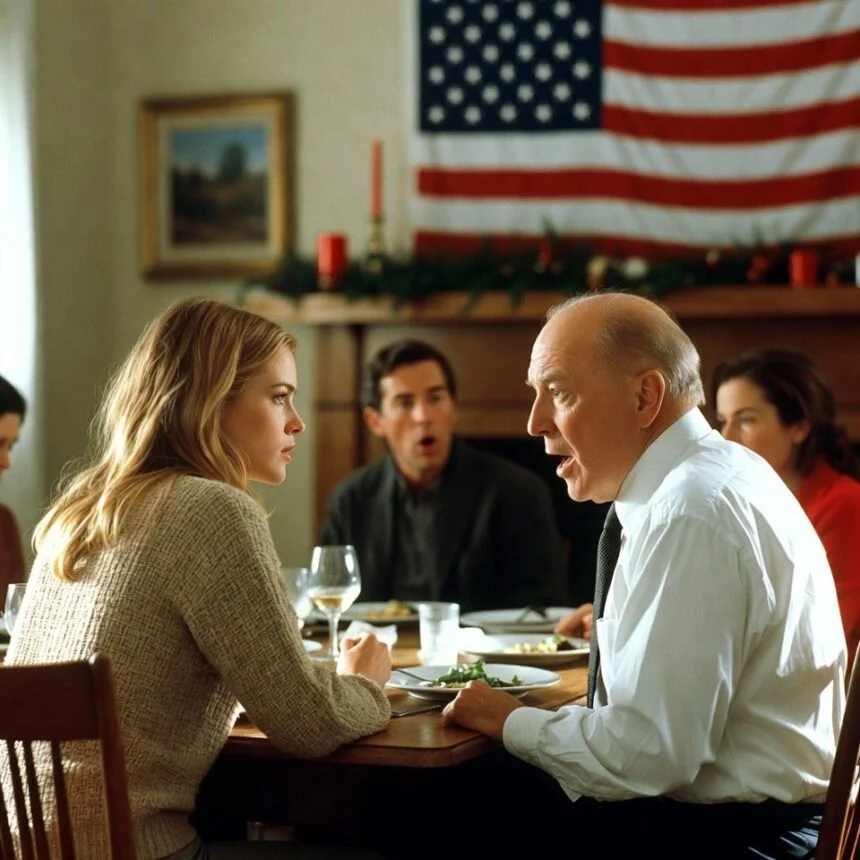
My father shoved my nine-year-old daughter out of her chair halfway through Christmas dinner, and the sound of her body hitting the hardwood was quieter than the silence that followed. Twenty people sat around my parents’ farmhouse table, the good china out, the centerpiece of holly and candles arranged just so, the smell of rosemary and ham floating over everything like it was a normal night. Outside, snow pressed up against the windows of their colonial in Westchester County, New York, soft and postcard-perfect. Inside, my father’s hand slammed into Lily’s small shoulder. “That seat is for my real grandkid,” he snapped. “Get out.” Her chair slid back and tipped, legs screeching on the floor before it went over. Lily’s knees hit first, then her palms, a dull thud of nine-year-old bones meeting polished oak. Her breath left her in a short, shocked gasp. A fork clinked against a plate. A napkin drifted off someone’s lap. No one moved. My mother sat closest to her, fingers still wrapped around the stem of her wineglass. My sister Olivia froze with her phone halfway back into her clutch. My father kept his fork suspended in midair like he was waiting for someone to hit play again. Lily looked up at me from the floor. Her eyes were wide and completely dry, like her body hadn’t gotten the message yet that this was supposed to hurt. That was the moment something inside me stopped trying to make sense of these people. I pushed back my chair. The scrape of wood against wood was louder than her fall. My father flinched at that, at the noise, not at his granddaughter on the floor. It told me everything I needed to know. I crossed the room and knelt beside Lily. Up close I could see the skin already reddening beneath her tights, the faint tremor in her hands. She grabbed my sleeve like the ground might tilt again. “I’ve got you,” I whispered, my voice low enough that only she could hear. “I’ve got you, baby.” She nodded once, quick, the way kids do when they’re trying very hard not to cry. I helped her to her feet, one hand under her elbow, the other steady on her back. She folded herself small beside me, like taking up less space might make her less of a target. I waited three heartbeats. My mother stared determinedly at the cranberry sauce.Olivia’s gaze flicked from her daughter Emma to Lily as if she were weighing which reaction would cost her the least. A cousin studied the centerpiece like it had started singing. Someone cleared their throat. No one said a word. My father finally exhaled. “She shouldn’t have been in that chair,” he said, like he was correcting flatware placement. “That place is for family.” Family. The word landed heavy and sour. I straightened, keeping Lily tucked against my side. My fingers found the strap of my bag on the back of my chair. The leather was familiar and grounding, pressing into my palm like a reminder. I’d told myself I was waiting until after the holidays. I wasn’t waiting anymore. My mother’s eyes snapped up the second I lifted the bag. “Hannah,” she said quickly, too quickly. “Don’t make a scene. It’s Christmas.” I almost laughed. Instead, I walked to my end of the table and set my bag down, right between the gravy boat and the platter of rolls. I unzipped it slowly, the sound loud in the thick quiet, and slid out a plain, unmarked folder. The folder had lived in that bag for a week. Tonight was the third time it had sat on this table. The first two, I’d left it closed. Not this time. I placed it directly in front of my parents, squarely between my father’s plate and my mother’s wineglass. “You don’t get to touch her,” I said, my voice calm in a way that surprised even me. “Not ever again.” My father’s jaw tightened. “Don’t be dramatic.” I looked him in the eye, the same pale blue I’d stared at my whole life and never quite believed. Then I said the four words I’d only ever rehearsed in my head. “You’ve been served, Dad.” For a second, nothing happened. The room was all breath and heat and the faint ding of some timer in the kitchen. Then my mother’s wineglass slipped from her fingers. It hit the table with a sharp clink, red liquid sloshing dangerously close to the folder before tipping over, staining the white tablecloth in a spreading bloom the color of someone else’s heart. — The thing about breaking points is they never really appear out of nowhere. People like to pretend they do. It makes it easier to act shocked. “Oh, she just snapped,” they’ll say, like the last straw wasn’t stacked on top of thousands of carefully placed ones. It didn’t start with my father knocking my child to the floor. It started in all the small ways they told me who I was. Growing up in that house in Westchester, Olivia was sunshine and I was static. That was the family joke. Olivia walked into a room and compliments followed like confetti. She got “Look at you!” and “You’re glowing!” and “Sit by me.” I got “Move, you’re in the way.” When Olivia was five and smeared chocolate cake on the wallpaper, my mother laughed and dabbed at the stain. “She’s spirited,” she said fondly. When I, at seven, knocked over the same vase by breathing too close to it, my father shook his head and muttered loud enough for everyone to hear, “She breaks everything she touches.” If he laughed while he said it, it didn’t count as cruel. If everyone else laughed with him, it became the truth. I learned early that in our house, tone mattered more than impact. I also learned there were things we didn’t talk about. The first time I heard my own existence questioned, I was fifteen and eavesdropping without meaning to. Thanksgiving, the whole extended family crammed into the same house that, years later, would host the Christmas where Lily hit the floor. I was in the hallway, halfway to the bathroom, when I heard my aunt’s voice float from the dining room. “She doesn’t really look like Richard, does she?” A beat. Then my father’s familiar chuckle. “Well, every family’s got its mysteries.” Laughter followed, warm and easy. No one stepped into the hall to see if I’d heard. No one came to find me in the bathroom, where I stared at my own reflection and tried to figure out which parts of my face didn’t belong. My mother never corrected him. That was her talent—smoothing napkins over messes and changing the subject. If cruelty was his sport, silence was her strategy. I didn’t have proof of anything, just whispers and offhand comments and the way my father’s eyes sharpened around me when he’d had a little too much to drink. I told myself I was imagining it. Then my grandfather died. My father’s father, the only person in that house who treated me like I wasn’t a mistake someone forgot to erase. He wasn’t warm. He didn’t hug. He wasn’t the grandpa who slipped you candy or told you bedtime stories. But he’d pat my shoulder when I walked by and say, “You’re sharp, kid. Don’t let anyone dull that.” He left behind a quiet grief and a louder shift in power. After the funeral, the papers came out. Not in front of me, of course. I was twenty-three, the age where you’re considered old enough to work two jobs but too young to be trusted with a pen. I watched from the kitchen while my father and Olivia disappeared into his office with an attorney and a stack of folders. My mother told me it was “just boring paperwork.” When I finally got up the nerve to ask if my grandfather had set anything aside for me—a small cushion, a bit of help to get out of my unsafe basement apartment after a break-in—my mother didn’t look up from rinsing dishes. “There wasn’t anything,” she said, her voice flat as running water. I believed her. At least, I tried to. Believing her meant my father’s endless jokes and small cruelties were just personality, not strategy. Believing her meant I wasn’t being stolen from on paper and in person. The alternative was worse: that they could look straight at me and choose to lie. Years blurred into each other. I met Lily’s dad during a stretch of time when I was working nights at a hospital registration desk and grabbing breakfast at a diner near the Metro-North station. He was a paramedic on the night shift, kind in the way tired people are when they’ve seen too much. We were together long enough to have Lily and to realize we weren’t good together. He moved to Denver when she was two. He sends postcards and birthday money. He is not the villain of this story. My parents loved having another reason to complain. “You always did like making things harder on yourself,” my father would say, looking at Lily like she was a complication instead of a child. My mother would pat his arm. “Don’t start,” she’d murmur. She never said, “Don’t say that about our granddaughter.” Two weeks before the Christmas my family lost everything, Olivia called me while I was packing Lily’s lunch. Her name flashed on my phone between a PTA reminder and a notification from my banking app reminding me my balance was low. “Hey,” I answered, tucking the phone between my ear and shoulder while I sliced apples. “Can you watch Emma for an hour?” Olivia asked, breathless in the way busy people like to sound. “I’ve got a work call and daycare closed early for the holidays. Just swing by Mom and Dad’s. She already has her stuff there.” Work call. The phrase translated to: I need you to make my life easier and I’m not going to acknowledge it as a favor. “I have a shift at the clinic at three,” I said carefully. “It’s eleven, Hannah,” she replied. “It’s literally one hour.” It was never one hour. I looked over at Lily, who was coloring at the kitchen table, tongue peeking out in concentration. Her leggings had another tiny hole at the knee. I’d need to sew it. Again. “Fine,” I said. “I’ll be there in twenty.” My parents’ house looked exactly the same as it always had. Brick front, black shutters, wreath on the door with a red bow that somehow never frayed. The kind of place real estate listings call “classic” and “timeless” like that’s a moral achievement. Emma opened the door before I could knock, her hair pulled into a perfect bow, her sweater embroidered with her name. She flung her arms around my waist like I was arriving with presents. “Aunt Hannah!” she squealed. “We’re baking cookies later!” “Are we?” I smiled, hanging my coat on the same hook I’d used as a teenager. Olivia swept in ten minutes later, high-heeled boots clicking on the hardwood. She kissed Emma’s forehead in a distracted peck, phone already in her hand. “She knows the rules,” Olivia said as she grabbed her laptop bag. “No screens, no junk food. If she gets bored, there are crafts.” “I’ll manage,” I said. She paused just long enough to squeeze my arm. “You’re a lifesaver,” she said. “Seriously.” Then she was gone. The house settled into a quiet that felt artificial, like a hotel lobby between conferences. Emma spread her dolls out on the rug and launched into a complicated story involving a princess betrayal and a missing crown. I picked up stray bits of wrapping paper from the coffee table, because even when you’re a guest in my parents’ house, you clean. That’s when I noticed Olivia’s laptop on the couch. Sleek. Silver. Closed. I left it alone. It wasn’t mine. And even if it was, I’ve spent a lifetime being told not to touch things. Emma noticed it about three minutes later. She climbed onto the couch, small fingers already reaching. “Hey, sweetheart,” I started, “let’s leave Aunt Liv’s computer alone, okay? It’s not a toy.” “It’s fine,” Emma said cheerfully, flipping the lid up with the ease of someone who’d been told yes more often than no. The screen lit up. A password box appeared. My stomach tightened. Before I could say anything, Emma’s hands skated across the keys. No hesitation. No guessing. She hit enter. The screen unlocked. Kids don’t memorize passwords by accident. “Emma,” I said gently, stepping closer. “Let’s find your markers, honey. We can draw.” “Just a second,” she murmured, already clicking. A document snapped open, filling the screen. Black text, white background, bold headings. The kind of formatting that broadcasts importance even if you’re too far away to read the words. My grandfather’s name sat right at the top. I sat down without meaning to. “Hannah?” Emma asked. “Can I watch cartoons now?” “Yeah,” I said absently, my eyes scanning the page. “Pick one.” She bounced off the couch toward the TV, remote in hand, blissfully unaware that the air in the room had shifted. The document was a trust. THE LAW OFFICES OF HARRIS & FIELDS, the header read. HENRY JAMES CALDWELL REVOCABLE TRUST. My grandfather’s name. My eyes slid down. “Beneficiaries,” the next heading said. Olivia’s full legal name appeared first. Underneath it, as plain as the couch cushion under my hand, was mine. HANNAH MARGARET CALDWELL. The room went out of focus for a second. A line farther down snagged my attention. “Upon the Settlor’s death, trust principal of four hundred eighty thousand dollars (USD 480,000) to be distributed in equal shares (50/50) to the above-named beneficiaries.” I didn’t need to read the rest. I saw the date stamped on the final page, the month my grandfather died. The same month my mother had told me “there wasn’t anything.” The same month Olivia had shown up with a brand-new SUV and a laugh about being “so blessed.” The numbers blurred. I took one photo, hands steady despite the way my heart hammered. Just one. The part that mattered. Then I closed the document, shut the laptop, and set it back exactly where it had been. Emma tugged at my sleeve. “Can I have a snack?” “Sure,” I said, forcing my voice to sound normal. “Fruit or crackers?” “Both,” she grinned. Of course both. That night, when Olivia came back, she breezed into the living room smelling like expensive perfume and confidence. “Everything good?” she asked. “Fine,” I said. Confronting people like my family without a plan is like walking into a hurricane with an umbrella. You might feel brave, but you’re still going to get destroyed. Two days later, I sat across from a woman in a navy blazer in a midtown office that smelled like coffee and copier paper. Her nameplate read CLAIRE DONOVAN, ESQ. I slid my phone across her desk, the photo of the trust pulled up and waiting. She studied it for five seconds. Then her eyebrows lifted. “If your name is on this,” she said, voice level, “trustees don’t get to pretend you don’t exist.” My throat felt dry. “My parents told me there was nothing left,” I said. “Years ago. When my apartment was broken into and I was trying to get Lily into a safer neighborhood. They said Grandpa didn’t leave anything for me.” Claire nodded slowly, the way doctors do when they’ve seen this particular injury a hundred times. “Trustees have duties,” she said. “They’re not owners. They’re managers. Managers don’t get to decide whose name matters.” “They’ll say it was a misunderstanding,” I muttered. “They always do,” she replied. “That’s not a defense. That’s a habit.” She pulled a yellow legal pad toward her and wrote in block letters: FULL ACCOUNTING. “Bare minimum,” she said. “We ask the court to order a complete accounting of the trust. Every dollar in, every dollar out, every signature on every disbursement. We ask them to freeze distributions until it’s done.” My palms were sweating. “Will they know it’s me?” “Yes,” she said calmly. “That’s the point.” I pictured my father’s face, the way his smile never quite reached his eyes when he looked at me. I pictured Olivia’s hand on his arm at every holiday, like she’d been assigned the role of favorite and didn’t want to lose it. “What happens if they’ve been moving money?” I asked. “Then we show the court how,” Claire said simply. She began typing, her fingers quick and precise over the keyboard. Legal language blossomed on the screen—petitioner, respondent, trustee, beneficiary, trust principal. It didn’t accuse. It didn’t rant. It demanded clarity. By the time she printed the petition and slid it into a folder, my heart was beating so hard it felt like it had moved into my throat. “This doesn’t mean a trial next week,” she said, her tone softening just slightly. “It means transparency. And if there’s nothing to hide, they’ll be fine.” We both knew how unlikely that was. She held the folder for a second before letting go. “Once this is served,” she said carefully, “they’re going to be angry. They may try to make this about anything but the numbers.” “Like what?” I asked, though some part of me already knew. “Like whether you belong,” Claire said. Something inside me went very still. I thought of my aunt’s voice in the hallway. My father’s laugh. The way everyone always looked away when certain comments were made. “I’m ready,” I said. It was only partially true. But some things you move toward even when your legs are shaking. For the next week, the folder lived in my bag. I carried it everywhere. To work. To school pickup. To the laundromat. It brushed against my hip when I walked, a flat rectangle of paper and ink that weighed more than it should. Sometimes, at night, I’d take it out and set it on the kitchen table, just to remind myself it was real. Legal service. Demands for the truth written in a language my parents respected. I told myself I’d wait until after Christmas. “Don’t ruin the holidays,” my mother’s voice echoed in my head. “Don’t make things awkward.” Old scripts, worn soft from overuse. Then my father shoved my child out of a chair, and the sound of her hitting the floor was quieter than the sound paper makes when you slide it across a table. Waiting stopped being an option. We didn’t stay at dinner after I served them. I didn’t wait to see who reached for the folder first. I didn’t watch my father’s face as the words trust, accounting, mismanagement hit him like a language he didn’t want to speak. I lifted Lily into my arms, her legs wrapping around my waist like they had when she was much smaller. “She okay?” my cousin Lauren whispered as we passed. “She will be,” I said. No one stopped us. Outside, the cold air slapped my cheeks, the sky already dark. Christmas lights blinked along my parents’ porch rail, cheerfully oblivious. Lily tucked her face into my neck, her little breaths uneven. She didn’t cry in the car. That scared me more than anything. She sat in the passenger seat, hands folded, staring out at the snowbanks like they were on the other side of a television screen. “Does it hurt?” I asked quietly as we hit a red light. She shrugged, a tiny movement. “It’s fine.” It wasn’t. But my daughter had learned early that saying something hurt didn’t guarantee anyone would care. A few blocks from our apartment, her voice floated across the console. “Grandpa doesn’t like me,” she said. The words landed like a fist under my ribs. “That’s not true,” I started automatically, then stopped, my fingers tightening on the steering wheel. Lies, even well-intentioned ones, rot from the inside. “What he did,” I said carefully, “that was about him. Not you. You didn’t do anything wrong.” She chewed on her lip, eyes still on the windshield. “Is it because I’m not real?” I pulled over. Right there, hazard lights blinking, snow dusting the hood. I turned fully toward her. “Look at me,” I said softly. She did, tentative and searching. “You are real,” I said, making each word heavy enough to stand on its own. “You are my child. You belong with me. Always.” She studied my face the way kids do when they’re trying to decide whether to file something under truth or fiction. Then she nodded once, slow, as if she was placing those words on a shelf where she could reach them later. At home, I wrapped her knee in ice, made hot chocolate with too many marshmallows, and put on the animated movie she always picked when she needed comfort. She leaned into me on the couch, her head tucked under my chin, her whole body angled like she was prepared for the world to shove her again if she let her guard down. After she fell asleep, I sat alone at the kitchen table. The folder lay in the center, closed now, but humming with potential. It wasn’t just about money. It was about the narrative my parents had built around me brick by brick, year after year, until I believed I was lucky to be included at all. Ink, I was starting to understand, didn’t care about family stories. It only cared about signatures. The wave hit the next morning. Missed calls. Voicemails. Text messages that popped up in rapid succession like a slot machine spinning: Mom, Olivia, Unknown, Dad. I didn’t answer any of them. I made pancakes shaped like snowmen and let Lily drown them in syrup. I braided her hair. I drove her to a friend’s house for a playdate and smiled at the other mom like everything was normal. Then, while she was busy building a LEGO city that would inevitably collapse, I sat in my car and listened. My mother’s voice was first, high and breathless. “Hannah, what did you do? You blind-sided us in front of everyone. This is family business. We could have handled this privately. You’re going to tear us apart.” Olivia’s voicemail came next. “What is wrong with you? You’re suing Mom and Dad? Over what—some misunderstanding about Grandpa’s money? Take it back. Call your attorney and fix it. Do you have any idea how this makes us look?” My father didn’t leave a voicemail. He sent a text. You’re not taking anything from this family. I stared at the screen until the letters blurred. He thought this was about cash. He was wrong. The first hearing was set faster than I expected. Claire called one Tuesday morning while I was smearing peanut butter on bread. “They filed a response,” she said. “How bad?” I asked. “They’re not denying the trust exists,” she said. “They’re denying you.” For a second, the kitchen tilted. Lily looked up from packing her backpack, brow creased. “I’m fine,” I mouthed. She wasn’t convinced, but she went back to shoving markers into the front pocket. Claire continued. “They’re asking the court to dismiss your petition and sanction you for filing in bad faith. The argument is that you’re harassing them over assets that were never yours.” “Sanction me,” I repeated, the word tasting metallic. “And your father is implying there’s always been…doubt about your parentage,” she added. There it was. The thing sharpened and stored for decades, pulled out now like a weapon with my name already carved into the handle. I gripped the edge of the counter until my knuckles went white. “So that’s the play,” I said quietly. “They’re trying to shift the conversation,” Claire replied. “From math to shame. From records to rumor.” Desperate people throw sand. They hope you’ll rub your own eyes blind. The courthouse in White Plains smelled like dust and floor polish. On the day of the hearing, the waiting area hummed with low voices and rustling paper. Attorneys in dark suits leaned toward their clients, speaking in tones that made bad news sound manageable. My parents sat on the opposite side of the room. My mother’s hands twisted the strap of her purse into a tight spiral. My father’s posture was ramrod straight, jaw clenched, eyes fixed on some point in the middle distance. Olivia sat beside them in a cream coat, hair perfect, expression furious. When she caught me looking, she glared like I’d spilled red wine on her dress. Claire touched my elbow. “Remember,” she murmured. “We’re not here to perform. We’re here to preserve.” Inside the courtroom, everything felt smaller than on TV. No sweeping gallery, no echoing footsteps, just neutral walls and a judge who looked like he’d seen this exact family a hundred times under different last names. My father’s attorney spoke first. She used words like misunderstanding and confusion, like my petition was a tantrum instead of a request for math. She slid closer to the edge of the cliff with every sentence. “There has always been some question,” she said delicately, “regarding whether Ms. Caldwell is, in fact, the biological child of Mr. Caldwell, which informed the trustees’ understanding of the trust’s intent—” The judge held up a hand. “Counsel,” he said, voice mild but sharp. “Is the petitioner’s name on the trust?” She hesitated. “Yes, Your Honor,” she said finally. “Then trustees have a duty to that beneficiary,” he replied. “We’re not litigating biology today. We’re talking about paper.” He turned to Claire. “Motion to dismiss is denied. Petition for full accounting is granted. All distributions are to be frozen pending review. Submit records within thirty days.” The gavel didn’t slam. It didn’t need to. My father’s face went a shade paler. Olivia’s mouth tightened. My mother stared at her lap like she wanted to disappear into it. Outside, in the hallway, my phone buzzed. Olivia: You think you won? You have no idea what you started. I slipped the phone back into my bag next to the folder. Ink, I thought, beats rumor. Every time. The smear campaign started small. It always does. A cousin messaged me on Facebook. “Hey, just checking in. Your mom sounds really upset. Are you sure this is the right way to handle things? Families are complicated.” A great-aunt I barely knew emailed to say she was “praying for my heart.” At work, a coworker pulled me aside in the break room. “I, uh, saw something on Instagram,” she said, voice careful. “About, like, family drama? I just wanted to say if you need time off…” I didn’t have to search to find it. Olivia’s post sat near the top of my feed. A photo of a generic winter landscape. A caption that read: Some people will tear a family apart for money. It’s heartbreaking to watch. Please pray for peace. No names. No details. Just enough for anyone who knew us to connect the dots and leave heart emojis and comments about forgiveness. No one asked how my nine-year-old’s knee was healing. I turned my phone face down on the table and went back to charting vitals. When I got home that night, Lily was at the kitchen table, doing math homework. “Why do people lie?” she asked without looking up. I rinsed a mug and thought about how to answer a question adults have been dodging for centuries. “Sometimes the truth doesn’t help them,” I said. She nodded slowly, as if filing that somewhere next to fractions and spelling words. A week later, a small plain box arrived in my mailbox. No logo. No note. Just a return address: my father’s attorney. Inside was a paternity test kit. My father’s swabs were already sealed, labeled, ready. The implication was heavy enough to bend the cardboard. I stood in my hallway, the kit in my hand, the closet door to my left. Then I slid the box onto the highest shelf and shut the door. For the first time in my life, I understood that I didn’t owe anyone proof of my existence. Not even the man whose last name I carried. The documents started coming in waves. Bank statements. Transaction histories. Distribution summaries. Copies of checks with my parents’ signatures in blue ink. Paper looks neutral. It isn’t. It remembers everything. Claire called me back to her office on a gray Thursday. She had a stack of papers in front of her, corners aligned, highlighter marks in precise yellow lines. “Sit,” she said. I sat. She slid a single page toward me. “Look at the approvals column,” she said. I scanned the grid. Dates. Amounts. Categories labeled education, housing, family support. Beside each line: initials. Signatures. My mother’s looping handwriting over and over. My lungs forgot how to work for a second. “It wasn’t just him,” I said quietly. “No,” Claire said. “She signed off.” I’d spent years telling myself my mother was stuck. That she was controlled, that she didn’t understand, that she was as much a victim of my father’s manipulations as I was. The truth was messier. She’d been holding a pen. “What are we looking at?” I asked, my voice sounding far away. Claire tapped the top line. “Trust principal at the time of your grandfather’s death,” she said. “Four hundred eighty thousand dollars. Intended split: fifty-fifty between you and Olivia. That’s two hundred forty thousand each.” Two hundred forty thousand. The number sat on the page like a fact carved in stone. “And now?” I asked. She pointed to the bottom line. “Current balance: thirty-eight thousand.” For a moment, I actually looked for a typo. “That can’t be right,” I whispered. “Oh, it’s right,” Claire said. “Down payments, tuition, renovations, vehicles, ‘family support’—all drawn from the trust. All authorized by your parents as trustees. None distributed to you.” I thought of my mother rinsing dishes, saying “there wasn’t anything.” I thought of Olivia’s SUV, the kitchen remodel, the trips. Something inside me clicked into place with a painful kind of clarity. They hadn’t just decided I didn’t count. They’d spent my portion and called it generosity. The second hearing was quieter. No talk of biology this time. Just numbers. Claire laid out the records with the calm of someone who trusted math more than narratives. She talked about duties, fiduciary responsibility, unilateral decisions made without the consent of both beneficiaries. My parents’ attorney tried to wrap the story in softer language. They’d helped the daughter who “needed it more.” They’d used funds to “support family.” The judge leaned forward, glasses low on his nose. “Helping family requires consent,” he said. “And documentation. Trustees do not have discretion to punish. They have duties.” He looked directly at my father. “You don’t get to spend one child’s inheritance and call it support for another,” he said. The word mismanagement entered the record. It didn’t feel like a victory. It felt like a diagnosis. The court ordered an exact restitution calculation. Trust principal owed. Interest. Legal costs. Penalties. A path forward that didn’t require anyone in my family to agree with me. That night, while I brushed Lily’s hair, she watched me in the mirror. “Are Grandma and Grandpa mad at us?” she asked. “Yes,” I said, choosing honesty over comfort. Her shoulders tensed. “Is that bad?” “It’s not our problem to fix,” I said. She considered that, then nodded, just once. Progress, I was learning, sometimes looked like a nine-year-old deciding she didn’t have to manage adult feelings. In the weeks that followed, my parents escalated. If they couldn’t win on paper, they’d try to win in the court of public opinion. Relatives called to tell me I was “airing dirty laundry.” An old family friend sent a long text about forgiveness and how money “wasn’t worth losing everyone over.” Olivia posted another caption. Sometimes the ones you help the most are the ones who hurt you the worst. I’m praying for anyone dealing with betrayal right now. Her followers responded with heart emojis and stories of their own difficult siblings. I blocked her. I blocked my parents. I blocked anyone who thought both sides was an acceptable stance when one side had pushed my daughter to the floor and spent my inheritance. For the first time, silence was something I chose. The final hearing didn’t feel cinematic. There were no dramatic gasps, no shouted confessions. It felt administrative. I would learn later that this is what justice often looks like. The courtroom was even smaller this time. Neutral carpet. Neutral walls. A clock that ticked too loudly. My parents sat at one table. My father’s suit was a little looser on him. My mother’s hair had more gray than I remembered. Olivia sat behind them, face tight, as if she’d bitten into something sour and couldn’t spit it out. Claire stood and summarized months of paperwork in a few clean paragraphs. She didn’t mention Christmas. She didn’t mention Lily’s knee or the phrase real grandkid. She talked about four hundred eighty thousand dollars, two beneficiaries, one trust, and a long pattern of unauthorized distributions. My parents’ attorney tried one last time to pivot. “Families are complex,” she began. “Intent is hard to quantify. There was long-standing uncertainty that informed the trustees’ decisions—” The judge cut her off. “Trustees do not have discretion to punish,” he said again, his tone even more final this time. “They have duties. The court has already found mismanagement and diversion of assets. Restitution is ordered in the amount of two hundred forty thousand dollars to the petitioner, plus accrued interest, plus legal fees and penalties. Total obligation: three hundred sixty-eight thousand dollars.” Three hundred sixty-eight thousand. The number echoed in the quiet room. Olivia went pale. My mother didn’t look up. My father’s jaw worked, but no sound came out. The judge signed the order. “Court is adjourned,” he said. Just like that, the story my family had told about me for decades—ungrateful, dramatic, unworthy—had its spine snapped in a place ink could reach. Outside, in the hallway, my father finally spoke. “This isn’t over,” he said quietly, eyes fixed straight ahead. For the first time in my life, I met his gaze without flinching. “It is,” I said. Because it was. The money didn’t arrive overnight. Consequences rarely do. They come in pieces. A listing for a “classic four-bedroom colonial in desirable school district” hitting Zillow. Rumors from cousins about downsizing. A family home turned into a line item in someone else’s mortgage. Four months later, on an ordinary Tuesday, an email from my bank pinged while I was filling out Lily’s field trip form. Deposit: $368,000.00. I stared at the number so long the screen dimmed. It didn’t feel like winning the lottery. It felt like finally being handed something that had always had my name on it. I paid off the lingering medical debt from Lily’s ER visit after the break-in two years ago. I paid down my car. I put six months of expenses in an account labeled SAFETY in all caps and another chunk in a college fund with Lily’s name at the top. The rest stayed where it was for a while. We moved to a smaller building in a better neighborhood. Second floor. Deadbolt that didn’t stick. A little patch of grass out back where Lily dragged an old beanbag and declared it her reading zone. “They sold the house,” a cousin texted me one day, as if it were breaking news. “Yeah,” I wrote back. She sent another message. “They’re really struggling.” For a moment, guilt fluttered like a reflex. Then I remembered Lily’s body hitting the floor. I remembered thirty-eight thousand dollars where two hundred forty should have been. Some losses are just bills finally coming due. The question of biology didn’t disappear just because the money landed where it should have. It still sat in the back of my mind like a splinter. Whispers have a way of doing that. Even when you know they’re a weapon, you still find yourself prodding the wound they leave. One night, after Lily had fallen asleep on the couch halfway through a movie, I stood in the hallway staring at the closet door. The paternity test kit waited on the top shelf, exactly where I’d left it. I didn’t owe them proof. But I owed myself peace. I took the box down and set it on the kitchen table. The packaging was clinical. Instructions in calm font. Return envelope already printed and prepaid. My father’s sample was inside. The audacity of that made me almost laugh. He’d been so sure weaponizing doubt would work in his favor that he’d literally prepaid for confirmation. I didn’t turn it into a big moment. I didn’t light candles or cry. I swabbed my cheek, sealed the envelope, and dropped it in the mail the next morning along with Lily’s permission slip and the rent check. Life, I was learning, rarely pauses for your emotional milestones. The waiting was worse than I expected. Every time my email pinged, my stomach dropped. Every night, when I tucked Lily in, I found myself studying her face, looking for features that matched mine, his, someone else’s. Two weeks later, in the middle of a Tuesday afternoon, the result arrived in my inbox. Biological match. I sat down hard in the nearest chair. Not from relief. From fury. They could have resolved this decades ago with one test and one honest conversation. Instead, they’d built a whole identity for me on maybe. They’d justified decades of cruelty and exclusion on a doubt they’d never bothered to verify. I forwarded the result to my parents. No subject line. No message. Just the PDF. Then I blocked their email addresses. I slept through the night for the first time in months. Blocking them didn’t bring complete silence. It brought attempts. Numbers I didn’t recognize rang and rang. Voicemails stacked up from area codes I knew belonged to extended family members. A neighbor mentioned my mother had stopped by our old building looking for me. Eventually, my doorbell rang. I checked the peephole and felt my chest tighten. My mother stood in the hallway, shoulders hunched, hands clasped like a woman who’d rehearsed a speech and wasn’t sure she’d get to deliver it. Lily was at school. I opened the door just enough to make it clear she wasn’t welcome inside. “Hannah,” she said, voice soft and rough around the edges. “Please. Just a minute.” I didn’t say anything. Silence had always been her weapon. This time, I handed it back. “Your father has been…different,” she tried. “He’s asking about Lily. He wants to see her. Now that we know, we can put all of this behind us. We can be a family again.” Now that we know. As if love were a subscription that only activated once a lab confirmed eligibility. I stared at her for a long moment. “Before you were born,” she blurted, words tumbling over each other, “I slept with someone else. Once. Your father suspected. Or maybe he knew. I don’t even remember which came first anymore. From that day on, you were a question mark for him. I let him treat you that way because I was guilty. I thought…I thought I deserved it.” Her voice broke on the last word. “And somehow,” she whispered, “you paid for it.” The words fell between us like shards of glass. “It shouldn’t have mattered,” I said quietly. “You were my mother whether I was his or not. You chose him anyway.” Her face crumpled. “We can fix this,” she said weakly. “We can start over. He’s ready now. We know you’re really his—” “No,” I said. The word felt solid in my mouth, like something I could build a life on. “You don’t get to come back because the story is comfortable again,” I continued. “You don’t get to ask for my child when you couldn’t protect me, and you watched him hurt her.” Tears slid down her cheeks. “I didn’t know how to stop him,” she whispered. “You signed your name,” I said. Her shoulders shook. “Hannah, please.” I thought of Lily’s question in the car. Is it because I’m not real? I thought of every night I’d gone to sleep in that house as a child, wondering what I’d done wrong to deserve being the punchline. “The only thing you’re leaving with,” I said, “is the knowledge that you were wrong. About me. About what I deserved. About what family means.” Then I closed the door. She didn’t knock again. Holidays look different now. There’s no big farmhouse table, no twenty people pressing their grievances into overcooked ham. No forced group photos where you have to angle yourself just right so the bruise on your child’s knee doesn’t show. There’s just me and Lily in our small living room, a slightly crooked Christmas tree we picked out from the lot near the grocery store, and pancakes for dinner because we decided that’s our tradition now. She sprawls on the rug with her new books, laughing without glancing around to see who might be watching. She takes up space. So do I. We don’t talk to my parents. We don’t see Olivia. Relatives occasionally send messages about how “life is short” and “you’ll regret it when they’re gone.” Maybe. But I know what I regret more: the years I spent teaching myself to be small so they could feel big. One Saturday in March, Lily and I are standing in the cereal aisle at Target, arguing about whether chocolate counts as breakfast. “It does if you put strawberries on it,” she insists, dead serious. “That’s not how nutrition works,” I say, trying not to smile. She grins up at me, mischief in her eyes. And it hits me. I’m not bracing. I’m not scanning the aisle for my parents’ faces, for a cousin ready to deliver some guilt-laced message. My shoulders aren’t tight. My jaw isn’t clenched. We’re just a mom and a nine-year-old debating cereal. That’s the win. Not the three hundred sixty-eight thousand dollars, though I’m grateful for every cent that keeps us safe. Not the trust paperwork with my name printed clean and undeniable. The win is that my daughter no longer asks if she’s real. Later that night, as we’re doing dishes, Lily hands me a plate. “Mom?” she says. “Yeah?” “What does family mean?” I dry my hands and think for a moment. “Family is who keeps you safe,” I say slowly. “Even when it’s hard. Especially when it’s hard.” She nods like that answer fits. She goes back to splashing water on purpose, just to make me laugh. I watch her and think about the woman I might have been if I’d kept playing my part at that Christmas table. The woman who would have swallowed the shove and called it peace. Who would have taught her daughter that belonging was a prize you earned by shrinking. That woman feels very far away now. I didn’t save my parents. I didn’t save my sister. I saved my child. And somewhere along the way, I saved myself. Sometimes, late at night, after Lily’s asleep and the apartment is quiet, I’ll scroll through comments on stories like mine. People from cities I’ve never visited write things like “I thought I was alone” and “This happened to me too, just with different details.” If you’re reading this from some kitchen table miles away, maybe with your own version of a bruise you’re still trying to name, I hope you hear this part clearly. Blood didn’t make my family. Paper didn’t either. Choice did. They lost their money. They lost their narrative. They lost access to the granddaughter they called not real. We kept our names. We kept our future. We kept each other. And in the end, that was worth more than any number printed on a bank statement. If any part of this story stayed with you, I’d love to know where you’re reading from. Not for them. For the quiet reminder that none of us are really telling these stories alone. I didn’t expect much when I finally hit post on that story. It was a quiet Tuesday night, hours after Lily had fallen asleep with a book spread across her chest, one arm flung wide like she was claiming more of the bed than her nine-year-old frame technically needed. The apartment hummed with the low, familiar sounds of the fridge and the radiator ticking. The cursor blinked at the end of my last sentence. I’d written it all out in one long rush: the shove, the trust, the hearings, the test, the door closing. Not in legal language this time. In mine. I didn’t put our last name. I didn’t mention the county. I changed a few details, just enough to make it unsearchable to anyone who hadn’t lived it. Then I did what I’ve been told not to do my entire life. I made a scene. I shared it. By morning, hundreds of people had left comments. Some were from New York, Ohio, Texas, California. Some were from countries I’d only ever seen on maps. Women my mother’s age. Men my father’s age. People who had cut their parents off years ago and still woke up wondering if they were the villain. One woman wrote, “My dad never hit my kids, but he used words like knives. I walked away five years ago. I still shake every Christmas. Reading this makes me feel less crazy.” Another said, “My grandfather used a trust to control us, too. I wish I’d had your courage. I let my kids grow up around people who treated them like ‘less than’ because I thought that was what good daughters did.” They weren’t asking for anything. They were just holding up mirrors. Halfway through my lunch break, I caught myself scrolling and re-reading the same handful of lines until my eyes blurred. Have you ever read a stranger’s story and felt your own chest crack open a little, like someone finally found words for the bruise you’ve been pretending not to see? That’s what it felt like. I set my phone down on the counter, next to Lily’s cereal bowl from that morning. For the first time since everything happened, I didn’t feel like the girl who “ruined Christmas.” I felt like a mother who refused to pretend a bruise was a blessing. A few weeks after the money hit my account and the story made its way into corners of the internet I would never see, I did something that had been nudging at the back of my mind since the night of the shove. I booked a therapy appointment. For me. Not for Lily. Not for us together. For the woman who had always been told she was “too sensitive” and “too dramatic” and “too much,” and who had spent thirty-five years trying to compress herself into a version that took up as little emotional space as possible. The office was on the third floor of a low brick building near the train station. The waiting room smelled like coffee and old magazines. A small fountain burbled in the corner like it was trying a little too hard to be soothing. My therapist’s name was Dana. She wore black jeans and sneakers and had the kind of calm eyes that make you realize how loud your own nervous system has been. “So,” she said, once I’d told her the short version. “You chose your daughter over your parents. That’s the headline I’m hearing.” I let out a breath I didn’t know I’d been holding. “When you say it like that, it sounds simple,” I said. “It is,” she replied. “And it isn’t.” We talked about a lot in that first session: the trust, sure, but also the way my father’s jokes had burrowed under my skin. The way my mother’s silence had become a script I started reading from in my own life. “Children learn three stories about themselves from their families,” Dana said at one point, leaning back in her chair. “What they’re allowed to feel, what they’re allowed to need, and what they’re allowed to take up space with.” She looked at me. “What story did you get?” The answer spilled out before I could filter it. “That I’m lucky to be here,” I said. “That if I want to stay, I should keep my voice down and be useful.” Dana nodded. “And what story do you want Lily to get?” My throat went tight. “That she belongs because she exists,” I said. “Not because she proves it.” The room went quiet. Have you ever sat in front of a stranger and realized they were handing you back a version of your life that made more sense than the one you’d been clutching? That’s what that day felt like. Lily noticed the changes before I did. A few months into therapy, she came into the kitchen while I was chopping vegetables and said, “You say no more now.” I froze, knife halfway through a bell pepper. “In a bad way?” I asked. She shrugged, swinging her legs against the cabinet. “In a…different way,” she said. “Like when Mrs. Parker asked if you could bake for the whole school fundraiser and you said you could only do one batch. You didn’t look sorry about it.” I laughed, surprised. “You noticed that?” She nodded like it was obvious. “Before, you would have stayed up all night and then been tired and grumpy with me,” she said matter-of-factly. Kids, it turns out, are ruthless observers of our exhaustion. Later that week, an unknown number called my phone while we were eating spaghetti at the small table by the window. “Don’t,” Lily said around a mouthful of pasta. “It’ll be them.” I let it go to voicemail. It was. My father’s voice came through, flat and measured. “You’re making a mistake,” he said. “We’re still your family. You can’t erase blood.” I deleted it without listening to the rest. Dana had asked me, in our last session, what I wanted the word family to mean for us moving forward. “Safety,” I’d said. “You know that’s a low bar, right?” she replied, one eyebrow raised. “It’s a start,” I said. Spring came to Westchester in fits and starts. One Saturday in April, Lily and I took the train into the city. We walked through Bryant Park, shared a pretzel from a street cart, and watched people taking pictures in front of the library lions like they were old friends. On the way home, she leaned her head against my shoulder and said, “Do you think Grandpa will ever say sorry?” I hesitated. “I don’t know,” I said honestly. “Would you forgive him?” she asked. The train rocked gently over the tracks. Forgiveness is one of those words that gets thrown around like confetti in families like mine. Forgive. Forget. Move on. Let it go. What they usually mean is: stop making us uncomfortable. “I might be able to forgive him for what he did to me,” I said slowly. “If he truly understood it and took responsibility. I don’t know if I could ever forgive what he did to you.” She was quiet for a long time. “Do I have to?” she asked. “No,” I said immediately. She relaxed a little against me. “What would you do,” I wanted to ask the strangers who had read my story, “if the person who hurt you wanted access to your child again? Is there any apology that would feel big enough?” The question hung in my chest like a stone. I didn’t have an answer. But I knew we weren’t ready. News about my parents reached me sideways. It always had. A cousin texted to say they’d seen my father at the hardware store buying paint for a much smaller house. “He looks tired,” she wrote. “Thinner.” An old neighbor left me a voicemail saying my mother had asked about Lily at the grocery store, voice wobbling. “She said she misses you,” the neighbor added. “Said she doesn’t know how things got so bad.” I knew exactly how things had gotten that bad. I’d just spent a year in therapy unspooling the answer. One afternoon in June, an email slipped past my filters from Olivia. Subject line: We need to talk. I hovered over the trash icon, then opened it. She didn’t mention the trust or the money. She didn’t mention the shove. She wrote about how hard things had been for her since the house sold, how she never realized how much Dad had been “carrying everyone,” how scary it was to think about tuition and mortgages without the cushion of the trust. At the end, she said, “You’ve made your point. Can we stop this now? Emma keeps asking why we don’t see you and Lily anymore.” A few years ago, that would have worked. Guilt was the language of our family. I typed and deleted three responses. Finally, I wrote: I hope you and Emma are okay. I’m not willing to have a relationship with people who stood by while Dad hurt my child. If that changes, we can talk. Then I hit send. It wasn’t dramatic. It was a boundary. The next big shift came from somewhere I didn’t expect. Lily’s school counselor called one afternoon. “Nothing’s wrong,” she said quickly, as my heart tried to exit my chest through my throat. “Actually, I wanted to share something good.” I sat down at my tiny kitchen table. “Okay,” I said, trying to sound less like I was bracing for impact. “We did an exercise in class today,” she said. “The kids were drawing their families. Lily drew the two of you on a couch with a big blanket and a bowl of popcorn.” I smiled despite myself. “That tracks,” I said. “There was something else,” the counselor added. “We went around and asked them to write one sentence about what family means to them. A lot of kids said stuff like ‘family is love’ or ‘family is people who live with you.’ Lily wrote, ‘Family is who keeps you safe, even when it’s hard.’” My throat closed up. “She said, ‘My mom taught me that,’” the counselor continued. After we hung up, I sat there with my phone in my hand, staring at the worn wood grain of the table. We talk a lot about generational trauma. We talk less about generational repair. Have you ever caught your kid repeating something you said and realized, with a rush of gratitude and terror, that this time the inheritance might be different? That’s what that moment felt like. About a year after the final court order, my grandfather’s attorney sent a letter. An actual letter. Cream-colored stationery. Blue ink. A relic from another time. Dear Ms. Caldwell, it began. As you know, I represented your grandfather, Henry Caldwell, in the drafting of his estate plan. I have been following the litigation with interest. Enclosed, please find a copy of a letter he wrote and instructed me to deliver to you in the event of any dispute regarding the trust. My hands shook as I unfolded the second page. Hannah, If you’re reading this, it means the paperwork I signed has caused trouble. That doesn’t surprise me. Money brings out the worst in people, even the ones we love. I want you to hear this from me, in my own words, not through your father’s version. You are my granddaughter. There was never any doubt in my mind. I don’t care what anyone says or thinks or whispers in hallways after a few drinks. I know my own blood when I see it. But more importantly, I know character. You have it. In spades. If your name is on that trust, it is because I meant to put it there. Not as charity. As recognition. You were never an afterthought. Don’t let anyone convince you otherwise. – H.J.C. I sat at the table and cried. Not the choked, silent tears I’d learned to hide as a kid. Big, ugly sobs that made my chest ache and my nose run and my shoulders shake. Lily padded into the kitchen in her socks, rubbing her eyes. “Mom?” she said, startled. “What happened?” I held up the letter. “Grandpa Henry wrote to me,” I said. “The nice one?” she asked. “Yeah,” I laughed wetly. “The nice one.” “Is he mad at you too?” she asked. “No,” I said, my voice cracking. “He…knew.” I didn’t tell her all the words. But I told her the most important part. “He said I was never an afterthought,” I said. She climbed into my lap and wrapped her arms around my neck. “You’re not,” she said firmly. “You’re my mom.” Sometimes, the validation you wanted from one generation arrives through the arms of the next. Years blurred in the way they do when life gets busy in an ordinary, blessedly boring way. Lily turned ten, then eleven. We argued about homework and bedtime and how much time on her tablet was “too much.” I took on a second role at the clinic, part case management, part paperwork, leveraging the hard-earned expertise I’d gained wrestling with the legal system. People started coming to me with their own questions about trusts and wills. “My aunt says I’m not in the will because I ‘don’t need it,’” a woman in the waiting room said once, eyes flashing. “Is that even allowed?” I wasn’t a lawyer, but I knew enough to say, “Get everything in writing. Ask for copies. Don’t let anyone make you feel greedy for wanting to see your own name on paper.” Every time I said it to someone else, a younger version of me heard it too. One Sunday afternoon, as I was sorting laundry, my phone buzzed with a notification from the platform where I’d posted my story. Someone had left a comment: “I’m sitting in my car outside my parents’ house trying to decide whether to walk in. They’ve never hit my kids, but they make them feel small. I keep hearing you say, ‘Family is who keeps you safe, even when it’s hard.’ What would you do?” I stared at the screen for a long time. I couldn’t tell her what to do. I could only tell her what I’d learned. So I typed: “I’d ask myself which version of this night I want my kids to remember: the one where we pretend nothing is wrong and they learn to swallow their hurt, or the one where they see me protect them even if other people don’t like it. There’s no easy choice. There is a truer one.” Then I put the phone down and went back to folding shirts. Because healing, I was discovering, isn’t a montage. It’s laundry and school forms and spaghetti dinners and the million small choices to keep doing the harder, truer thing. The last time I saw my parents was in a grocery store parking lot two weeks before Lily’s twelfth birthday. We were loading bags into the trunk. Lily was debating whether we should try the new brand of ice cream sandwiches. “Mom, it says ‘extra fudge,’” she argued, as if that were a moral imperative. And then I heard his voice. “Hannah.” It was incredible how fast my body remembered. My shoulders tensed. My jaw clenched. My fingers tightened around the grocery bag. I turned. My father stood a few feet away, hands in his coat pockets, hair thinner and grayer than the last time I’d seen him in court. My mother hovered behind him, smaller somehow. Lily froze, then moved closer to me without being told. “Hi,” I said. My voice came out steadier than I felt. “We heard you were living over here now,” my mother said, her eyes darting to Lily and back. “We thought maybe we could—” “No,” Lily said, cutting her off. All three adults turned to look at her. She lifted her chin. “I don’t want to talk to you,” she said. “You pushed me. You didn’t say sorry. You’re not safe.” The words were simple. They landed like a verdict. My father flinched. “I was upset,” he said, looking at me instead of her. “It was a misunderstanding.” I shook my head. “No, Dad,” I said quietly. “It was very clear.” My mother’s eyes filled with tears. “We’ve lost so much,” she whispered. “The house, the money, the holidays. Isn’t it time to stop punishing us?” Lily’s hand found mine. I squeezed it. “This was never about punishment,” I said. “It was about protection. We’re…okay. We’re better this way.” My father’s mouth tightened. “We’re still your parents,” he said. “I know,” I replied. “And I’m still Lily’s mother.” I turned to my daughter. “Do you want to leave or finish loading the car?” I asked. “Leave,” she said. So we did. We drove away. I didn’t look in the rearview mirror. Sometimes the bravest thing you can do is not turn back. We celebrated Lily’s twelfth birthday with a handful of friends in our living room. Pizza, a lopsided homemade cake, a stack of library books wrapped in brown paper because she swore surprises were more fun than perfect wrapping. After everyone left and the apartment was quiet again, she curled up next to me on the couch. “Do you ever miss them?” she asked. I thought about it. “I miss the idea of them,” I said honestly. “The version where they were who I needed them to be. I don’t miss how they actually were.” She nodded slowly. “I don’t remember much before,” she admitted. “Just flashes. The table. The noise. The floor.” Her hand brushed unconsciously against her knee. “It’s okay if you remember,” I said softly. She looked up at me. “I remember you picking me up,” she said. “And saying, ‘I’ve got you.’” My eyes stung. “Good,” I said. “Hold onto that part.” If you’ve ever had to rewrite what family means from scratch, you know there are moments that hit harder than any court order: a kid choosing safety over politeness, a boundary held in a parking lot, a birthday where the only tension is over who gets the last slice of cake. Which moment would have hit you the hardest if this were your life—the shove at the Christmas table, the judge saying trustees can’t punish, the paternity test coming back as a match, or the day a twelve-year-old girl said, “You’re not safe” and walked away? I think about all of them. I think about the first time I said “no” and didn’t immediately apologize afterward. Sometimes, late at night, I sit at our little table with a mug of tea, scrolling through the comments on that old post. People still find it. They leave pieces of their own stories, like folded notes passed down a long row of desks. “My brother is the favorite and my parents use money to keep it that way.” “My mom says I’m ungrateful because I won’t let her babysit after she screamed at my son.” “My dad’s will leaves everything to my stepmom and tells me to ‘be content with memories.’” Over and over, in different words, people are asking the same question: Am I allowed to walk away from people who hurt me if they’re family? I don’t have a universal answer. I just have this life. This kid. This small apartment where the loudest sounds on holidays are laughter and the occasional argument over board game rules. If you’re reading this on a screen somewhere—maybe on your phone in a parked car outside a house that doesn’t feel safe, maybe in a quiet bedroom after another holiday that left you hollow—I hope you know this much is true: You’re allowed to set a line. You’re allowed to step back. You’re allowed to decide that your kids will inherit something different. For me, the first boundary I ever really set with my family wasn’t the lawsuit or the test or even blocking their numbers. It was four words at a Christmas table. You’ve been served, Dad. Everything else grew from there. So if you’re willing to share—just between you and whatever small corner of the internet you trust—what was the first real boundary you ever drew with your own family? Was it a word you refused to let them call you again, a holiday you skipped, a door you closed and didn’t reopen? I ask not because your answer owes anyone a performance, but because sometimes saying it out loud is the first step toward making it real. And whether you’re thousands of miles away or one town over, reading this at your kitchen table or on your phone in a parking lot, I hope one thing lands softer than everything else: You don’t have to keep sitting in chairs that only hurt you just because someone else insists that’s where you belong