At seventeen, most people are preoccupied with prom, college applications, and the exhilarating, terrifying leap into adulthood. But for me, there was only one thing on my mind: the weight of a decision that would shape the next fifteen years of my life. I was a senior in high school, deeply in love with a boy named Mark, and certain that our future was a path we would carve together. Then, a week before Christmas, the world shifted beneath my feet.
The call came while I was on my bedroom floor, surrounded by rolls of wrapping paper and the scent of pine. Mark’s mother was screaming—sharp, incoherent sounds that eventually became words: Accident. Truck. He can’t feel his legs.
That night, I sat in the sterile hospital room under the flickering fluorescent lights. Mark lay in a bed, wires and machines tangled around him, his neck stabilized by a brace. The prognosis was a death sentence for the future we had imagined: a spinal cord injury, permanent paralysis from the waist down. When I returned home, numb and trembling, I found my wealthy parents waiting for me at the kitchen table. They weren’t there to console me; they were there to discuss an exit strategy.
“You’re seventeen,” my mother said, her voice cutting like a scalpel. “You have law school ahead of you, a career, a real future. You can’t tie yourself to… this.”
“To Mark?” I shot back.
“To a life of caregiving,” my father added. “Don’t ruin your future before it even starts. You can find someone healthy. Someone successful.”
The ultimatum was cold and clinical: If I stayed with Mark, I was on my own. No college fund, no financial support, no family. They thought by removing my safety net, I would be forced to choose “logic.” Instead, I chose love. I packed a duffel bag, walked out of my childhood home, and moved into the modest house where Mark’s parents lived.
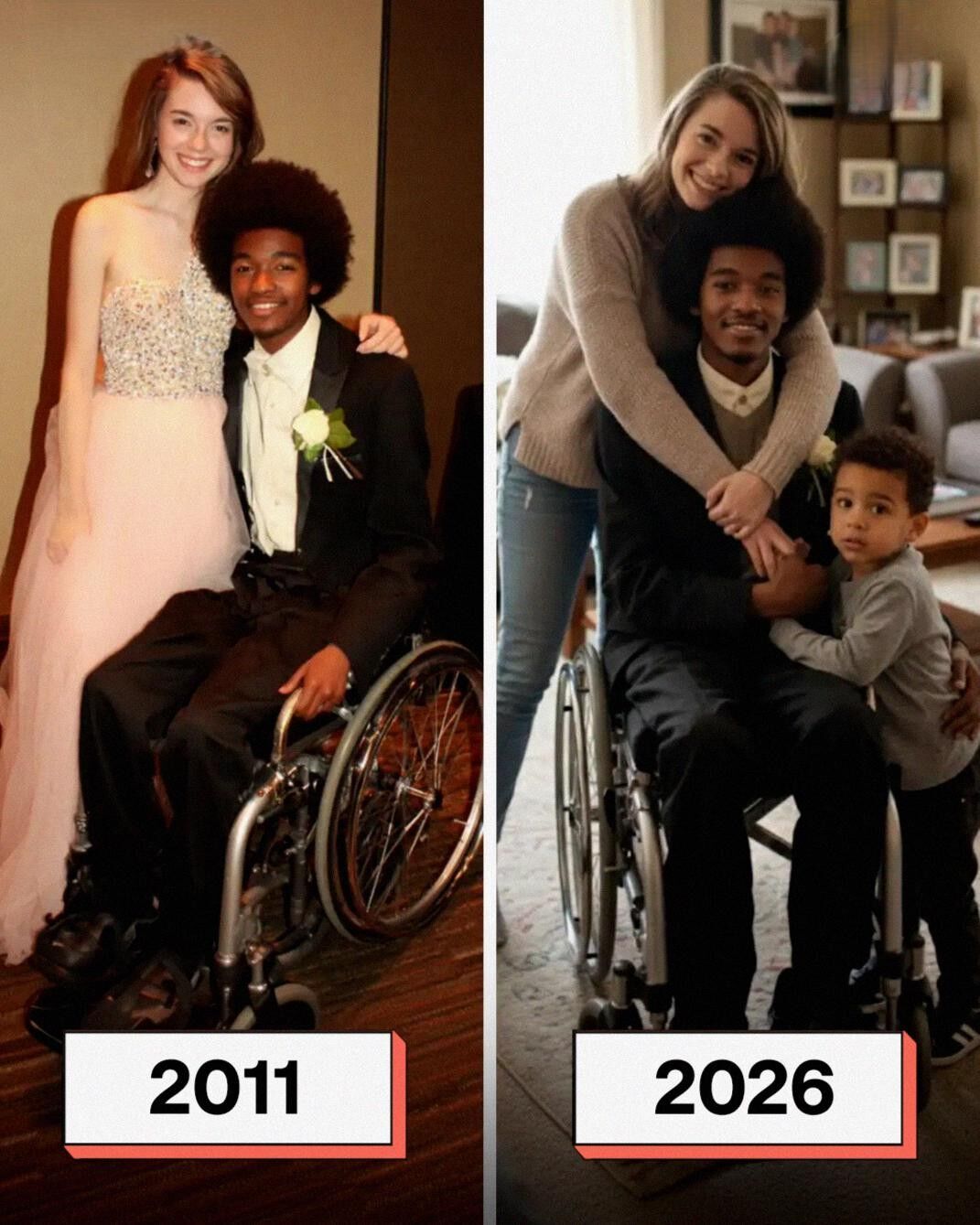
The years that followed were a crash course in survival. I traded my dream school for community college and worked in coffee shops while spending my nights learning skills no teenager should have to learn—how to transfer a grown man from bed to chair, how to care for his catheter, and how to battle insurance companies that saw my husband as a liability. We built a life from sheer determination and moments of stolen joy. We danced at prom with me standing between his knees; we married in a backyard with a Costco cake and no one from my family in the folding chairs.
For fifteen years, I convinced myself our love was the ultimate “against all odds” story. Mark earned a degree in IT and worked remotely, becoming the steady, calm center of our home. We had a son—a beautiful boy who became our world. I sent a birth announcement to my parents’ office, but the silence that followed was confirmation of my exile. I didn’t regret it. Every time I looked at Mark, I saw the man I had given up everything for—the innocent victim of a snowy night and a patch of black ice.
Then, one Tuesday afternoon, when I should have been living a normal day, I came home early to surprise him. I opened the door and heard a voice that made my skin prickle. It was my mother. I hadn’t heard her voice in fifteen years, but my body recognized the authority in it.
I walked into the kitchen to find her standing over Mark. Her face was flushed, holding a stack of papers, while Mark sat in his wheelchair, looking like he was about to face a firing squad.
“How could you do this to her?” she screamed at him. “How could you lie to my daughter for fifteen years?”
“Mom?” I whispered.
She turned to me, and for a moment, I saw a flicker of the woman who used to tuck me in at night. But then the armor returned. “Sit down,” she said. “You need to see who you really sacrificed your life for.”
She dropped the papers on the table. They were emails, old call logs, and a police report from the night of the accident—documents she had tracked down with the relentless precision only my mother possessed. I flipped through them, my heart pounding. The date and time matched, but the location of the accident was nowhere near his grandparents’ house.
I saw the name Jenna—my best friend from high school. There were messages from that afternoon. “Can’t stay long,” Mark had written. “Got to get back before she suspects.” Jenna’s reply: “Drive safe. Love you.”
The room felt suffocating. Mark wasn’t driving home from his grandparents that night. He was coming back from a secret meeting with my best friend. He hadn’t crashed because he was being a dutiful grandson; he had crashed because he was a cheater.
“Tell me she’s lying,” I demanded.
Mark didn’t look at the papers. He stared at the floor. “I was young and selfish,” he whispered, voice cracking. “It was only for a few months. I thought I loved you both. I panicked in the hospital. I knew if you thought I was the innocent victim, you’d stay. If you knew the truth… I knew you’d leave.”
“So you let me destroy my life for a version of you that wasn’t real,” I said, the weight of fifteen years of sacrifice—the lost education, the poverty, the distance from my family—suddenly pressing down on me like a mountain of lead.
My mother explained that she had recently run into Jenna. Jenna, now struggling with a series of miscarriages, had confessed everything to her, believing she was being punished for betraying me all those years ago.
I looked at Mark—the man I had lifted into bed, the man whose dignity I had fought for every single day—and realized I didn’t know him at all. He hadn’t just stolen my youth; he had stolen my agency. He had robbed me of the right to make an informed choice.
“I need you to leave,” I said.
“Where am I supposed to go?” he sobbed.
I let out a harsh laugh. “That’s what I had to figure out at seventeen when I chose you. I’m sure you’ll manage.”
I didn’t stay to listen to his apologies. I packed a suitcase for myself and our son. My mother stood in the hallway, silent and crying. In that moment, we were both losers in a game we’d been playing for far too long. I took my son to my parents’ house—his first time there—and watched as they broke down at the sight of their grandson.
The divorce was a slow, painful collision of the life I thought I had and the painful reality I now faced. Mark argued that he had been a “good husband” for fifteen years, but the foundation of our life together had crumbled. Love without truth isn’t love—it’s a prison.
Now, I’m building something new. I have a small apartment and a job that finally allows me to use the skills I had set aside. My relationship with my parents is awkward, fragile, but we’re slowly healing it. I don’t regret my capacity to love deeply, but I regret that I gave that love to someone who wasn’t real. I’ve learned that while choosing love can be beautiful, choosing the truth is the only way to ensure that love doesn’t eventually become your prison.