I used to believe I could spot a lie from a mile away. It was a skill I thought I had honed through observation, intuition, and countless small betrayals in my childhood that had taught me the subtle language of deceit. My mother, Nancy, raised me on straight lines and straight talk—keep your porch clean, your hair brushed, and your secrets buried so deep that no one could ever stumble over them. She believed that clarity and order were the antidotes to chaos, that discipline and honesty could prevent a lifetime of regret. At thirty-eight, I thought I had mastered that philosophy completely. I was a mother of two bright, inquisitive children who relied on my guidance, a wife to a charming man whose laughter filled the corners of our home, and the unofficial commander of our block’s neighborhood watch spreadsheet, keeping tabs on the comings and goings of everyone within a three-block radius. My biggest weekly dilemma was whether tulips or daffodils would look better by the mailbox, and whether my new recipe would impress the PTA at the next school fundraiser. My life felt orderly, predictable, and safe. That illusion shattered the morning Mr. Whitmore died, and with him went every certainty I had about who I was—or who I thought I had been.
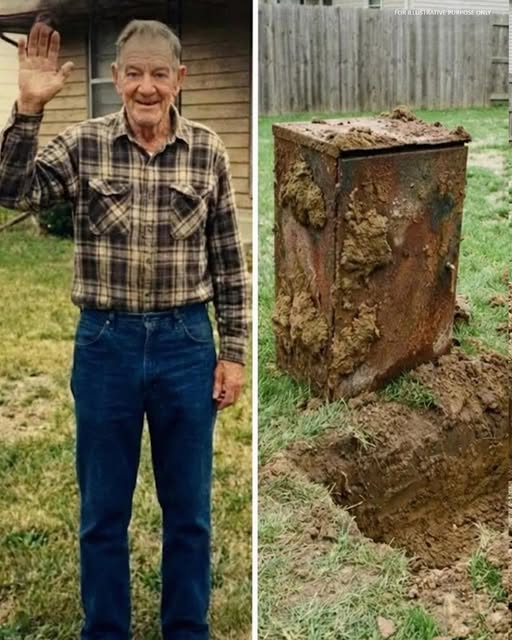
The day after his funeral, I found a thick envelope in my mailbox with my name written in looping blue ink, the kind that hinted at care, patience, and a hidden gentleness. Inside was a short, carefully penned letter telling me that something had been buried for forty years beneath his old apple tree—something I had a right to know. Against my husband Richie’s cautious concerns and unspoken fear, I went alone the next morning, a mixture of curiosity and dread knotting my stomach. The soil gave easily under my shovel, as if it, too, had been waiting for this moment. And soon, there it was: a rusted metal box, the kind that had endured decades of rain, frost, and decay but still held its precious secret. Inside, I discovered a photograph of a man holding a newborn under harsh hospital lights, a hospital bracelet with my birth name printed on it, and a letter, yellowed and folded with age, beginning with words that shattered me utterly: My darling Tanya… You are my daughter.
All my assumptions about abandonment, about why my life had felt incomplete in inexplicable ways, crumbled. He had not abandoned me. He had been forced away. My mother, young, frightened, and pressured by her own family, had chosen security over him, compliance over truth. She had buried her own desire in order to preserve a life that could be counted as safe, respectable, and socially acceptable. And he had moved in next door just to watch me grow, close enough to see my milestones, far enough not to disrupt the carefully constructed life she built around us. The revelation was at once heart-wrenching and clarifying. When I confronted my mother, the armor of composure she had worn for decades finally slipped. Her hands trembled; her eyes glistened. She said she thought she was protecting me. I told her quietly, firmly, that she had been protecting herself. The words hung in the space between us—sharp, fragile, irreversible. And in that instant, our family’s entire hidden history, long buried beneath polite smiles and unspoken rules, was brought into the open.
In the days that followed, apologies were offered and whispered conversations unfolded behind closed doors, but something fundamental had shifted. The truth demanded recognition, even if it could not erase the past. I brought apple blossoms to his grave, each petal a fragile offering for the years we had lost and the moments we could never reclaim. Grief did not disappear with the revelation of the truth; it reshaped itself, morphing into a complex mixture of sorrow, understanding, and a newfound closeness that had been denied for decades. I had lost a father twice—once in ignorance, once in knowing—and the weight of that loss settled in my chest with a permanence I could not ignore. As for my mother, forgiveness does not arrive on command, and trust is not rebuilt overnight, no matter how much love or remorse is offered. Yet, the secret is no longer buried, and for the first time in my life, I know exactly where I come from, who my father was, and why my story unfolded the way it did. No one will ever have the power to hide that from me again. I can carry the truth with me, and in doing so, I can finally reconcile the past with the present, walking forward with both clarity and the quiet strength of someone who has survived the most intimate kind of betrayal and emerged whole.