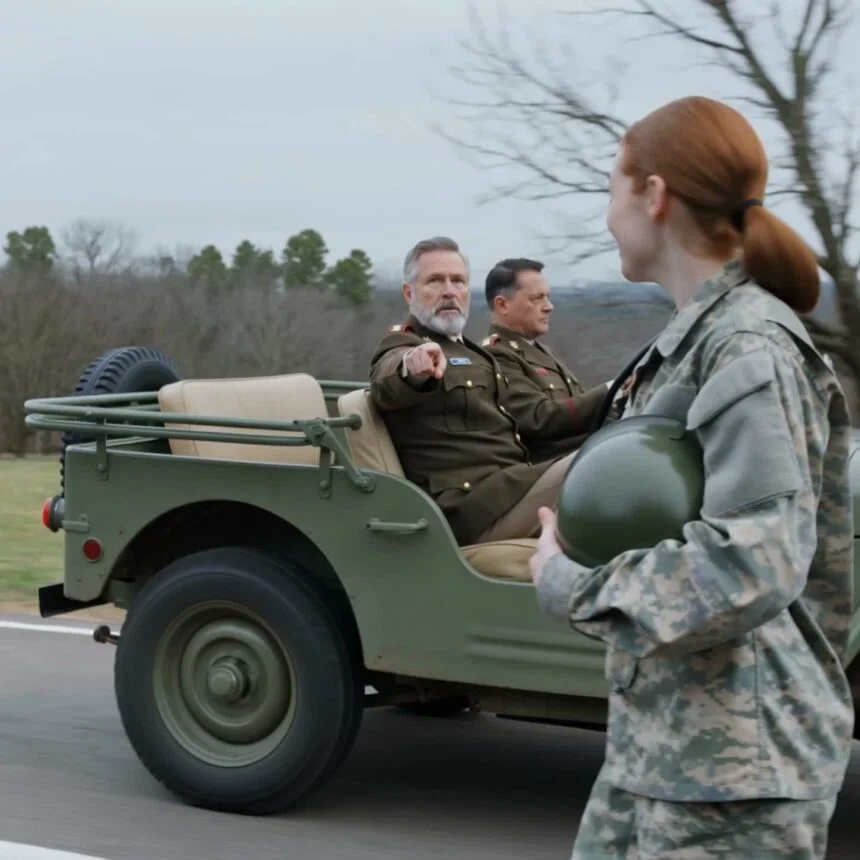
The Authority She Never Had to Prove
“Why aren’t you saluting me?” Lieutenant Colonel Richard Brennan barked across the parade ground. Major Sarah Thompson stopped, slowly pulling out her Strategic Command badge. “Colonel, we hold equivalent rank. Protocol doesn’t require majors to salute lieutenant colonels,” she said calmly. The soldiers froze—witnesses to a moment that would redefine Fort Harrison.
The Woman They Underestimated
Sarah grew up in military housing, the only daughter among five children. Her father, an Army mechanic, and her mother, a nurse at Walter Reed, taught her resilience. By twelve, she could field-strip an M16; by fifteen, she outran and outperformed her brothers. Rejected by West Point over a minor timing issue, she enlisted at eighteen, excelled in basic training, deployed to Afghanistan clearing IEDs, and earned a commission after Officer Candidate School. She became a master strategist, published widely, and by thirty-three was a respected Major in Strategic Command.
Her new assignment: Fort Harrison, a base plagued by toxic leadership under Brennan, whose intimidation and subtle sexism had silenced complaints for years.
The Confrontation
Within an hour of arrival, Sarah’s first interaction with Brennan exposed his behavior. He challenged her authority aggressively; she calmly documented every word, revealed her Strategic Command badge, and reminded him that respect flows both ways. The parade ground went silent. Brennan had just proven every complaint against him, publicly, with witnesses.
The Ripple Effect
The story spread across the base. Female soldiers, long marginalized, found validation. Staff Sergeant Gonzalez told Sarah, “We just wanted to be evaluated on actual performance.” Over weeks, Sarah listened, documented, and held Brennan accountable. He altered his behavior—sometimes performatively, sometimes genuinely.
The Evaluation Report
Three weeks in, Sarah submitted a meticulous report: seventeen instances of gender-based discrimination, public humiliation as leadership, and low morale. She recommended leadership training, a ninety-day improvement plan for Brennan, and mentorship for female soldiers. General Martinez approved.
The Transformation
Leadership workshops began. Brennan confronted his past, realized his faults, and sought Sarah’s guidance. Gradually, Fort Harrison’s culture shifted: public humiliation ended, field assignments matched qualifications, female soldiers were recognized, and morale improved. The base was transforming from fear-based leadership to respect-driven performance.
The Final Test
Three months later, a readiness inspection praised the battalion. Sarah credited Brennan’s commitment but emphasized ongoing accountability. Brennan acknowledged she’d “saved his career” by holding a mirror to his behavior.
Moving Forward
Sarah’s six-month assignment ended with measurable improvements: complaints dropped, retention rose, and morale peaked. She left for her next assignment at Fort Bragg, promoted to Lieutenant Colonel, confident that one person standing firm in competence and dignity could change a system. She had never needed her badge to prove her worth—just courage, consistency, and clarity.