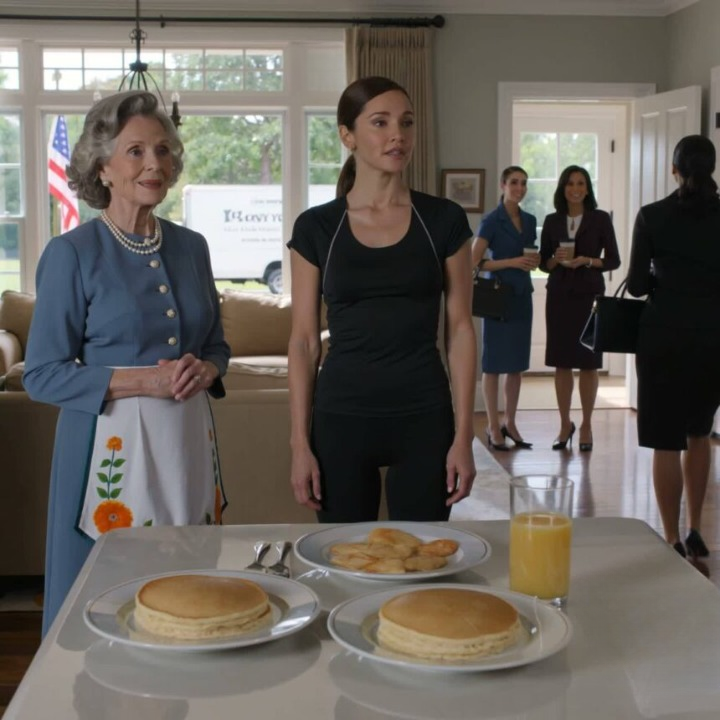
The silence after the driver spoke didn’t settle.
It collapsed.
Whatever warmth had been in the kitchen moments earlier was gone, replaced by something sharp and unfamiliar. The kind of quiet that makes people suddenly aware of their own breathing.
Valerie moved first.
Her heels struck the tile too fast, too uneven, as she crossed to the front door and pulled it open.
“What is this supposed to be?” she demanded.
A man stood outside with a clipboard, calm in a way that didn’t match her panic.
“Delivery and removal order,” he said. “For Mrs. Stella Hayes.”
My name again.
Not softened by family.
Not reshaped by her.
Just mine.
I stepped forward.
No rush. No hesitation.
Just movement that finally belonged to me again.
By the time I reached the kitchen, the room had changed shape. Same furniture. Same people. But the energy had shifted so completely it felt like stepping into a memory of a place that no longer existed.
Valerie stood near the doorway, one hand gripping the frame, the other clutching her phone like it might save her from what she was hearing.
Her friends weren’t laughing anymore.
They were watching her.
Arnold entered behind me and placed the folder on the table.
No performance.
No drama.
Just inevitability.
“This property,” he said, opening it, “is governed by a life estate agreement. Mrs. Hayes retains full legal residency rights for life. No transfer of control. No removal. No restriction.”
Valerie stared at him.
Then at me.
Then at the papers.
“This is Ron’s house,” she said quickly. “He said—”
“No,” I replied quietly. “This is my home.”
The sentence didn’t rise.
It didn’t need to.
Something in it made the room smaller.
Arnold continued, voice steady. “Any attempt to displace or pressure the legal resident would be a violation of the agreement.”
The word violation landed heavier than anything else that morning.
One of Valerie’s friends stood up. “I think I should go.”
Then another followed.
Because laughter doesn’t survive explanation.
The driver cleared his throat at the door. “Where would you like us to begin, ma’am?”
All eyes turned to me.
Not Valerie anymore.
Me.
I looked at her.
Not with anger.
With final clarity.
“Upstairs,” I said. “Master bedroom.”
Valerie flinched.
Not at the words—but at what they meant.
She stepped forward quickly. “Stella, wait. We can fix this.”
I met her eyes.
“We already spoke,” I said. “You just didn’t listen.”
Her mouth opened.
Nothing came out.
And for the first time that morning, she had no audience to perform for.