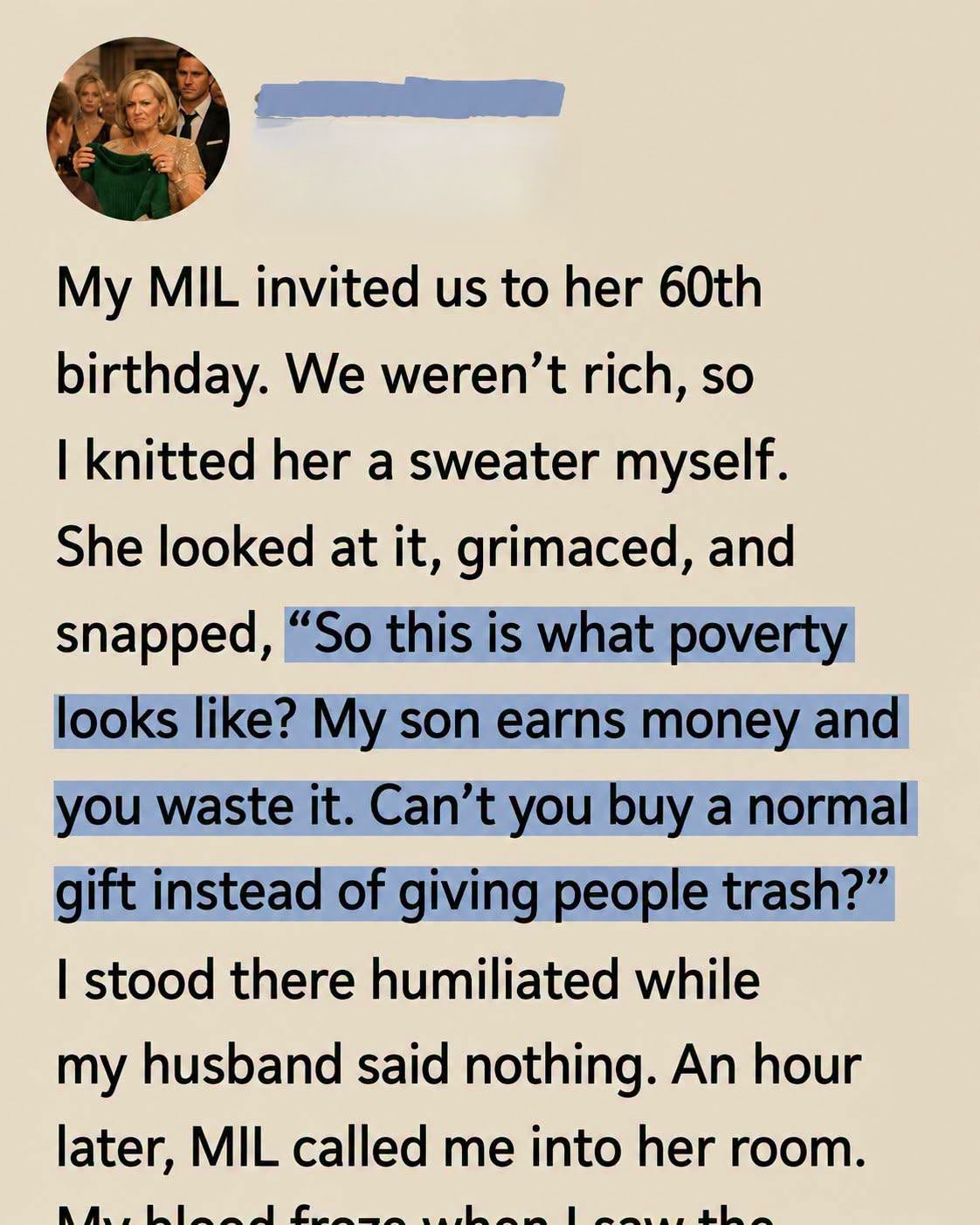
Margaret’s 60th birthday was a lavish celebration, filled with wealthy guests, elegant dresses, and expensive gifts.
My family couldn’t afford that kind of luxury. Most of our money went toward therapy for our eight-year-old son, Liam.
Still, I wanted to give Margaret something meaningful, so I spent weeks knitting her an emerald-green sweater by hand.
When she opened it at the party, she looked disgusted.
“So this is what poverty looks like?” she said loudly. “Can’t you buy a normal gift instead of giving me trash?”
Everyone went silent.
I stood there humiliated, while my husband, Daniel, said nothing.
Later, a housekeeper told me Margaret wanted to see me.
I expected another humiliation.
Instead, I found the sweater carefully hanging in her wardrobe.
Margaret looked at me and quietly said, “I never meant to hurt you. I wanted my son to feel ashamed.”
Then she revealed the truth.
She knew about Liam’s therapy bills—and she had been secretly paying them.
“Daniel refused to take responsibility,” she said. “He said your child was your problem.”
She had insulted me publicly hoping Daniel would finally defend me, become a husband, and become a father.
But he didn’t.
“I failed raising him,” she admitted.
Then she handed me a bank card.
“This is your emergency fund. Use it for Liam and yourself.”
Months later, Daniel and I divorced.
But Margaret stood beside me in court.
And when we walked outside, I noticed she was wearing the sweater I had made her.
She took my hand and said nothing.
In that moment, I realized she wasn’t losing a daughter-in-law.
She was choosing a daughter.