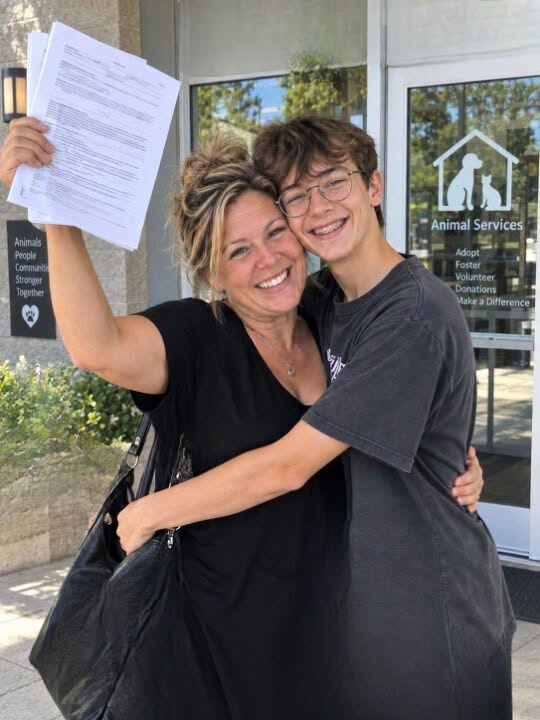
Luke’s fork hit the plate as his hands began to shake.
“Mom, I need to tell you why,” he whispered through tears.
It had been only two weeks since his adoption became official.
At 16, Luke had already lived with ten different foster families. Everyone warned me that adopting a teenager with such a troubled history would end badly.
I was 47 and had spent three lonely years grieving the loss of my husband and my children, Grace and Noah. Their bedrooms remained untouched, and my once-busy house had become painfully quiet.
Then I met Luke.
He wasn’t difficult. He was gentle, polite, and almost afraid to take up space. He remembered that Grace hated raisins, fixed my loose porch step without being asked, and always washed his own dishes.
One morning, he accidentally called me “Mom.”
I smiled and told him, “Have a good day, sweetheart.”
For the first time, the house felt like home again.
But two weeks after the adoption, Luke sat across from me at dinner looking terrified.
“You’re probably going to regret making me your son,” he said.
Then he told me the truth.
Luke had a nine-year-old half-sister named Emma. They had entered foster care together, but when a family wanted to adopt Emma, they refused to take Luke too.
At just 14, Luke let her go because he believed she deserved a safe home.
Afterward, he deliberately pushed away every family that wanted to adopt him.
He was afraid Emma would think he had chosen them over her.
Then Luke showed me a box.
Inside were four years of letters he had written to Emma.
Every one ended with the same sentence:
“I’m still your brother.”
The next morning, I contacted his caseworker. Eventually, we discovered that Emma’s adoptive parents had received Luke’s letters, but communication between the siblings had been restricted.
Four years had passed.
Then came the reunion.
Emma appeared at the top of the stairs holding the worn stuffed rabbit Luke had given her years earlier.
“You said Mr. Buttons would keep me safe until you came back,” she cried.
Then she ran straight into his arms.
The years they had lost couldn’t be recovered, but their relationship slowly returned—through phone calls, birthdays, holidays, and weekends together.
Months later, Emma stood beside Luke as he repaired the same porch step.
Luke called me “Mom,” then looked at Emma with fear in his eyes.
Emma simply smiled.
“Ask your mom if she can help.”
Luke laughed.
And in that moment, he finally understood:
Becoming my son never meant losing his sister. There had always been room in our family for both of them.