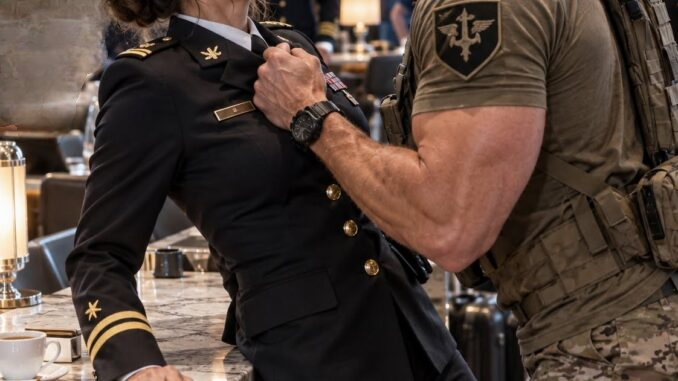
For several seconds after Rear Admiral Thomas Mercer spoke, nobody moved.
Lieutenant Commander Hayes stepped back, his confidence replaced by uncertainty.
Mercer asked if I was injured. I wasn’t.
He then turned to Hayes, who admitted he had wrongly assumed I wasn’t authorized to be there.
“What do you want done?” Mercer asked me.
“I want my coffee replaced.”
Later, on the government transport, Chief Warrant Officer Bell told me Hayes had an excellent record but had requested reassignment three weeks earlier for personal reasons.
When I arrived at Group Seven, I learned Hayes was already one of the issues requiring command attention.
He came to my office and apologized for the airport incident. Then I asked why he wanted to leave.
“My father knew someone named Elena Vance,” he said.
His father was Michael Hayes, who had served with my brother Daniel.
Michael had died eight months earlier, leaving behind a private folder containing his son’s name—and Daniel’s.
Hayes revealed that his father had warned him to leave if Group Seven ever came under the command of someone connected to Task Force Archer.
“He said there were some debts families shouldn’t inherit.”
That night, my sister Rebecca called.
She had found a letter from Daniel addressed to me:
“For Elena, if Michael never tells her.”
The next morning, Hayes brought me his father’s folder.
Inside was a letter from Daniel:
“Tell Elena I chose it. Do not let Dad make you carry what belongs to me.”
Daniel revealed that the mission we believed had destroyed our family was not what we thought. There had been a communications failure, and he had knowingly chosen to stay.
“Don’t inherit Dad’s anger. And don’t let Michael’s son inherit his guilt.”
For seventeen years, I had carried the belief that Daniel’s choices had been taken from him.
They hadn’t.
Daniel had chosen.
Over the following months, Hayes and I rebuilt trust. Group Seven changed too. We encouraged disagreement, improved procedures, and stopped treating mistakes as permanent definitions of character.
Six months later, my mother told me something I had never understood:
“Maybe you can just miss him now.”
For the first time, that didn’t feel like betrayal.
I finally understood.
My father’s anger wasn’t mine.
Michael’s guilt wasn’t Hayes’s.
Daniel’s choices didn’t belong to me.
And Hayes’s mistake that morning didn’t have to define him forever.
Sometimes the greatest inheritance is what we finally decide not to pass on.