My neighbor Vern called me on a Wednesday afternoon while my wife, Ardis, and I were wintering in Mesa, Arizona.
“Gordon,” he said quietly, “there’s a man living in your basement. He told me he pays your son six hundred dollars a month.”
I set down my coffee.
Our son, Brett, was supposed to check our Iowa house while we were away. He could park his truck in our garage and make sure the pipes didn’t freeze. That was our entire agreement.
Now his girlfriend, Jade, had moved in, and her brother Austin was renting our basement—without our permission.
Ardis listened as I explained.
“Six hundred dollars,” she repeated. “For our basement.”
We could have called Brett immediately. But I knew him. On the phone, he would have a story ready before the second ring.
“I want to look him in the face when he explains this,” I said.
The next morning, we began packing.
We left Arizona two months early and drove nearly 1,500 miles back to Iowa. For three days, we crossed deserts, plains, and snow-covered roads. Neither of us said much.
Ardis kept remembering Brett as a little boy—the child who had once hidden a stray dog in our garage because he was afraid I would make him give it away.
I kept wondering how that boy had become a man who could rent out his parents’ home behind their backs.
When we finally reached our street, a black pickup sat outside our house. Our neighbor’s curtains moved as we pulled into the driveway.
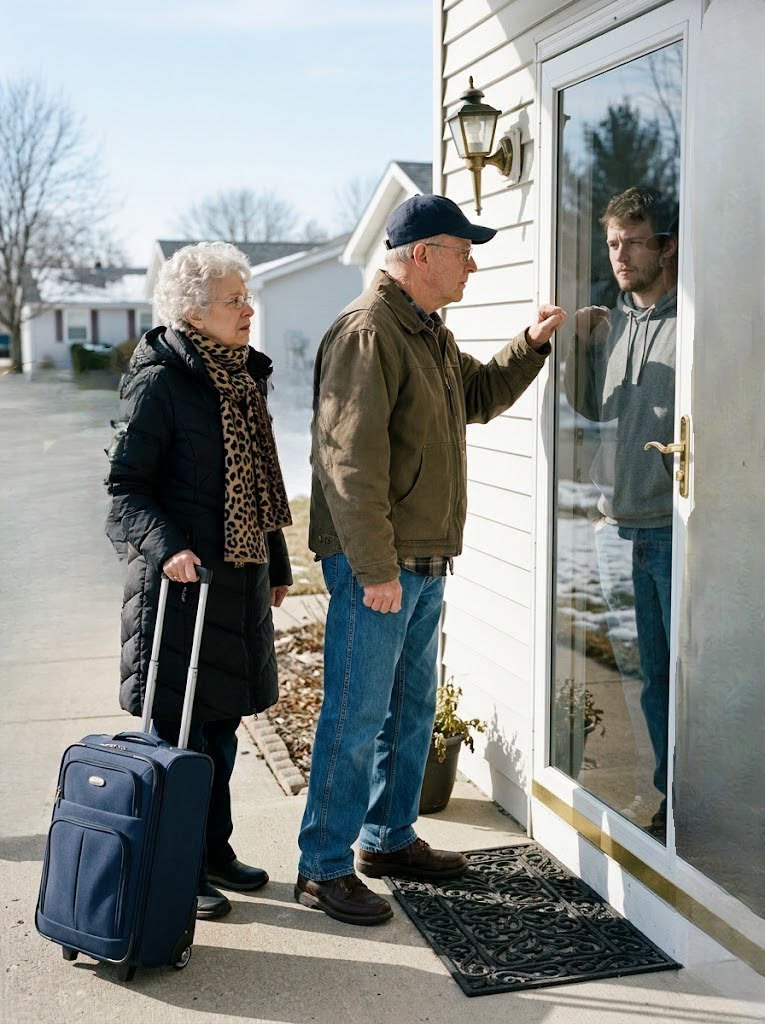
I knocked on my own front door.
A young man answered.
“Can I help you?”
“I’m Gordon Brekke,” I said. “This is my house.”
The color drained from his face.
“No, sir,” he stammered. “Brett told me his parents gave him the house. He said you moved to Arizona permanently.”
His name was Austin Kessler, Jade’s brother. He had paid Brett $600 every month, believing he was renting a legitimate room.
He even showed me a notebook documenting his payments.
“I’m so sorry,” he said. “I can pack tonight.”
“It’s March,” I replied. “And it’s going to be nine degrees tonight. Nobody is going anywhere tonight.”
I believed him. He had been deceived, too.
Inside, the house smelled of unfamiliar cooking. Women’s boots sat by the door, and a new television occupied the living room.
But when Ardis reached the window, she stopped.
Her African violets were alive and blooming. Even her Christmas cactus, which hadn’t flowered in three years, was covered in pink blossoms.
“Who’s been taking care of these?” I asked.
“Brett,” Austin answered. “Every Sunday. He won’t let anybody else touch them.”
Ardis gently touched a leaf.
She didn’t say anything, but I could see how much that small detail meant to her.
Then Jade came home from work. She looked at us and immediately began apologizing.
“Brett said you gave us permission,” she explained. “He told me he called you at Christmas.”
He hadn’t.
She also revealed something else: Brett had lost his job at the cabinet plant in December. He had been working part-time for a feed mill, but he hadn’t told us.
Our son had been hiding much more than an unauthorized tenant.
At five twenty-five, Brett’s blue truck appeared at the end of the street.
He stopped in the middle of the road when he saw our Toyota in the driveway. For two minutes, he sat with his head resting on the steering wheel.
Then he climbed out, walked up the front path, and knocked.
My thirty-six-year-old son stood on the stoop I had built decades earlier, holding his cap in both hands.
“Hi, Mom,” he said.
“Hi, honey,” Ardis replied. “Come in. It’s cold.”
He looked at me.
“Dad, I can explain.”
“I know you can,” I said. “That’s what worries me.”
I took my coat from the chair.
“Put your cap on. We’re going for a drive.”
I drove him to the grain elevator where I had worked for forty years. We parked near the scale house, beneath the tall concrete bins.
I told him about 1985, when the elevator nearly closed and I went six weeks without pay. I had been a young father with a mortgage and no savings. My own father had quietly lent me $400 to make the house payment.
I had been ashamed to ask him for help.
Then I turned to Brett.
“Now you tell me.”
And finally, he did.
The cabinet plant had laid off its entire second shift just before Christmas. Brett had lost his steady income, but he still had a truck payment of $412 a month and $380 in monthly child support for his little girl, Emma.
He had never missed a child-support payment. He was determined not to start.
When his apartment became too expensive, he moved out and began using our empty house. Jade moved in, and when Austin needed somewhere to stay, Brett saw an opportunity.
He charged Austin $600 a month.
He told him the house belonged to him.
“I thought I could make it work for three months,” Brett admitted. “Find a real job, put everything back the way it was, and you’d never even know.”
“Why didn’t you call me?” I asked.
He stared down at his cap.
“Dad, you worked forty years without missing a day. You’ve got a plaque on the wall. How was I supposed to call you in Arizona and say I’m thirty-six, I lost my job, and I can’t make my truck payment?”
I had no immediate answer.
Then he said something that stopped me.
“You never told me you needed help, either. Not about Grandpa. Not for forty years.”
He was right. I had hidden my own struggles because I thought asking for help was a kind of failure.
Somehow, I had taught my son the same lesson.
But that didn’t excuse his lies.
I drove him into the elevator office, where Jeff Ostrander, the manager, was finishing the day’s paperwork.
“Jeff, are you still looking for spring help?” I asked.
“Always,” he said. “Eighteen dollars an hour. Overtime during the busy weeks.”
I stepped aside and let Brett speak for himself.
My son removed his cap and asked for the job. He explained that he had been laid off and was driving part-time for the feed mill.
No excuses. No pretending everything was fine.
Jeff offered him a start date the following Monday.
On the drive home, Brett thanked me.
I reached over and squeezed the back of his neck, the way I had when he was little.
That evening, Ardis made pork chops and scalloped potatoes. We sat around the table with Brett, Jade, and Austin.
Brett apologized to Austin for lying about the house. He promised to repay every dollar Austin had given him.
But Austin shook his head.
“I had a warm room for three months,” he said. “I got what I paid for. You don’t owe me.”
Then he looked at us.
“You owe them.”
A week later, Austin moved into a camper he could rent temporarily while searching for a permanent place. Before leaving, he offered us money for the heat and hot water.
Ardis tried twice to return it. He refused.
“My mom would’ve wanted it that way,” he told her.
Brett and Jade stayed with us until May, when they rented a modest two-bedroom house near the Lutheran church. They paid their own rent, and Brett worked the entire spring season at the elevator.
He arrived fifteen minutes early every morning.
By October, Jeff offered him a full-time position with benefits.
That night, Brett called us.
“Dad, they kept me on. Full time.”
“I heard,” I said. “Jeff told me at the café.”
He laughed.
“Of course he did.”
Then his voice softened.
“Thank you, Dad. For the drive. For standing by the coffee pot. For keeping your mouth shut while I asked for the job.”
“That was the hard part,” I admitted.
“I know. I could tell.”
The following November, Brett appeared at our front door at six in the morning, carrying a duffel bag and a green thermos of coffee.
“Go get your coats,” he said. “I’m driving.”
Our son drove us all the way back to Arizona—nearly 1,500 miles.
Somewhere in Kansas, Ardis leaned forward from the back seat.
“Brett, do you remember Biscuit?”
He laughed so hard he had to slow down.
“Four days in the garage,” he said. “I thought Dad was going to kill me.”
“I knew the whole time,” I told him.
He stared at me in disbelief.
“You knew?”
“The whole time. I was just waiting for you to tell me.”
He was quiet for a mile or two.
“That sounds about right,” he finally said.
When he dropped us at our little park model, he hung Ardis’s cardinal flag on the post and set out our folding chairs.
Then he flew home the next morning.
Every Sunday, he watered his mother’s violets.
And in October, he put her Christmas cactus in the dark closet, just as she always did.
That Christmas, it bloomed again.
Brett sent us a picture.
I still think about the day Vern called. Our son had lied to us, rented out our house, and hidden his unemployment. We had every reason to be angry.
But beneath those mistakes was a man who was ashamed to admit he needed help.
We didn’t pretend his choices were acceptable. We made him face them, apologize, and begin again.
And I learned something I wish I had understood years earlier:
Sometimes, the most important thing a father can give his son isn’t money or a solution. It’s a chance to tell the truth—and the dignity to stand on his own feet again.