The morning I inherited my mother’s condominium, I found a folded note written in her familiar handwriting.
It contained seven words:
Tell your husband you inherited a lot of debt.
At first, I thought grief had made me misread the sentence. I stood in the bright entryway of a beautiful three-bedroom condo, staring at the polished hardwood floors and sunlight spilling across the walls, wondering whether my mother had somehow left the note for someone else.
My mother, Ruth, had never been dramatic.
She had never played games or manipulated people. In all the years I had known her, she had always been practical, thoughtful, and quietly dependable.
So why would she ask me to lie to my husband?
Three hours later, I began to understand.
My name is Claire. I was thirty-four when my mother died, and until that moment, I thought my life was stable. I had a husband I believed I knew, a comfortable apartment in Charlotte, and a job at an architecture firm where I spent my days managing impossible deadlines and solving other people’s problems.
And I had my mother.
Every Sunday evening at seven o’clock, my phone rang. No matter what else was happening, she called.
Before asking about my job, my groceries, or whether Daniel had finally learned the difference between basil and parsley, she always asked the same question.
“What made you laugh this week?”
When I was younger, I thought it was just one of her little rituals. Later, I understood that she was checking the pulse of my life.
She believed laughter was a vital sign.
If I laughed, I was still in there.
If I had nothing to say, she worried.
My mother did everything quietly. She had raised me alone after my father left when I was nine, teaching second grade in public schools for thirty-two years. She made a teacher’s salary stretch across everything we needed and somehow never allowed me to feel poor.
She bought my winter coats a size too big so they would last longer. She made inexpensive meals feel comforting and hand-me-down furniture feel stylish.
Only when I grew older did I understand how much sacrifice that required.
My mother had been sick for nearly two years before she died, though she never told me the full extent of it. She let me help with appointments and sit beside her on difficult afternoons, but she kept the worst of her suffering to herself.
She had spent her whole life carrying her own burdens and trying not to place them on anyone else.
She died peacefully in her sleep.
Five days after the funeral, her attorney, Mr. Hargrove, called and asked me to visit his office to sign some estate documents.
I expected a modest inheritance. Perhaps a small savings account, a few pieces of jewelry, or some bonds she had forgotten to cash.
My mother rented her apartment. She drove an old Honda and wore the same wool coat for fifteen years.
I never imagined she owned anything substantial.
I was wrong.
Mr. Hargrove slid a document across his desk.
I saw an address in Dilworth.
Then I saw the word Deed.
Then I saw my name.
My mother had owned a three-bedroom, two-bathroom condominium on the seventh floor of a well-maintained building near Freedom Park. It had a south-facing balcony, a dedicated parking space, and a storage unit.
It was completely paid off.
No mortgage.
No co-owner.
No debt attached to it.
She had purchased it four years earlier using money inherited from my grandmother. She had rented it to a traveling nurse and later to a professor on sabbatical, allowing the rental income to accumulate in a separate account.
She had planned everything carefully.
“She updated the transfer documents about eighteen months ago,” Mr. Hargrove explained. “The property is titled solely in your name.”
“She never told me,” I whispered.
“No,” he replied gently. “She did not.”
He handed me the keys.
I drove straight to the condominium without calling Daniel. At the time, I told myself I wanted a moment alone before sharing the news.
But the truth was that I wanted the first look to belong only to me.
The building was quiet and elegant, with marble floors, real plants, and sunlight falling across the lobby. When I stepped inside the condo, grief and gratitude collided.
The home was beautiful without being flashy. Warm light pooled across honey-colored floors. The kitchen opened into a spacious living area, and the guest bedroom overlooked the trees surrounding the park.
I walked through every room twice.
Then a third time, with tears in my eyes.
There were two white mugs in a cabinet, neatly folded towels in the linen closet, and an empty bookshelf in the second bedroom.
My mother had been there.
She had stood in those rooms and imagined a future for me that she would never live to see.
I felt loved and wounded at the same time.
Then I noticed an envelope on the console table beside the entrance.
My name was written across the front in my mother’s careful handwriting.
Inside was a short note.
Claire,
This is yours.
Do not put Daniel’s name on the deed.
Do not tell his family what you have.
Tell them, if they ask, that I left a lot of debt.
Let them react.
Trust what you see.
I love you more than any apartment, any deed, any amount of money. But I love you enough to tell you the truth.
Watch carefully, sweetheart.
Watch what people do when they think there is nothing to want from you.
Mom.
I read it twice before sitting down on the small bench near the door.
My mother had not simply left me property.
She had left me a test.
On the drive home, I kept touching the folded note in my pocket. The detail that disturbed me most was her instruction to tell not just my husband, but his entire family.
She expected Daniel to share the news with them.
That meant she knew something I didn’t.
When I arrived at our apartment, Daniel was standing in the kitchen, speaking quietly on the phone.
“No, not yet,” he said.
“Yeah, I know.”
“I’ll talk to her.”
He ended the call as I entered.
“Sorry,” he said. “Work.”
Then he asked, almost immediately, “How did it go with the lawyer?”
I filled a glass with water and kept my voice steady.
“Fine. There wasn’t much. Some savings, a little jewelry, and apparently some debt.”
His expression changed very little.
“Debt?”
“Some kind of credit line. I don’t know the full amount yet.”
He nodded, and sympathy settled across his face with surprising speed.
“That’s rough. We’ll figure it out.”
He kissed my forehead and placed a reassuring hand on my neck.
For years, that gesture had comforted me.
Now, because of my mother’s note, I found myself studying it.
That night, I barely slept.
The following morning, Daniel casually asked whether I had contacted my aunt Diane about the estate.
“She might want to know if the debt situation is significant,” he said.
I turned toward him.
Why was he already thinking about which relatives needed to know about my mother’s supposed debt?
After he left for work, I called Mr. Hargrove.
I asked whether the condominium was entirely in my name and whether anyone else had contacted him.
The first answer was immediate.
“Yes. Sole ownership. Clean transfer.”
The second came after a pause.
“Your husband called yesterday afternoon,” he explained. “He asked some general questions about your mother’s estate. I did not share any substantive details.”
I sat down slowly.
Daniel had contacted the lawyer before I had even returned home from the condo.
My mother’s warning was beginning to make terrible sense.
I needed proof, so I called Patricia, my mother’s closest friend.
At the funeral, Patricia had held my hands and told me, “Your mother told me some things. When you’re ready, call me.”
When I finally did, she invited me to lunch and added one instruction.
“Don’t tell Daniel where you’re going.”
At Patricia’s kitchen table, she placed a manila folder in front of me.
Inside were property records, notes in my mother’s handwriting, legal information, and printed emails.
Patricia explained that my mother had become worried about Daniel’s family months earlier. She had overheard a conversation about her finances and what might happen to her assets after her death.
Daniel hadn’t shut the conversation down.
He had answered their questions.
Later, my mother discovered that a shared family email account was still open on the computer in my apartment. She found messages between Daniel and his mother, Sandra.
I opened the first printed email.
Sandra had written that she believed Ruth owned something valuable and wanted Daniel to find out what it was before it became locked into an estate controlled by me.
Then I read Daniel’s reply.
He had discussed the situation with his brother Robert, who believed there might be ways to gain influence over the inheritance if I added Daniel to the property or moved the assets into joint arrangements before receiving independent legal advice.
Daniel had written:
Please don’t push too hard until we know what there is. If Claire gets suspicious, it complicates things.
I read the message twice.
My mother had been sick. I had been worrying about appointments, hospital visits, and the time we had left together.
Meanwhile, my husband and his family had been discussing what might happen to my inheritance.
Patricia showed me more of my mother’s notes. She had documented suspicious questions, researched how inherited property could be protected, and carefully arranged for the condominium to transfer directly into my name.
One line stood out:
Must warn Claire only after transfer secure.
My mother had not simply suspected a problem.
She had planned around it.
She had quietly built a barrier around me while she was dying.
That evening, Daniel suggested meeting with someone who understood estate matters.
“Maybe Robert,” he said. “He’s done a lot with property and family transfers.”
I remembered the emails.
“That’s thoughtful,” I replied, “but Mr. Hargrove recommended that I speak to an estate attorney before involving anyone else.”
For the first time, I saw a flicker of recalculation cross Daniel’s face.
The next day, Robert called me himself. He offered to help with the estate, mentioning possible debts, liens, and title complications.
Then he invited me to Sunday lunch at his mother’s house.
Sandra wanted to talk things through.
I agreed.
But before Sunday arrived, I spoke with Mr. Hargrove again. His advice was clear: do not sign anything, do not add anyone to the deed, and do not combine inherited assets with joint accounts.
My mother had protected the property carefully.
I needed to protect myself just as carefully.
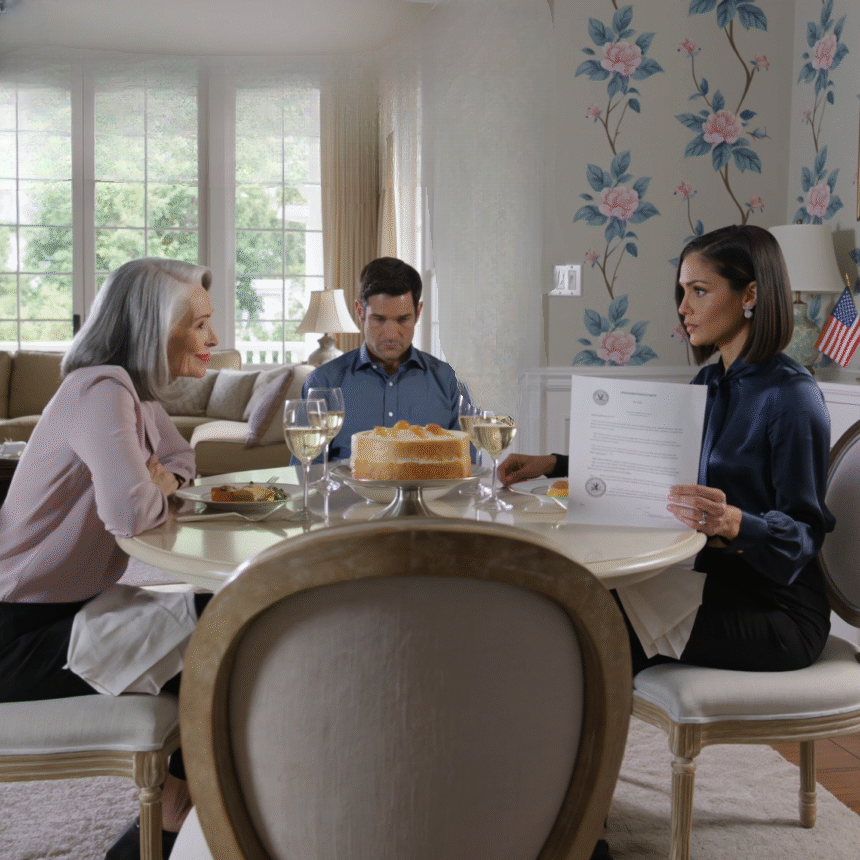
On Sunday morning, I put on a navy blouse and dark trousers. Then, on impulse, I wore my mother’s pearl earrings.
When Daniel and I arrived, Sandra greeted me with an embrace and asked how I was holding up.
Robert was already at the dining table.
So was Marcus Trent, Daniel’s cousin, who worked as a notary.
I immediately understood that this was not an ordinary family lunch.
Why would a notary be there?
Why had Robert invited me so insistently?
And why did Daniel keep checking his phone?
Lunch proceeded with polite conversation. Sandra asked about my work. Robert discussed the housing market. Marcus spoke about his nephew’s baseball team.
But I watched the glances passing between them.
After the plates were cleared and Sandra brought out lemon cake, she folded her hands on the table.
“Claire, sweetheart, we’re worried about you,” she said. “Losing your mother is enough. On top of that, this debt situation is too much to navigate alone.”
I said nothing.
Robert reached beside his chair and pulled out a leather folder.
He placed a document in front of me.
“Nothing dramatic,” he explained. “Just a practical temporary arrangement. Joint management until everything is sorted. It keeps decisions streamlined and protects the marriage from financial confusion.”
I looked down.
The document proposed joint oversight and management of assets, properties, and proceeds inherited from my mother’s estate.
Daniel’s name was already typed into the appropriate spaces.
Yellow tabs marked the places where signatures were required.
At the bottom was a space for notarization.
Marcus was there to witness it.
They had prepared the paperwork before they even knew what my mother had left me.
Sandra smiled.
“Marcus can notarize it right here. Then you won’t have to deal with lawyers dragging things out and charging fees. Family should make hard things easier, don’t you think?”
I set the document down.
The room became very quiet.
“When was this prepared?” I asked.
“Just this week,” Robert answered quickly.
I looked at Daniel.
He wouldn’t meet my eyes.
Then I looked at Sandra, who was waiting for me to play the role she had assigned me: grieving, confused, and grateful for their help.
I folded my hands on the table, just as my mother used to do when she wanted to remain calm.
“Can I be honest with all of you?” I asked.
Sandra smiled. “Always.”
“I know about the emails.”
Her expression shifted.
“I know about the messages between you and Daniel discussing my mother’s possible assets. I know Robert advised that Daniel should be added before I received independent legal advice. I know Marcus was consulted in advance.
“And I know this lunch was never about concern.”
Nobody spoke.
I continued.
“My mother did not leave me debt. She left me a fully paid-off condominium in Dilworth. It is in my name alone. I’ve already spoken to an estate attorney, and I’ll be meeting with a family lawyer tomorrow morning.
“I’m not signing anything today.”
Daniel pushed his chair back so abruptly that it scraped across the floor.
He stood, turned toward the door, and walked out.
Robert gathered the folder with angry movements. Marcus soon followed.
Within minutes, they were gone.
Only Sandra and I remained at the table.
The lemon cake sat untouched between us.
At last, Sandra spoke.
“Your mother was an interfering woman.”
I stood and picked up my bag.
“No,” I replied. “My mother was the smartest person I’ve ever known. She loved me enough to protect me from this table.”
Then I walked out.
That evening, Daniel returned to our apartment looking exhausted. He apologized for calling the lawyer, for not confronting his mother, and for allowing the situation to go too far.
I listened until he finished.
Then I asked the question I had been afraid to ask.
“Did you marry me because you loved me? Or because you thought one day there might be something worth managing?”
He answered immediately.
“I married you because I loved you.”
I believed that he had loved me when we married.
But when I asked whether he had known about my mother’s possible money later in our marriage, he looked away.
That silence hurt more than any excuse could.
He wasn’t necessarily a mastermind. He was a man who had allowed greed and family pressure to grow around him while telling himself that his silence meant he wasn’t responsible.
I asked him to stay somewhere else while I decided what to do.
The next morning, Mr. Hargrove confirmed that the property was legally protected as my separate inheritance. Then I met with Katherine Marsh, a family attorney recommended by Patricia.
She reviewed the emails, the proposed agreement, and my mother’s notes.
“This matters,” she told me. “The document was prepared in advance. They chose a family lunch, brought a notary, and presented it while you were grieving. That suggests planning, not spontaneity.”
I told her I wanted my property protected and everything documented.
“That,” she said, “is achievable.”
I changed the locks on the condo and began writing down the entire timeline, from the moment I received the keys to the moment Robert placed that folder in front of me.
My mother had always believed that when something mattered, you wrote it down before someone else could rewrite the story.
Over the following days, Katherine sent formal letters to Sandra, Robert, and Marcus. The letters created a record of what had happened and demanded that no further documents concerning my inheritance be presented without legal counsel.
Sandra called, furious that I had responded so firmly.
She accused me of being emotional and causing unnecessary damage.
I reminded her that she had brought a notary to a family lunch with documents designed to give Daniel control over property that belonged to me alone.
“I have the emails. I have the document. I have witnesses,” I told her. “This is not damage, Sandra. This is a boundary.”
Then I made my position clear.
“Whatever happens with my marriage, your access to my finances is over. That is not a negotiation.”
It was the first time I had ever spoken to her without worrying about keeping the peace.
And it felt right.
Daniel later came to the condo, where he finally told me more about what had happened. His mother had started asking questions about my mother’s finances. Robert encouraged the idea that it was sensible to protect the family’s future. Daniel first dismissed the conversations, then tolerated them, and eventually participated.
He kept telling himself it was hypothetical.
He told himself that marriage meant shared futures.
He told himself that if he wasn’t the one pushing the plan, he wasn’t really responsible.
But when I asked when he had known it was wrong, he finally gave me an honest answer.
“I always knew,” he said. “I just kept refusing to say the words clearly.”
That answer hurt because it left no room for misunderstanding.
I didn’t know whether our marriage could survive what he had revealed. We began therapy separately, not as a promise of reconciliation, but as a way to face the truth without hiding behind excuses.
Weeks passed, and then months.
Some things became easier to understand. Others became impossible to ignore.
Through it all, I kept returning to my mother’s note.
Watch what people do when they think there is nothing to want from you.
She had understood something I had spent years refusing to see: kindness means little when it disappears the moment someone thinks there is nothing to gain.
My mother had lived quietly, saved carefully, and protected me without ever asking for recognition.
They had mistaken her modest life for a simple one.
They had mistaken her silence for ignorance.
And they had mistaken my grief for weakness.
They were wrong about all three.
The condominium was never just a property. It was the final thing my mother gave me: a home, a financial foundation, and the chance to see the people around me clearly.
I still miss her every Sunday at seven o’clock.
I still wish I could answer her question and tell her what made me laugh that week.
But now I understand why she asked it.
She wanted to know whether I was still myself, whether life was still giving me reasons to feel alive, whether I could still recognize the difference between a life that looked good and one that truly was good.
My mother could not be there to guide me through the consequences of what she had uncovered.
But she had left me the truth, written in her own hand.
And sometimes, the most loving thing a person can leave behind is not an answer.
It is the warning that finally helps you ask the right questions.