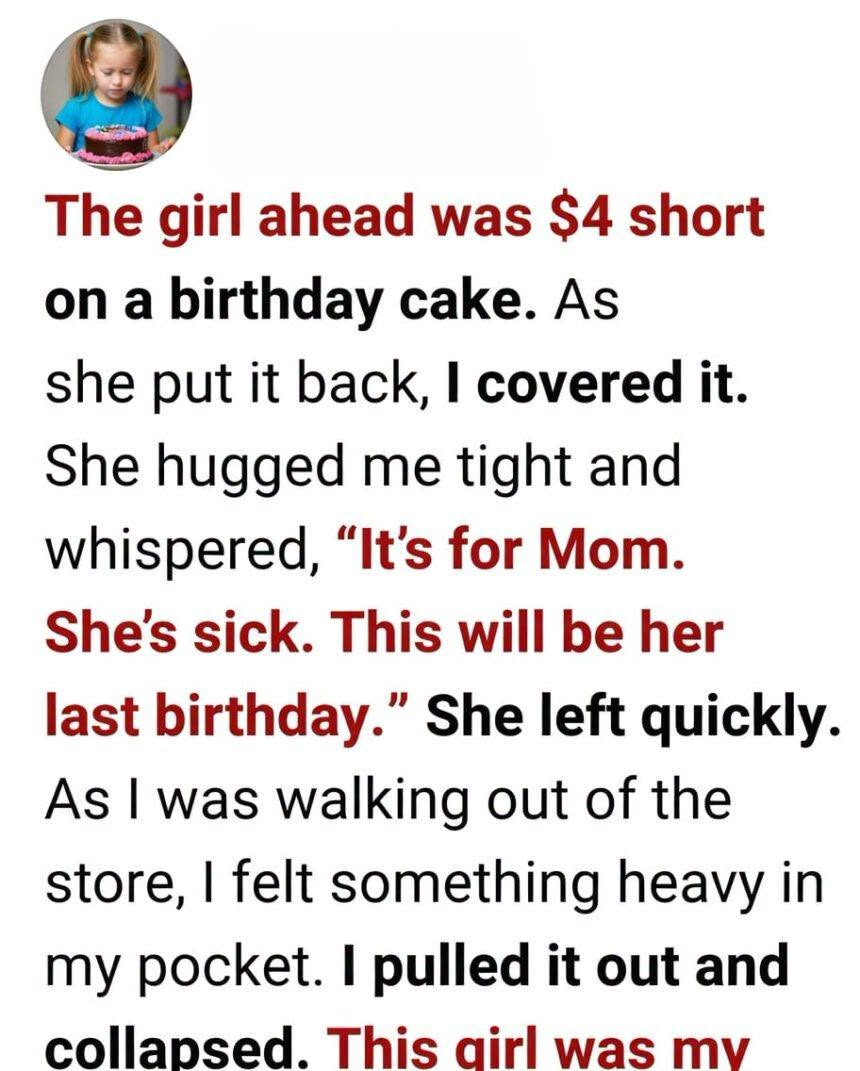
I still remember the way she hesitated at the checkout counter.
The girl couldn’t have been more than ten years old. She held a small chocolate birthday cake in both hands, its frosting uneven and decorated with bright plastic flowers. Her fingers trembled as she counted her coins and crumpled bills.
Finally, she admitted in a barely audible voice that she was four dollars short.
The cashier shook her head gently. The little girl stared at the cake as if holding it tightly enough might somehow make it hers.
I couldn’t stand there and watch her disappointment.
I stepped forward and offered to pay the difference.
“Yeah. Birthdays matter,” I told her.
Her reaction broke my heart.
She hugged the cake, then suddenly hugged me, too, as if the world were fragile and she desperately needed something to hold on to.
Through her tears, she whispered, “It’s for my mom. She’s sick. This will be her last birthday.”
I froze.
Before I could ask anything else, she pulled away, wiped her eyes, and hurried out of the store with the cake in her arms.
I paid for my things and slowly followed her, unable to shake the encounter from my mind.
Then, halfway to my car, I felt something shift inside my coat pocket.
Confused, I reached inside and pulled out a small vintage watch.
It was my mother’s watch—the one I hadn’t seen in sixteen years.
Beneath it was an old photograph of a woman and a little girl standing outside a yellow house. The picture was worn and creased, as though it had been carried for years.
I turned it over.
On the back, in my mother’s unmistakable handwriting, were four heartbreaking words:
“Find her. Forgive her.”
Sixteen years of silence, distance, and pride came crashing down around me.
I looked frantically across the parking lot.
And there she was.
The little girl stood waiting, still clutching the birthday cake.
“Hey! Wait!” I called, holding up the watch.
Her eyes filled with tears.
“I was hoping it was you,” she whispered.
Then she showed me the notes she had kept and told me about the Saturdays she had spent watching and waiting for me to appear. Her mother had given her instructions to find me, and she had held on to that hope for a long time.
Suddenly, the strange encounter at the checkout counter took on a meaning I could never have imagined.
The four dollars she had been short wasn’t simply an unfortunate coincidence. It had become a bridge between the family I thought I had lost and a past I had spent sixteen years avoiding.
That evening, we went together to my mother’s house.
As I entered her bedroom, time seemed to slow. There she was, frail and tired, looking so much older than I remembered.
But when she saw me, she smiled.
“I forgave you a long time ago,” she whispered.
Those words broke through the walls I had spent years building around my heart.
I crossed the room and embraced her, tears streaming down my face. For sixteen years, I had carried distance and regret. Now, at last, I was home.
We celebrated her birthday quietly. There were no grand decorations or elaborate plans—just three people sharing a precious moment that none of us knew how much time we had left to hold on to.
And when the night grew still, my mother slipped away peacefully.
I was heartbroken, but I was grateful that I had made it back in time to see her, hold her, and hear her forgiveness.
Afterward, I looked at Lily, the little girl who had unknowingly brought me back to my family.
She was my sister.
She was also my connection to the part of my life I had feared was gone forever.
I made myself a promise that night.
I would never hesitate to show up for her. I had already lost sixteen years, and I wasn’t going to let pride, silence, or fear take away any more time.
Sometimes, life brings people back to us in the most unexpected ways. Sometimes, the smallest act of kindness opens a door we thought had been closed forever.
And sometimes, all it takes is a little girl, a birthday cake, and four missing dollars to give a broken family a second chance.