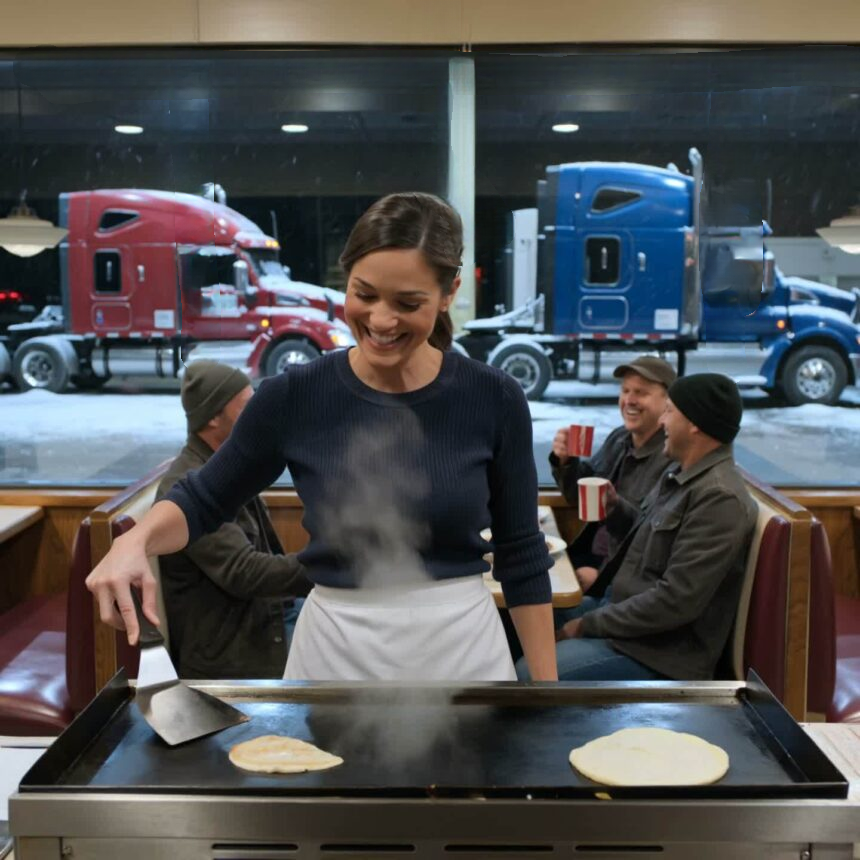
The first pale light of dawn crept through the windows of Rosie’s Diner as Jenny Miller unlocked the front door and began another day in what had become the most meaningful routine of her life.
At twenty-nine, Jenny had been opening the diner at 5:30 a.m. for five years. The familiar restaurant, with its red vinyl booths, chrome fixtures, and black-and-white checkered floor, was more than just a place to work. It was where she had built a life of her own after growing up in foster care.
Every morning, Jenny prepared the coffee, heated the grill, and greeted the regular customers who came through the door. But one quiet little boy would soon become the most important part of her daily routine.
He always arrived early, took the same corner booth, and ordered nothing more than a glass of water.
He was polite, reserved, and usually buried in the pages of the same old book. His clothes were clean but worn, and Jenny couldn’t help noticing how carefully he rationed his water and how slowly he ate whenever food was available.
One morning, she made a decision.
She prepared a plate of golden pancakes, carried it to his table, and smiled.
“Oh, I’m so sorry,” she said. “The kitchen accidentally made too many pancakes this morning. They’ll just go to waste if someone doesn’t eat them. Would you mind helping me out?”
The boy looked up in surprise.
“I… are you sure?” he asked quietly.
“Absolutely,” Jenny replied. “You’d be doing me a favor.”
He accepted the pancakes and began eating slowly, savoring every bite as though the meal were something precious.
When Jenny returned to clear the table, the plate was completely empty.
“Thank you,” the boy whispered.
“You’re very welcome,” she replied.
The next morning, Jenny made extra pancakes again.
Soon, an unspoken understanding developed between them. She would pretend the kitchen had made too much food, and he would accept it without asking questions. Before leaving, he always placed his carefully calculated dollar on the table.
Jenny never demanded an explanation. She simply wanted to make sure he had something to eat.
Her coworker Rita eventually noticed the pattern.
“You’re feeding that kid every morning,” she said. “You know you’re getting attached, right? They always move on eventually.”
“Maybe,” Jenny answered quietly. “But I remember what it felt like to be hungry too.”
As the weeks passed, Jenny began bringing him books as well. When she noticed he had read the same one repeatedly, she borrowed a new novel from the library and placed it beside his pancakes.
“For me?” he asked, his eyes widening.
“If you’d like it,” Jenny said. “You can keep it as long as you want.”
For the first time, his face lit up with unmistakable joy.
Jenny didn’t know his name, where he lived, or what had brought him to the diner every morning. She only knew that he needed help, and she could provide it.
Then, just before December, the boy disappeared.
Thanksgiving passed, and he never returned. Friday became Saturday, and Saturday became Sunday. Days turned into weeks, but his corner booth remained empty.
Jenny worried constantly. She had no name or address to give authorities, and she couldn’t stop wondering whether the boy was safe.
Still, she continued preparing extra pancakes every morning, hoping he might walk through the door again.
Instead, someone photographed her serving an empty booth and posted the images online, mocking her for supposedly feeding an imaginary customer.
The cruel comments spread throughout the small town.
“Maybe she should focus on real customers.”
“Free pancakes for invisible children!”
Jenny was devastated. Her simple act of kindness had become a joke to people who knew nothing about the child she was trying to help.
One evening, feeling defeated, she opened a wooden box containing her late father’s military journal. Staff Sergeant Michael Miller had spent years serving his country, and his words had guided Jenny through many difficult moments.
As she turned the pages, she found a passage she had read countless times:
“Shared bread is never wasted, even when the hungry have moved on. The act of giving changes the giver as much as the receiver, and a heart that stays open to need will never truly be empty.”
Jenny closed the journal and made her decision.
She would keep making the pancakes.
Not because she was certain the boy would return, but because kindness mattered—even when nobody understood it.
Then, on December 19, at exactly 9:17 a.m., everything changed.
Four black SUVs pulled up outside Rosie’s Diner in perfect formation.
The restaurant fell silent as uniformed military personnel stepped out of the vehicles. A high-ranking officer walked toward the entrance and entered the diner with an unmistakable air of authority.
Jenny was refilling coffee cups when he approached her.
“I’m looking for Jenny Miller,” he said.
“That’s me,” she answered nervously.
“My name is Colonel James Morrison. I’d like to speak with you privately.”
Jenny’s heart began to race. Had she done something wrong? Why would the military come looking for her?
In the small office behind the kitchen, the colonel finally explained.
“Miss Miller, I need to tell you about a boy named David Chen.”
Jenny froze.
The boy.
“David is the son of Master Sergeant Angela Chen, one of our intelligence officers,” the colonel continued. “His mother has been deployed overseas for the past eight months.”
David had been living with his seventy-three-year-old grandmother, Rose Chen, while his mother served abroad. But nine weeks earlier, Rose had suffered a massive stroke and been hospitalized.
David had entered emergency foster care while officials worked to arrange his mother’s return. The process had taken longer than expected because of the classified nature of her assignment.
Suddenly, Jenny understood why he had disappeared.
“David told us about this diner,” Colonel Morrison explained. “He told us about a waitress who brought him pancakes every morning when he had nowhere else to go.”
Jenny’s eyes filled with tears.
“When his grandmother was hospitalized, he was frightened and alone. He came here because it was somewhere safe. You made sure he had something to eat without making him feel ashamed.”
The colonel paused before delivering the words that Jenny would never forget.
“You were helping the son of a soldier who was serving her country. While his mother was overseas protecting others, you were looking after her child.”
Jenny covered her mouth, overwhelmed by emotion.
“His mother returned from deployment yesterday,” the colonel continued. “She and David are outside. David specifically asked to see you.”
Jenny rose from her chair, barely able to contain her emotions.
When she stepped outside, she saw a woman in military dress uniform standing beside one of the SUVs. Master Sergeant Angela Chen looked exhausted but relieved.
And beside her stood David.
He looked healthier, his clothes fit properly, and his eyes were bright again.
The moment he saw Jenny, he ran toward her.
“Miss Jenny!”
She knelt down just as he threw his arms around her neck.
“I missed you so much,” he whispered. “I missed the pancakes, but I missed you more.”
Jenny hugged him tightly, tears streaming down her face.
“I missed you too, sweetheart. I made pancakes every single day, just in case you came back.”
David pulled away, astonished.
“Every single day?”
“Every single day,” she answered.
Master Sergeant Chen approached, tears running down her cheeks.
“I don’t know how to thank you,” she said. “When I was thousands of miles away, I worried every day about whether my son was safe. You took care of him when I couldn’t.”
Jenny shook her head.
“I just did what felt right.”
“No,” Angela replied firmly. “You did something extraordinary. You fed him, gave him books, and made him feel that someone cared whether he was okay.”
Then Angela shared another piece of news.
David’s grandmother was recovering, and Angela had been assigned to a position in the United States so she could stay close to her son and help care for her mother-in-law.
The family had rented a house just a few blocks from the diner.
“David specifically asked to live somewhere close,” Angela said with a smile. “He wants to keep having breakfast with you, if that’s okay.”
Jenny looked at David, whose face was glowing.
“I think we can arrange that,” she said.
By that evening, Jenny’s story had spread far beyond Millbrook. The same people who had mocked her now watched as local and national news outlets celebrated the waitress who had quietly helped a child in need.
Donations poured into Rosie’s Diner. Veterans’ organizations reached out, and the struggling restaurant began to thrive.
But Jenny cared most about one thing: David was safe, his mother was home, and their family had a chance to rebuild.
In the months that followed, David returned to the diner every morning. Sometimes his mother joined him before school, and Jenny became a close friend of the family.
One morning, Angela told Jenny something David had said about those difficult days.
“He told me it wasn’t just that you fed him,” she explained. “You made him feel like he mattered.”
Jenny looked down, fighting back tears.
“I just remembered what it felt like to be invisible.”
“Well,” Angela replied, “you made sure my son never felt invisible.”
A year later, another little girl walked into Rosie’s Diner. Her clothes were worn, her sneakers were held together with tape, and she quietly asked for a glass of water.
Jenny recognized the signs immediately.
She prepared a plate of extra pancakes and carried it to the girl’s table.
“Oh, I’m sorry,” she said with a warm smile. “The kitchen made too many pancakes this morning. They’ll just go to waste if someone doesn’t eat them. Would you mind helping me out?”
The girl looked up, surprised.
“Really? You’re sure?”
“Really,” Jenny answered.
David, now eleven and thriving in school, watched the scene unfold.
“Mom,” he whispered to Angela, “Miss Jenny’s doing it again.”
He soon approached the girl and offered her a book of his own.
It was the beginning of another story.
The girl’s name was Maria Santos. Her mother worked two jobs, leaving early each morning, and Maria had begun stopping at the diner because it was warm and safe before school.
Angela saw an opportunity to turn Jenny’s kindness into something bigger.
“What if we created a program?” she suggested. “A fund to make sure any child who needs breakfast can eat here, no questions asked. We could call it the Pancake Promise.”
Jenny’s eyes filled with tears.
“You’d do that?”
“Of course,” Angela replied. “No child should go hungry because their parent is serving overseas, working multiple jobs, or facing a crisis.”
Mr. Kowalski, the diner’s owner, joined the conversation.
“Count me in.”
Within a month, the Pancake Promise became an official community program. Local businesses donated money, volunteers helped identify children in need, and Rosie’s Diner became a safe place for families facing difficult circumstances.
A small plaque appeared by the front door:
“Every child deserves a warm meal and a caring heart.”
Three years after David first walked into the diner, Rosie’s had become much more than a restaurant. Children came for breakfast, books, and the reassurance that someone cared about them.
David grew into a confident student who proudly introduced Jenny as “the lady who took care of me when I needed it most.”
Maria, once a child in need herself, began helping younger children who faced similar struggles.
And Jenny continued opening the diner every morning, preparing extra pancakes for whoever might need them.
She had learned that kindness didn’t always come with recognition, and sometimes the people who needed help most couldn’t explain their circumstances.
But one simple act could change a child’s life.
And sometimes, just when you think nobody understands why you’re doing something kind, four black military SUVs can pull up outside your door and reveal that your kindness mattered more than you ever imagined.
One plate of pancakes at a time, Jenny Miller had created a legacy that would nourish her community for generations.