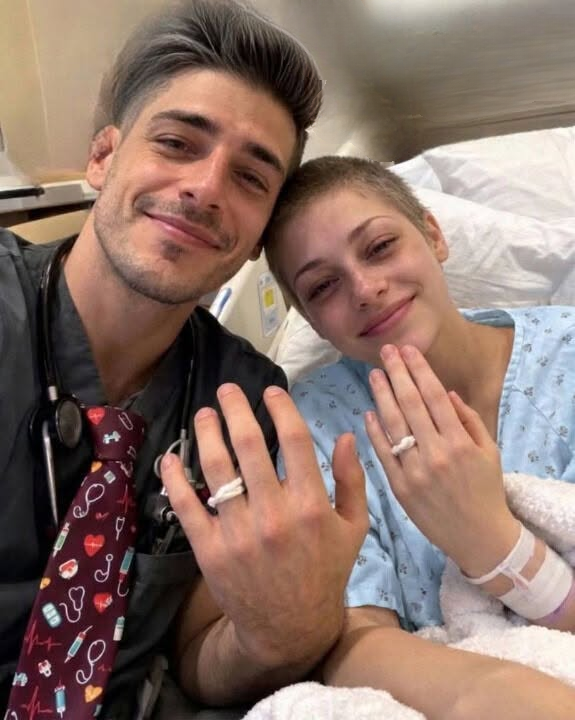
I was 30 years old, a doctor still struggling to pay off the student loans I had accumulated during medical school.
Then I met Alicia, an 18-year-old cancer patient with a sense of humor that never disappeared, even when chemotherapy left her exhausted.
We often joked during her hospital visits. But one day, after doctors told her she might have only three days left, she made an unexpected request.
“I want to marry you.”
At first, I thought she was joking. But Alicia explained that she wanted one important moment in her life that she could decide for herself.
I knew I was her physician, so I transferred her care to another doctor. Still, I made a decision I would later question: I agreed to her wish.
The next day, we held a small wedding in her hospital room. I wore a tie, the nurses made rings from bandages, and her sister, Nora, brought flowers.
Alicia smiled throughout the ceremony.
Two days later, she died.
At her funeral, Nora thanked me for making her sister happy. But everything changed when she handed me a box Alicia had left behind.
Inside was a lawyer’s letter revealing that Alicia had left me her share of her grandmother’s inheritance—enough to pay off all my student loans.
Nora was furious.
“You married her for the money!” she accused me.
I tried explaining that I hadn’t known about the inheritance, but she refused to believe me. She threatened to report me to the hospital.
The following morning, my supervisor, Dr. Patel, suspended my clinical duties and took my identification badge. She explained that marrying a patient crossed a professional boundary, even though I had transferred Alicia’s care.
Then I read Alicia’s handwritten note.
She explained that she knew how hard I had worked to become a doctor. She wanted to give me something that could make my life easier.
I was deeply moved, but I knew accepting the inheritance would make an already difficult situation even more complicated.
So I contacted the estate lawyer and formally refused the money.
Still, Nora continued accusing me publicly, and the hospital investigation moved forward. I eventually admitted something I had avoided saying: Alicia had asked for the wedding, but I was the medical professional, and the responsibility for my decision was mine.
When I met Nora again, I didn’t ask her to withdraw her complaint. I only asked her to tell the hospital what she had actually witnessed.
She acknowledged that she had helped arrange the wedding and had never known of any agreement involving the inheritance. She maintained her concerns about my professional judgment, but corrected her earlier accusation that she knew I had married Alicia for money.
Several weeks later, the hospital reached its decision.
They found no evidence that I had deliberately exploited Alicia for financial gain. However, they concluded that my decision showed poor professional judgment.
I was allowed to return to work under strict conditions, including a formal reprimand, professional-boundary training, and supervised clinical duties.
I also continued helping at my father’s shop on weekends while paying off my student loans.
On my first morning back at the hospital, I held my replacement identification badge with trembling hands.
Dr. Patel looked at me and said:
“No more weddings, Lucas.”
I nodded.
I had wanted to give Alicia one happy memory. But I had also learned that good intentions don’t erase professional responsibilities.
And sometimes, doing the right thing means admitting when you made the wrong decision.