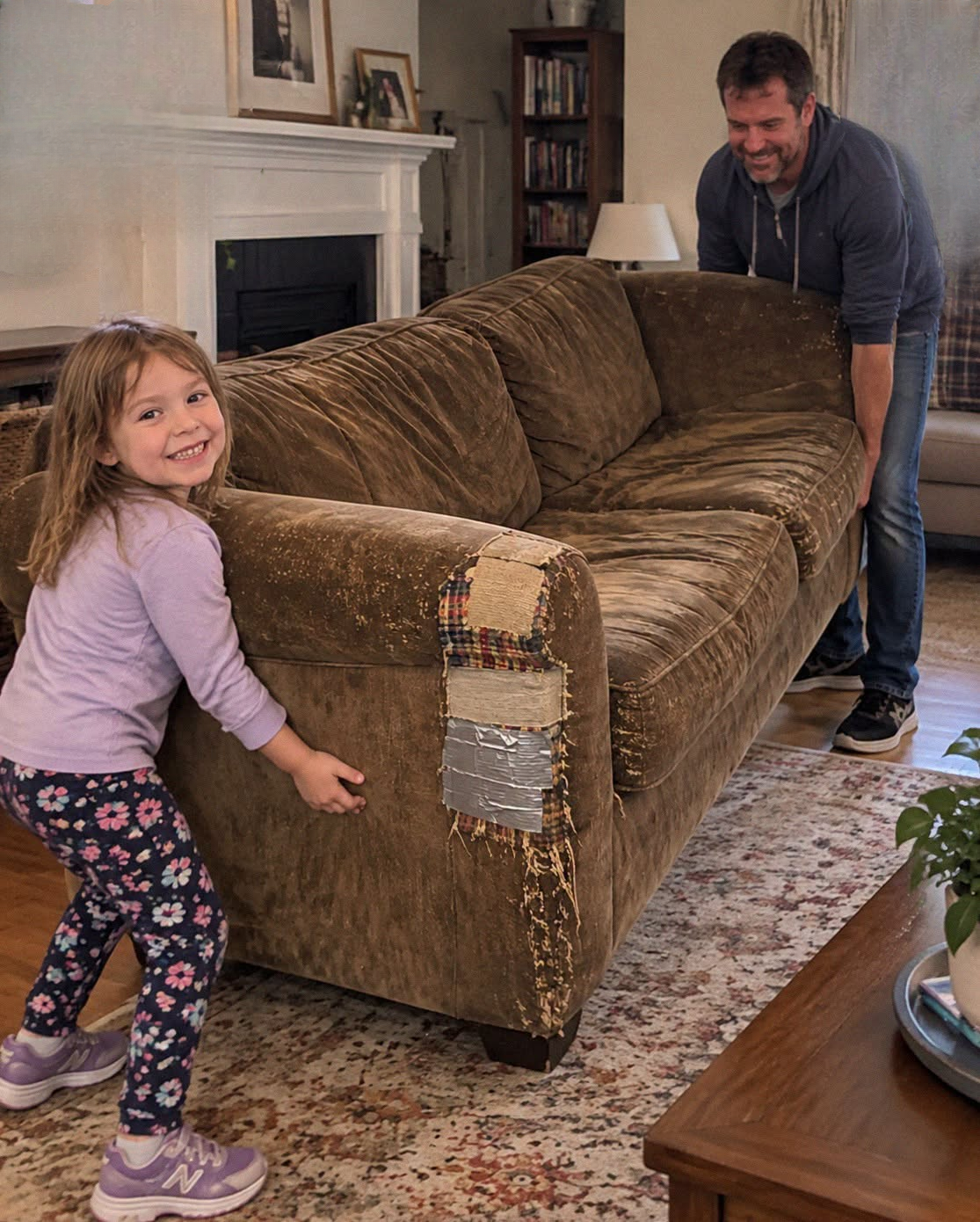
After my husband Arthur passed away, I struggled to let go of the things that reminded me of our 36 years together. Eventually, I decided to sell the old brown couch he’d refused to replace for 20 years.
The next morning, the young man who bought it returned with a package wrapped in yellowed tape.
“I think you should have your money back,” he said. “I found something inside.”
My name was written across the package in Arthur’s handwriting.
I hadn’t seen that handwriting in six months.
Inside was a thick stack of handwritten pages titled The Life We Didn’t Get.
The first chapters described our daughter Maisie, who had died at just eight months old. Arthur had imagined her growing up: her fifth birthday, learning to ride a bicycle, becoming a veterinarian, falling in love, and even getting married.
For years, we’d struggled to talk about Maisie. I couldn’t understand why Arthur had kept such a detailed story hidden from me.
Then I found his old notebooks. One entry said he’d hidden the manuscript inside the couch because he needed the courage to show me.
But there was something else.
When I visited our daughter Aurora, I admitted I wished Arthur had shared his writing with me. She told me something I’d never understood: growing up, she’d felt that Maisie was almost impossible to talk about. Whenever she asked about her sister, I became sad and put the subject away.
She had even thrown away a drawing of our family because she feared it might upset us.
I thought I was protecting her. She thought she was protecting me.
That evening, we finally talked honestly about the daughter we’d lost and the silence that had grown between us.
Later, I returned to Arthur’s manuscript and discovered that the pages didn’t end with Maisie.
There were chapters about Aurora, too.
He’d written about her first bicycle, the birthday cake she ruined by confusing salt with sugar, and the afternoon she made up silly songs while I washed dishes.
He remembered the little moments we’d almost forgotten.
At the end was a letter from Arthur.
He explained that he’d written about Maisie because he wanted to imagine the life we’d never had. He’d written about Aurora because he never wanted to forget the wonderful life we did have.
And he’d written about me because he loved the life we’d built together.
“I never wished Aurora away,” he wrote. “I loved her for who she was, not because she could replace anyone.”
The next day, I invited Aurora over and let her read the final chapters.
When she finished, she asked quietly, “Do you think Dad wished Maisie was here instead of me?”
I moved closer and held her hand.
“No, sweetheart. He wished both his girls were here.”
We opened the manuscript together.
The final chapter was titled The Day You Came Home.
And for the first time in years, we began remembering our family without being afraid of the memories.