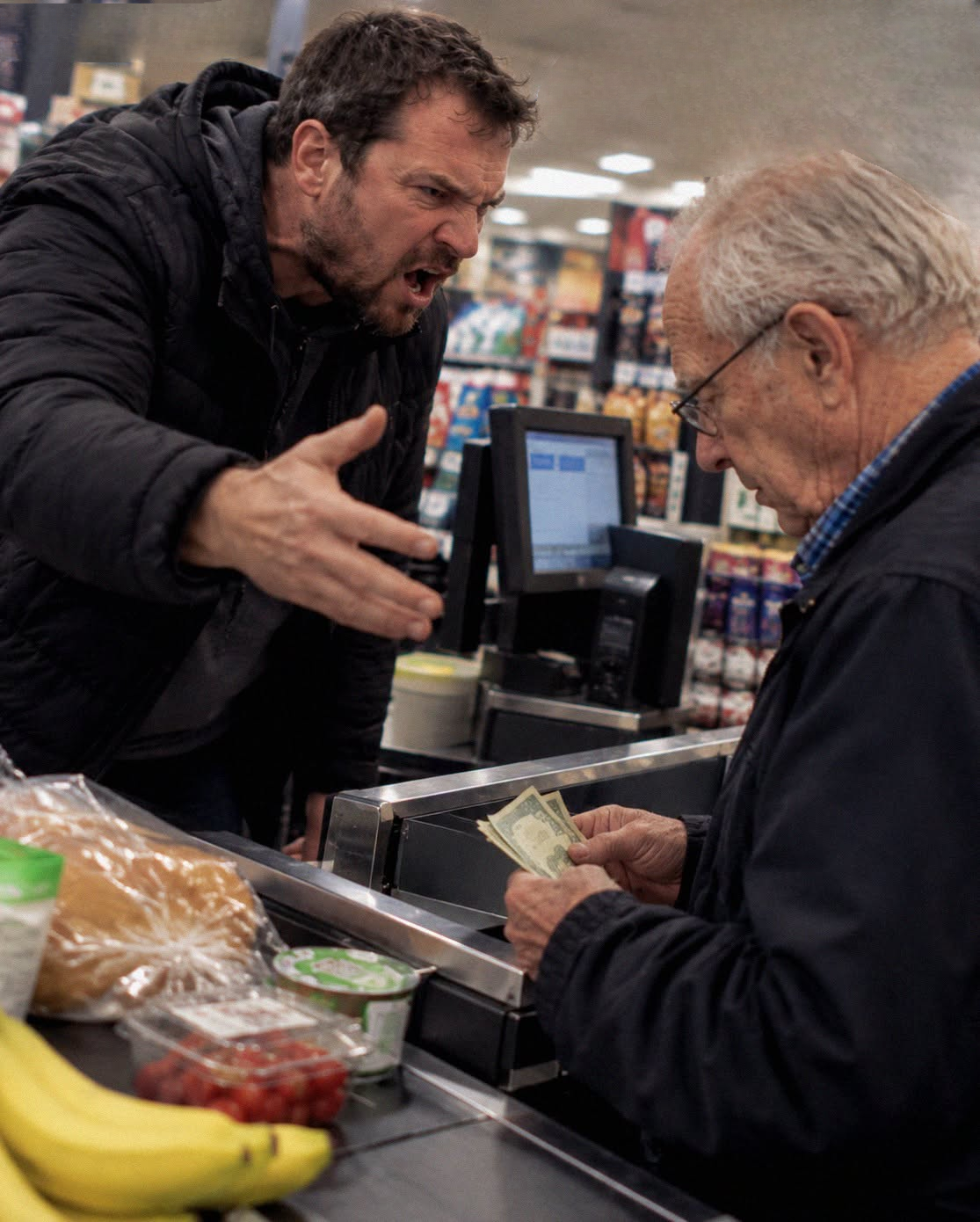
My 78-year-old father, Frank, only wanted to pay for his groceries himself. But when a stranger humiliated him in front of everyone, I watched his confidence crumble.
Since my mother passed away, Dad and I have gone grocery shopping together every Saturday. His arthritis makes counting money difficult, but he refuses to give up his independence.
That morning, while he carefully counted his bills, the man behind us began complaining.
“Are we going to stand here all day?”
I politely asked him to be patient.
Instead, he snapped, “Then take him to a nursing home! Some of us actually have places to be!”
Dad lowered his head.
“I’m sorry, young man,” he whispered.
Then the stranger shouted, “If your old man can’t even pay for groceries, he shouldn’t be shopping!”
He demanded the manager and called my father a “walking corpse.”
That’s when the young cashier, Daniel, stopped scanning our groceries.
He walked past the angry customer, brought over a chair, and gently asked Dad if he’d like to sit.
“There’s no rush, sir. Take whatever time you need. You have just as much right to be here as anybody else.”
My father finally looked up.
“Thank you, son.”
The stranger became even angrier and demanded the manager. But when the manager arrived, two other customers confirmed exactly what had happened.
The manager told the man to leave.
Everyone was relieved, but I noticed Dad staring at the floor.
“Perhaps you should do the shopping yourself from now on,” he told me. “We could go on different days. Save everybody some trouble.”
That nearly broke my heart.
One cruel stranger had made my father feel ashamed of something he’d done every Saturday for years.
I took his hand.
“Dad, do you really think I come here every Saturday because I need help buying milk?”
He looked confused.
“I come because I miss Mom, too,” I explained. “When we’re here arguing about tomatoes and ice cream, I get a little piece of how things used to be.”
His eyes filled with tears.
“Please don’t change our routine because that man made you feel ashamed.”
Dad took a breath, straightened up, and returned to the register.
“Then I’d like to finish paying.”
He counted his bills again, and Daniel patiently waited until he finished.
“You’ve got it exactly right,” the cashier said.
Dad smiled. “Still got it.”
Then something unexpected happened.
A woman who had defended us quietly paid for our groceries.
Dad was stunned.
“But I have the money,” he insisted.
“I know,” she replied. “I wasn’t trying to suggest you couldn’t afford your groceries. I just didn’t want that man’s words to be the last thing you took home today.”
Dad went silent.
Then he told her something my mother used to say:
“There are more good people in the world than bad ones. You just have to pay attention to the good ones.”
He thanked her, shook her hand, and promised that next time he’d pay for someone else’s groceries.
Before leaving, he turned to Daniel.
“We’ll see you next Saturday.”
Daniel smiled. “I’ll be here.”
Outside, Dad reminded me not to crush his ice cream in the grocery bags.
I laughed.
He was still making his own decisions. Still worrying about his ice cream. And still planning to go shopping with me next Saturday.
Sometimes, a little kindness does more than help someone through a difficult moment. It reminds them that they still belong.