I froze in the middle of my grandmother’s kitchen when I noticed the same name written over and over in her checkbook.
I had just returned home after an eleven-month deployment with the Marines. My plan was to spend a few weeks helping Grandma with household repairs and fixing the roof over her porch.
But what I discovered made my blood boil.
There were eleven separate checks for $400, all made payable to my uncle, Raymond.
Grandma Opal was 78 years old, a widow living on just $1,106 a month in Social Security benefits.
Those payments represented more than a third of her entire monthly income.
Next to the first check, she had written one word:
Lawn.
My uncle had collected $4,400 while I was thousands of miles away serving with the Marines.
The following morning, I carefully asked Grandma who had been mowing her quarter-acre property.
Her expression immediately changed.
“Raymond has been struggling financially,” she explained. “I just wanted to help my son.”
I didn’t argue.
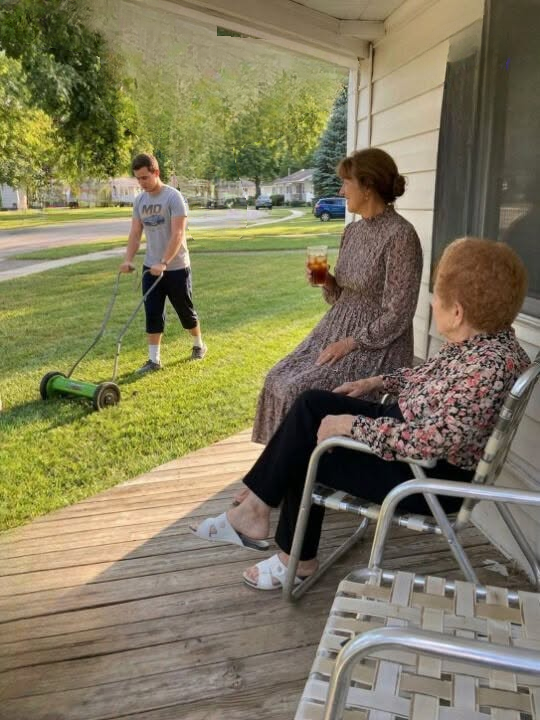
Instead, I went outside, found my grandfather’s old red Snapper lawn mower, repaired the engine, sharpened the blade, and changed the oil.
Then I mowed Grandma’s entire lawn myself.
That’s when I started noticing the neighboring houses.
Nine other properties belonged mostly to elderly residents, and their lawns were badly overgrown.
I offered to help one of them, an 81-year-old woman named Miss Edna.
During our conversation, she quietly mentioned something that made my stomach turn.
“Raymond charges me $200 every month to mow my yard.”
Another neighbor was paying him even more.
But the worst part wasn’t the money.
It was the lies.
Raymond had been telling these elderly homeowners that the city could fine them every single day if their grass grew beyond the permitted height.
What he conveniently failed to mention was that the local ordinance allowed homeowners time to correct the problem after receiving an official warning.
Some residents had been paying him for months because they were terrified of receiving fines they couldn’t afford.
That Saturday, I decided to do something about it.
I mowed all ten properties without accepting a single dollar.
A teenager named Tyler joined me and helped collect the grass clippings.
By the afternoon, the entire street looked completely different.
Then Raymond arrived in his expensive white pickup truck.
He stepped out, looked down the freshly mowed street, and appeared completely stunned.
“What exactly is going on here?” he demanded.
Before I could answer, Grandma walked outside.
For the first time, she confronted her son in front of the neighbors.
Raymond eventually admitted that he had lost his factory job and had been hiding his financial problems from his wife.
But that wasn’t the worst discovery.
While checking Grandma’s paperwork, I found a county tax notice showing that she still owed $1,312.46 in property taxes.
Raymond had taken $1,200 from her, claiming he would handle the payment.
He had even given her a handwritten receipt.
But the taxes had never been paid.
I immediately contacted the county tax collector, used money from my deployment savings to cover the outstanding balance, and obtained an official receipt.
I wasn’t going to let Grandma risk losing the home my grandfather had worked so hard to provide for her.
That evening, our entire family gathered around Grandma’s kitchen table.
We went through every payment Raymond had received.
When we added the lawn payments, the unpaid property taxes, the money collected from the neighbors, and the wages he owed Tyler, the total came to approximately $7,700.
Raymond’s wife, Sheila, was furious.
She insisted that he sell his expensive truck and repay everyone.
Eventually, he agreed.
He sold the vehicle, returned the money he owed, and personally apologized to every neighbor he had taken advantage of.
But Grandma had one final condition.
She wanted Raymond to spend every Saturday mowing the entire street for free.
I helped him practice the straight mowing lines my grandfather had taught us years earlier.
When my leave ended, I returned to Camp Lejeune.
A few months later, Grandma mailed me a photograph.
All ten properties looked beautiful again.
Raymond had found steady employment, the neighbors had received their money back, and the street had even won an award from the local Garden Club.
Inside the envelope was a page from Grandma’s checkbook.
Beside another $400 entry to Raymond, she had written:
“Returned.”
And underneath it:
“Lawn’s free now.”
At the bottom of the page, Grandma had added two words I will never forget:
“Straight lines.”