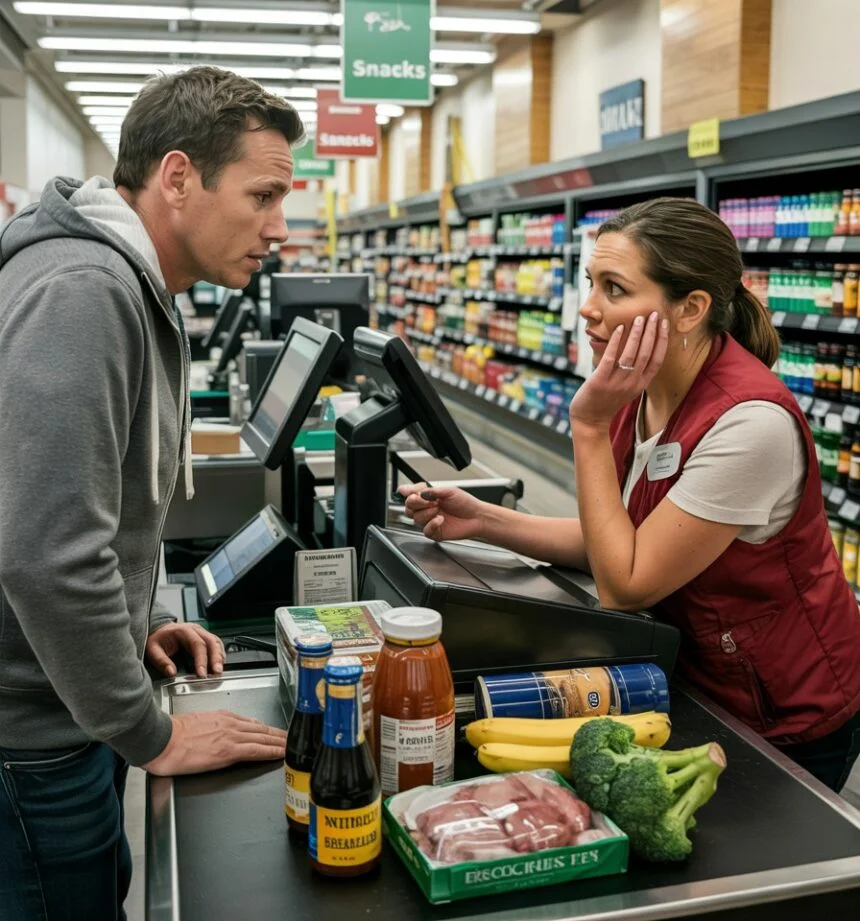
I’m so sorry.”
For a second my brain refused to translate the words into meaning. It heard them as sounds, syllables without context. Maybe it was an accent I’d misunderstood.
Maybe she’d said “last item” and I was just tired from another sleepless night. Maybe she was talking to someone else—the woman behind me with a toddler trying to escape the cart like it was a prison break. “Excuse me?” I asked, because that’s what you say when reality stutters and you desperately try to restart it.
Rosa’s expression didn’t change. She scanned the chicken breast. Beep.
The broccoli. Beep. Faster now, urgent, her movements clipped like she wanted this transaction finished before something could catch up to us.
Then she leaned forward, lowering her voice, though it didn’t feel quieter—it felt heavier, weighted with the kind of dread that settles in your bones. “They know you’re here,” she whispered. “They’ve known for two weeks.”
My stomach rolled like I’d missed a step on invisible stairs.
The grocery store suddenly felt too bright, too exposed, the ceiling too low and pressing down. “What—who?” The words came out too high, too thin. “Ma’am, I think you have me confused with—”
“Listen to me.” Rosa cut me off, and there was a crack in her composure now, a tremor at the edges.
Her eyes flicked up toward the ceiling, toward the black dome of the security camera above lane four. Then to the automatic doors that slid open and shut like a mechanical mouth, swallowing and releasing customers in an endless rhythm. “Don’t go home,” she said.
“Don’t pack. Get in your car and drive. Tonight.”
I stared at her, unable to make my face do anything.
I was frozen with my wallet halfway out of my back pocket like a man reaching for a life preserver in a dream where his arms wouldn’t quite work. Rosa scanned the marinara sauce. Beep.
The beer, the cans rattling against the conveyor belt because her hands were shaking now. “I can’t explain here,” she whispered. “Too many cameras.
Too many ears. But I recognized you from the list. Your photo.
Your name. Your address on Birch Street.”
The cold thread in my chest pulled so tight I couldn’t breathe. Birch Street.
She knew exactly where I lived. Nobody in Milbrook knew that except my landlord and the postal service. “There’s a list?” I managed.
Her jaw tightened like she was biting down on something sharp. “They’re coming tonight. Around ten.
They know you’ll be home by then. Settled. Alone.
Vulnerable.”
The total flashed on the screen: $43.67. Rosa looked at it like it was a funeral bill. Then she looked back at me, and in her face I saw something I’d never seen on a grocery store employee—pure, unfiltered grief.
Like she was watching a car accident happen in slow motion and there was nothing she could do to stop it. “Please,” she said, her voice cracking. “I know you don’t know me.
I know this sounds insane. But I worked for them for six years before I got out. I know how they operate.
They’re efficient. They’re brutal. And they don’t fail.”
The toddler behind me started crying.
The sound seemed to come from underwater, distant and distorted. I paid with my debit card because my hands knew what to do even if my brain had short-circuited. The machine approved the purchase with a cheerful jingle that made me want to vomit.
Rosa handed me the receipt. On the back, in small careful numbers, she’d written a phone number. “Call me when you’re safe,” she whispered.
“Or don’t call me at all. Just don’t go home tonight.”
I walked out of SaveMart with my groceries and a feeling of complete unreality, like I’d accidentally stepped into someone else’s nightmare and couldn’t find the door back to my own life. Outside, the October air was crisp in that way Vermont did crisp, like it was proud of it, like cold air was a competitive sport.
My car sat in the third row—a beat-up Nissan Sentra that still smelled faintly of the previous owner’s cheap cologne and fast food wrappers. I threw the bags in the trunk and sat behind the wheel with the receipt trembling in my hand. The black numbers on the back might as well have been coordinates to my grave.
I told myself the obvious thing: this is ridiculous. I was a software developer. I wrote code that helped small businesses secure their data.
I argued with coworkers about which pizza place delivered fastest. I paid rent on time. I went for runs when guilt outweighed laziness.
My life was an Excel spreadsheet—organized, predictable, painfully unremarkable. Nobody sent assassins after men who bought discounted bananas. And yet.
Rosa’s fear had been real. Not dramatic or theatrical—real in the way you can’t fake, like a hand reaching out from a burning building. Her details were too precise.
Ten p.m. My apartment on Birch Street. The idea of a list with my photo, my name, my address.
I checked my rearview mirror. A man in a Carhartt jacket pushed a cart across the lot. A woman loaded groceries into an SUV.
Normal. Ordinary. Exactly the kind of scene that meant nothing until you realized it could mean everything.
My phone sat in the cup holder like a loaded gun. The screen said 6:15 p.m. If Rosa was right, I had less than four hours.
The problem was, she might actually be right. Because I hadn’t always been Daniel Morrison, quiet software developer living alone in rural Vermont. Three years ago I’d been Daniel Morrison, senior data analyst at Veridian Solutions in Seattle, the guy who stayed late to finish projects and brought donuts on Fridays.
I’d been ordinary then too. Right up until I’d stumbled across something I wasn’t supposed to see. It had started with a coding error—a simple discrepancy in the financial data I was analyzing for a routine audit.
Numbers that didn’t match. Transactions that appeared twice. Nothing dramatic.
Just wrong enough to make me dig deeper because I was the kind of person who couldn’t leave a puzzle unsolved. What I found was a network. A sophisticated money laundering operation running through a dozen shell companies, funneling cash from sources I couldn’t identify into investments that seemed legitimate on the surface.
Millions of dollars. Maybe tens of millions. All carefully hidden in the architecture of our client databases.
I should have gone to my supervisor. I should have filed a report and let the company’s legal team handle it. Instead, I’d made copies.
I’d built my own encrypted files. I’d documented everything because some part of me—the part that had watched too many crime shows—knew that evidence disappeared when it became inconvenient. Then I’d made my second mistake.
I’d gone to the FBI. The agent I spoke to, a woman named Sarah Chen, had seemed genuinely concerned. She’d taken my evidence.
She’d asked all the right questions. She’d told me I’d done the right thing and to sit tight while they investigated. Two days later, my apartment had been broken into.
Nothing stolen—just carefully searched. My computer was gone. My backup drives were gone.
Every document I’d printed was gone. But they’d left my TV, my laptop, my watch. They weren’t thieves.
They were cleaners. Agent Chen stopped returning my calls. When I showed up at the FBI field office, security told me there was no agent by that name.
I checked my emails—every message from her had been deleted, even from my trash folder. That’s when I understood. The network wasn’t just criminals.
It included people who were supposed to catch criminals. It included people with badges and access and the power to make evidence—or witnesses—disappear. I’d emptied my bank account, bought a used car with cash, and driven east without a plan beyond “get far away and stay invisible.” I’d chosen Milbrook because it was small, because it was isolated, because nobody from my old life would ever have any reason to look for me here.
For three months it had worked. Now Rosa was telling me it hadn’t. I started the car and drove without a destination, just away from the SaveMart lights.
I ended up in the parking lot of Groundwork Coffee, a place that smelled like cinnamon and hipster ambition. I didn’t go inside. I just sat in the darkening car, watching the warm glow through the windows, trying to decide if I was having a psychotic break or if my worst fears were finally catching up.
The receipt lay in my lap. Rosa’s number stared up at me like a dare. I picked up my phone and dialed before I could talk myself out of it.
She answered on the first ring. “You called. Good.”
“Who are you?” I asked.
“Who are they? How do you know about me?”
“Not on the phone,” Rosa said immediately. “Cell signals can be tracked.
Can you get to the old lumber mill on Route 7? The abandoned one?”
“I don’t—I’m not going to some abandoned building to meet a stranger who just told me I’m about to be murdered.”
“Then drive to the police station and see how that works out for you,” she said flatly. “Milbrook PD has two officers.
One of them is on the payroll. Want to guess which one?”
My throat went dry. “How do you know that?”
“Because I used to coordinate logistics for the people who paid him.
The lumber mill. Thirty minutes. I’ll explain everything.
Or don’t come, and take your chances at home. Your choice.”
She hung up. I sat in the Groundwork Coffee parking lot, my heart hammering, my hands clammy on the steering wheel.
Every instinct I had was screaming that this was a trap. Meeting a stranger at an abandoned building at night was literally how people died in horror movies. But Rosa had known my address.
She’d known about the list. She’d known I was being watched. And if she wanted me dead, why warn me at all?
Why not just let whatever was coming happen? I checked the time. 6:47 p.m.
I had three hours and thirteen minutes before they came for me—whoever “they” were. I drove to the lumber mill. The building loomed against the darkening sky like a corpse of the town’s industrial past.
Windows gaped like empty eye sockets. The parking lot was cracked and overgrown with weeds that pushed through asphalt like the earth was trying to reclaim what humans had abandoned. I pulled my car behind what used to be the loading dock, hidden from the road, and waited with my engine running and my doors locked.
Rosa’s car appeared ten minutes later—a Honda Civic with a dented bumper and a faded Bernie sticker. She parked next to me, got out slowly, and approached with her hands visible. Like she was showing me she wasn’t armed.
Like she understood how terrified I was. I rolled down my window an inch. “Get out,” she said.
“We don’t have much time.”
“Tell me what’s going on first. Right here. Right now.”
Rosa glanced at the road, then back at me.
In the fading light she looked older than she had in the grocery store, the lines around her eyes deeper, carved by something heavier than age. “Three years ago, you filed a report with the FBI about financial irregularities at Veridian Solutions,” she said. “You documented a money laundering network.
You thought you were being a good citizen. You thought the authorities would protect you.”
My blood turned to ice. “How do you know that?”
“Because I worked for the people you exposed.
I was a logistics coordinator for something called the Helix Group. It’s not a company you can Google. It’s a network—politicians, law enforcement, corporate executives, all connected through layers of shell corporations and offshore accounts.
They move money for people who can’t use banks. Drug cartels, human traffickers, corrupt governments. Anyone with cash that needs to look clean.”
She paused, watching my face.
“When you went to the FBI, you didn’t know Agent Sarah Chen was on their payroll. You handed them everything they needed to identify you, track you, and neutralize the threat you represented. They’ve been watching you ever since.
Waiting for you to surface somewhere they could handle it quietly.”
“Why wait three months?” I asked. “Why not come after me immediately?”
“Because you went dark. No social media.
No credit cards. No cell phone with your real name. You did everything right.
It took them time to find you, and when they did, they wanted to be sure. To verify you were alone, that you hadn’t contacted journalists, that you weren’t planning something.”
“How do you know all this?”
Rosa’s expression hardened. “Because two weeks ago, I got a call from my old supervisor.
He wanted me to do one last job—verify the target’s routine, confirm the address, make sure there were no complications. He sent me your file. Your photo.
Everything.”
“And you agreed?”
“I told him yes.” Her voice cracked. “Because if I’d said no, he would’ve known something was wrong. I got out of the Helix Group six years ago, but you never really get out.
They let you retire as long as you stay useful. As long as you stay quiet.”
She took a shaky breath. “When I saw your file, I knew they were going to kill you.
Not arrest you, not scare you—kill you. Clean, professional, no body to find. They’ve done it before.
I’ve helped coordinate it before. And I told myself I was done with that. I told myself I wouldn’t be part of another murder.”
The word hung in the air between us like smoke.
“So you warned me,” I said slowly. “And now they’ll know it was you.”
“Probably.” Rosa smiled, but it was broken at the edges. “Which means we’re both dead if we don’t move fast.”
“What are you suggesting?”
“I know where they keep their files.
Physical files, the kind they can’t delete remotely. Insurance policies, basically—evidence on everyone in the network, so if someone flips, everyone goes down together. It’s in a storage facility in Burlington, disguised as a wine collection.
If we can get those files and get them to the right people—real journalists, not FBI agents on the take—we can burn the whole thing down.”
I stared at her. “You want to break into a storage facility and steal files from an organization that kills people?”
“I want to survive,” Rosa said. “And the only way we survive is if the Helix Group is too exposed to come after us.
If the files go public, they’ll be too busy protecting themselves to worry about two loose ends.”
“This is insane.”
“Yes. But you have a better plan?”
I didn’t. And we both knew it.
The storage facility was forty-five minutes away, in a commercial district on the outskirts of Burlington. Rosa had the access codes—apparently they hadn’t bothered changing them after she left, because why would they suspect a woman who’d been reliably quiet for six years? We drove in separate cars, which felt smarter in case one of us needed to run.
The facility was modern and well-lit, with security cameras covering every angle. Rosa pointed out which ones were real and which were dummies—a trick she’d learned working logistics. We entered through a service entrance she’d used before, our footsteps echoing in concrete corridors lined with identical storage units.
Unit 237 looked like all the others. Rosa punched in the code, and the door rolled up to reveal floor-to-ceiling shelves stacked with wine boxes. Expensive-looking labels.
Dust gathering on cardboard. “Third shelf, back left,” Rosa whispered. “That’s where they keep the real files.”
We moved quickly, pulling down boxes that were heavier than wine bottles had any right to be.
Inside: manila folders stuffed with documents, USB drives, photographs. Evidence of bribes, transfers, communications. Names I recognized from the news.
Faces I’d seen in political campaigns. I was stuffing files into a duffel bag when I heard it—footsteps in the hallway. Multiple sets.
Moving fast. Rosa’s face went white. “They knew.
They fucking knew.”
We had maybe thirty seconds before they reached us. The unit had no back exit. No windows.
We were trapped. “The vent,” I said, pointing to an air vent near the ceiling. “Can we—”
“Too small,” Rosa said.
Then her expression changed. Resolved. Sad.
“But I can buy you time.”
“What are you—”
She grabbed my shoulder, her grip surprisingly strong. “Take the files. There’s a loading dock at the end of this hallway, past the emergency exit.
Get to your car. Get these to someone who’ll publish them. Make this worth it.”
“I’m not leaving you—”
“You don’t have a choice.” She pushed me toward the door, then turned to face the hallway.
“I’ve been running from what I did for six years. I’m done running.”
The footsteps were close now. Voices calling out numbers, coordinating.
I grabbed the duffel bag and ran. Behind me, I heard Rosa’s voice ring out clear and defiant: “You want me? Come get me.”
Then shouting.
Chaos. I didn’t look back. I crashed through the emergency exit, an alarm screaming, and sprinted for the loading dock.
My car was where I’d left it, and I threw the duffel in the passenger seat and peeled out of the parking lot with my heart trying to break through my ribs. In my rearview mirror, I saw figures emerging from the building. Searching.
But I was already on the highway, merging into traffic, becoming invisible again. I drove through the night, the duffel bag sitting beside me like a ticking bomb. At a rest stop outside Boston, I contacted a journalist I’d been following online—someone with a reputation for taking on powerful people and actually publishing the results.
I sent encrypted files. I made copies and mailed them to three different newspapers. I did everything I could to ensure that if something happened to me, the truth would still get out.
The story broke four days later. Front page of the New York Times: “Massive Money Laundering Network Exposed—Officials, Executives Implicated.” The files Rosa and I had stolen were all the evidence prosecutors needed. Arrests started within a week.
The Helix Group imploded as everyone scrambled to cut deals and point fingers. I never found out what happened to Rosa that night. The news didn’t mention her.
There was no obituary, no missing person report. She’d disappeared into whatever void the Helix Group used for inconvenient people who knew too much. But she’d saved my life.
She’d given me a chance when she could have stayed silent, stayed safe, stayed complicit. I think about her every time I buy groceries now. I’m living in Portland under a new name, a new life built on the foundation of files she helped me steal.
The Helix Group is gone, shattered into federal indictments and prison sentences. I’m safe now—really safe, not just hiding-and-hoping safe. Sometimes I imagine walking into a grocery store and seeing Rosa at the register.
I imagine what I’d say. Thank you feels inadequate. I’m sorry feels worse.
Maybe there are no words for the kind of debt you owe someone who sacrificed everything so you could live. So instead I just remember. Every transaction.
Every receipt. Every ordinary moment in a fluorescent-lit store where someone once looked at me and decided that one more death was one too many. She gave me my last meal.
And then she gave me every meal after.