The drive from Portland to Seattle took four hours. I stopped twice, staring at the silver picture frame on my passenger seat—the anniversary gift I’d spent weeks choosing, still foolish enough to hope it might make me visible to my family.
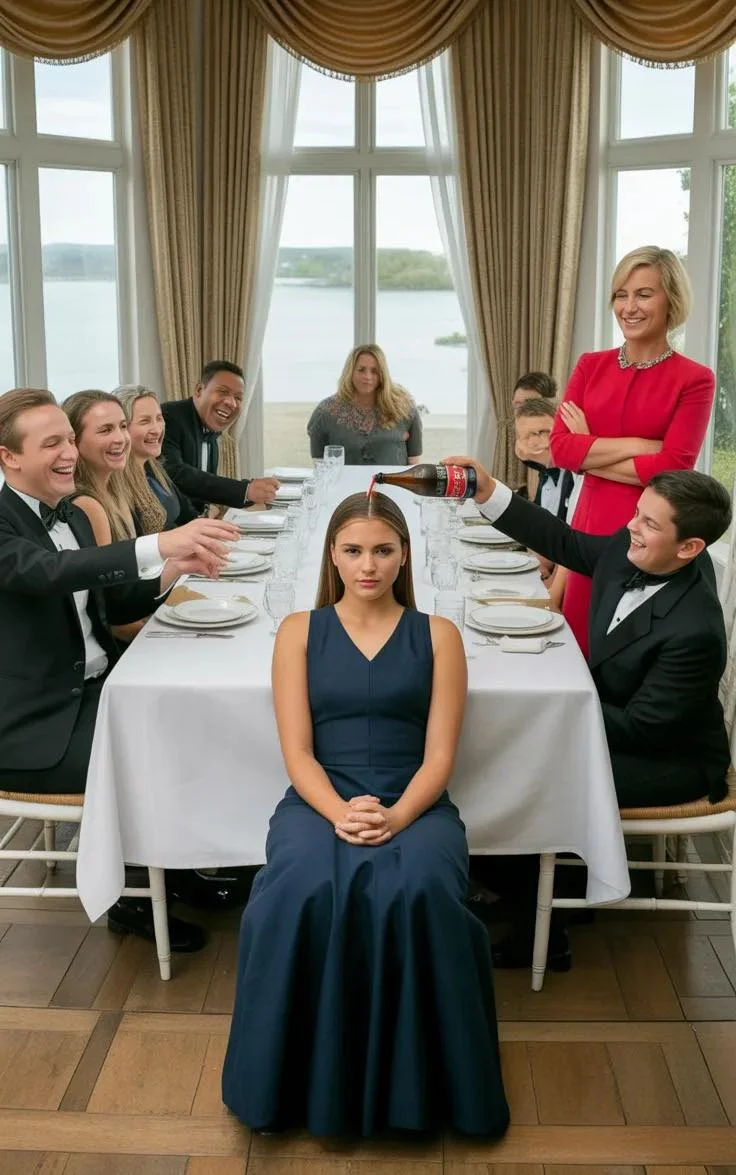
Dinner was at Harborview, an upscale waterfront restaurant my sister Lauren had clearly chosen. As always, she sat at the center of everything—praised for her boutique, her husband Greg admired, her son Mason celebrated. I was placed at the far end of the table. No one mentioned my bakery or the award I’d just won.
During the toasts, my father praised Lauren repeatedly and never said my name. Then Mason stood up, walked over to me, and said loudly, “Mom says you don’t belong here,” before dumping a cup of soda into my lap. The table erupted in laughter. My father waved it off—“Kids will be kids.” My mother smiled. Lauren didn’t apologize.
I didn’t cry. I finished dinner, gave them the picture frame—barely acknowledged—and drove back to Portland in silence. That night, I removed myself as co-signer from Lauren and Greg’s auto loan, something I had agreed to years earlier after family pressure. Without my credit backing them, the SUV was repossessed the next morning.
Lauren showed up at my apartment furious, demanding I fix it. My parents called me dramatic and unstable. My father texted that if I didn’t reverse the loan, I was no longer their daughter. I saved every message.
Then a former employee of Lauren’s sent me screenshots of texts between Lauren and my mother. They had been building a “paper trail” to paint me as emotionally unstable in case I ever caused problems with the loan. It was deliberate and premeditated.
With my uncle Daniel, a retired attorney, I organized everything. Soon after, my bakery window was smashed and my car keyed. Security footage showed Mason and another boy laughing as they vandalized my property. The police opened a formal case.
In court, the evidence was undeniable: the messages, the harassment, the forged documents, the vandalism. I testified calmly. Lauren tried to call it a prank and me overly sensitive, but the pattern was clear.
The judge ordered Lauren and Greg to pay $32,000 in damages. Mason received community service and counseling. The court formally recognized the financial coercion and emotional mistreatment. My parents were publicly admonished for enabling the dynamic.
I didn’t feel triumph—just relief. I had finally chosen myself.
In the months that followed, my bakery flourished. I expanded, hired staff, built real friendships, and found peace. One day my parents stood outside my shop, watching through the window. I didn’t invite them in. I closed early and walked out the back—not in anger, but in acceptance.
Sometimes I think about that silver picture frame and the woman who bought it, hoping love could be earned. I don’t pity her anymore. I’m grateful to her.
She endured everything.
And when the soda hit her lap and the laughter rose around her, she went home and chose herself.
I will never be invisible again.