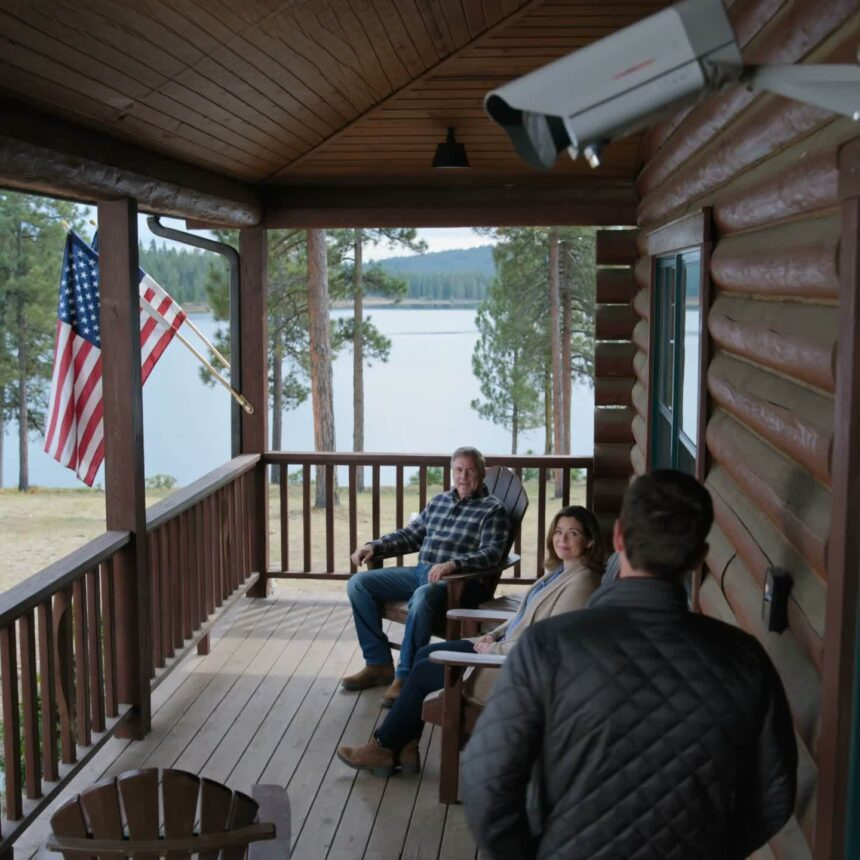
My Son-In-Law Demanded His Parents Move Into My Lake House, So I Let the “Camera” Speak
I retired at sixty-three and bought a lake house on Lake Vermilion in northern Minnesota. After thirty-seven years in structural engineering, I wanted one thing: peace.
The cabin cost $220,000, and I paid every cent myself. No inheritance. No windfall. Just decades of saving, missed vacations, long workdays, and sacrifices.
For the first few days, the cabin felt like exactly what I had earned.
Then my son-in-law, Gareth, called.
“Leonard, I wanted to give you a heads-up about my parents. They need somewhere to stay for a few months. Diane and I talked it over, and your cabin is the obvious solution.”
I stared at my coffee.
“You talked it over with me?”
“You’re one person in a three-bedroom house. It’s practical.”
Then he went further.
“If you have a problem with it, maybe you should sell the place and come back to Chicago where you can actually be useful to the family.”
That told me everything.
I had spent thirty-seven years learning that problems rarely appear where people expect them. They begin in weak points nobody bothers to inspect.
So I made three calls.
The township confirmed that anyone staying longer than thirty days had to be registered. My insurance agent warned me that unauthorized long-term occupants could affect my coverage. Then I hired an attorney, Kathleen Mercer.
Her advice was simple:
“Document everything.”
So I did.
I bought three motion-activated cameras with night vision and cellular alerts. One faced the driveway, one the front door, and one the dock.
A few days later, Gareth’s parents arrived.
Earl and Pauline stepped out of a rental car as if they already owned the place.
“Gareth said this was arranged,” Pauline said.
“It wasn’t,” I replied.
Earl frowned. “We’re family. You’ve got three bedrooms and you’re alone. You really won’t help us?”
“I worked thirty-seven years for this place,” I said. “And you’re standing on my porch telling me I’m selfish because I won’t give it to you.”
They refused to leave at first, but after I told them I would call the sheriff for trespassing, they finally drove away.
I saved the camera footage.
Gareth called twice afterward. His second voicemail was no longer polite.
“You think you can humiliate my parents and there won’t be consequences? We’ll see about that.”
I forwarded it to Kathleen.
Then I hired a private investigator to look into Earl and Pauline.
The report revealed Earl had declared bankruptcy after a failed restaurant investment and owed $75,000 from a civil judgment. The apartment Gareth claimed was “under renovation” had actually been foreclosed.
Then came the part that mattered.
Nearly $48,000 had been transferred from a joint account belonging to Diane and Gareth into Earl’s accounts.
It wasn’t family support.
It was money disappearing.
Then one afternoon, while I was in Duluth for a medical appointment, my phone buzzed.
The driveway camera showed Gareth.
But he wasn’t alone.
A man and woman were walking through my cabin with him.
The man carried a clipboard. The woman was measuring the windows.
Gareth was showing them the fireplace, the lake view, and the deck.
He was showing my house to potential buyers.
I watched the footage for twenty-two minutes.
Then I called Kathleen.
“This changes everything,” she said. “He just showed buyers through a property he doesn’t own.”
I knew then that his parents had never really been the point.
The cabin was.
Gareth wanted access. He wanted control. And eventually, he wanted to turn my property into money.
But I still had one problem.
My daughter, Diane.
I didn’t want to accuse her husband with half the story, so I asked her to meet me in Duluth.
At the diner, I slid the evidence across the table.
Bank transfers.
The foreclosure records.
The investigator’s report.
And the camera footage.
Diane stared at the photographs.
“He told me those transfers were an investment,” she whispered.
“There was no investment.”
She turned another page.
“He said the apartment renovation was delayed.”
“It was foreclosed.”
Then she saw the photograph of Gareth showing strangers through my cabin.
“He was selling your house?”
“Trying to.”
She went silent.
Then she cried.
Not loudly. Just the quiet kind of crying that happens when a person finally sees the truth they’ve been avoiding.
“What do I do?” she asked.
“Talk to a lawyer,” I said. “And don’t confront him until you know what you’re dealing with.”
She did.
Within days, Diane discovered something even worse.
Gareth had opened a line of credit in her name without her knowledge.
Nearly $31,000 had already been used.
When she confronted him, he didn’t deny it.
He called it a “temporary family bridge.”
Then he blamed my cabin.
“If your father had just let Mom and Dad stay there, none of this would be so tight.”
That’s when Diane understood.
The cabin wasn’t a favor.
It had been part of his financial plan.
She packed her daughter’s clothes, birth certificates, school records, medications, and important documents while Gareth was at work.
Then she went to her attorney, the bank, and the police.
Only afterward did she drive north to my cabin.
That night, Gareth called twelve times.
The next morning, he showed up.
I met him on the porch.
“I’m here to talk to my wife.”
“You can talk to your attorney.”
“This doesn’t concern you.”
“You opened debt in my daughter’s name, moved her money into your father’s debts, and tried to sell my cabin while I was at an appointment. Everything about this concerns me.”
He shouted for Diane.
I told him to leave.
A sheriff’s deputy arrived shortly afterward. Gareth tried to explain that it was all a misunderstanding.
The deputy stopped him.
“Sir, you’ve been told to leave private property.”
Gareth finally left.
That was the last time he stood on my porch.
The months that followed were ugly but straightforward.
Forensic accountants traced the money. Hidden accounts were uncovered. The line of credit was disputed. Diane filed for divorce.
Gareth tried claiming the cabin was somehow part of the family’s financial interests.
It wasn’t.
He tried saying the transfers were legitimate marital decisions.
They weren’t.
Then his own records destroyed him.
One recovered photograph showed a handwritten document titled:
Vermilion Options
Underneath were three notes:
Parents occupy.
List in spring.
Pay off Earl.
He had planned it.
The occupation.
The listing.
The debt repayment.
Everything.
The divorce eventually went through. Gareth’s claims collapsed under the evidence.
Diane and my granddaughter stayed at the lake house while she rebuilt her life.
At first, she apologized for everything.
For using hot water.
For leaving crayons on the table.
For taking up space.
I told her, “This isn’t a mess. This is what truth looks like before it gets organized.”
Slowly, she stopped apologizing.
My granddaughter began sleeping through the night. She started fishing with me on the dock.
One afternoon she caught a tiny perch and stared at it like it was treasure.
“Grandpa,” she whispered, “I think he was waiting for me.”
“Maybe,” I said.
Or maybe she was finally ready.
Years later, I still keep the cameras.
Not because I’m afraid anymore.
They simply became another quiet system doing its job.
The cabin became more than a retirement home. It became a place where my daughter could breathe again and my granddaughter could grow up feeling safe.
One evening, my granddaughter asked me:
“If someone says your house is their house, but it isn’t, do they know they’re lying?”
I thought about Gareth.
“Sometimes,” I said. “Sometimes they tell the lie so often it starts sounding true to them.”
“What do you do?”
“You tell the truth anyway.”
She nodded and went back to her fishing rod.
I looked across Lake Vermilion and thought about everything that had happened.
Gareth had mistaken my kindness for weakness.
He had mistaken family for entitlement.
And he had mistaken an empty bedroom for something he was entitled to take.
He forgot one important thing.
A house isn’t only a deed or a key.
Ownership is the right to say yes.
And the right to say no.
I worked thirty-seven years for that cabin.
And I wasn’t going to apologize for protecting it.