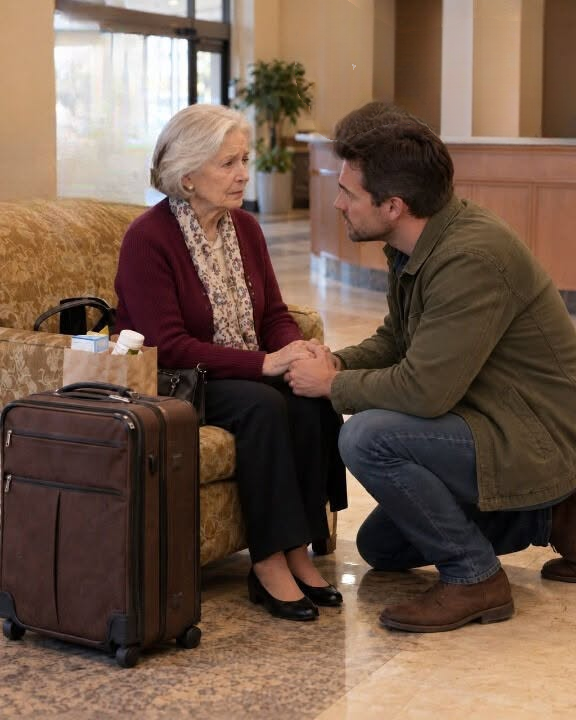
My parents told my grandmother they were taking her out for lunch. Three hours later, a nursing home called to tell me they had left her there with a suitcase and disappeared.
I drove 190 miles to bring Grandma Eleanor home.
When she got into my car, she fastened her seatbelt and looked at me seriously.
“Don’t call your parents, Daniel. Take me to the courthouse first. Then the bank.”
She handed me an envelope marked HOUSE DEED.
“My parents weren’t looking for somewhere to take care of me,” she whispered. “I think they wanted me out of the way.”
Grandma had recently questioned several suspicious withdrawals totaling $55,000 from her bank accounts. She had temporarily given my father power of attorney after surgery, trusting him to help manage her finances.
Instead, he had begun controlling her mail and telling her she could no longer handle her own affairs.
The morning she confronted him, my parents took her to the nursing home.
At the courthouse, we discovered that Grandma’s house had been transferred to a company called North Field Holdings. The deed carried a signature she insisted was forged, and the transfer had been recorded that very morning.
Even worse, my mother was listed as the company’s organizer, and my father was its manager.
Their company had been created just six weeks earlier.
When our attorney investigated further, she discovered that Grandma’s house was already listed for sale. The photographs showed her bedroom, kitchen, and treasured belongings. The listing described the property as vacant.
Someone had been preparing to take her home away while she was still alive.
At the bank, we learned that some of the missing money had gone to the company and other unfamiliar accounts. The bank documented the suspected fraud and restricted further access while investigating.
When my father finally called, Grandma answered.
“Who signed my name on the house deed?” she demanded.
He claimed he knew nothing about it.
But when my mother took the phone, she made a terrible mistake.
“You said she would accept everything once it was done!”
The silence that followed told us more than any explanation could have.
We returned to Grandma’s house with police assistance. Inside, we found packed boxes, emptied cupboards, and family photographs removed from the shelves. My parents had already begun clearing out the home she had shared with my grandfather for nearly fifty years.
Grandma held her late husband’s old wristwatch and whispered, “I want to sleep here tonight.”
That night, she admitted how my father had gradually made her doubt herself. Whenever she questioned him, he suggested she was becoming forgetful.
She had trusted her son so completely that she felt ashamed to suspect him.
I reminded her that trusting your own child was nothing to be embarrassed about.
Over the following weeks, our attorney challenged the property transfer. Investigators contacted the notary named on the deed, who denied witnessing Grandma sign it. Her official stamp had reportedly been kept in an office my mother had visited.
Further records connected the financial transfers to a business debt my parents had concealed from the family.
They were in debt. Grandma owned a valuable house. And it appeared they had tried to use her property to solve their financial problems.
Months later, the disputed deed was set aside, and Grandma’s ownership was restored in the public records. The bank recovered some of the missing money, while the remaining funds became part of the case involving my parents.
Grandma didn’t celebrate. She had simply wanted her home and independence back.
One spring morning, she asked me to take her to the garden center. Together, we planted bright orange marigolds around the porch.
For the first time in months, I heard her laugh again.
Eventually, she agreed to meet my father. He came alone and finally admitted that he had known she hadn’t agreed to the transfer.
“I’m sorry, Mom,” he whispered.
Grandma listened, but she wasn’t ready to let him back inside her house. She allowed him to write letters, leaving the decision to respond entirely up to her.
Then, one summer evening, she found an old note from my grandfather tucked inside the deed envelope.
It read: “Ellie, this house is ours because we kept choosing it.”
She handed me the note.
“I want you to remember this, too, Daniel.”
Looking at Grandma sitting beneath the porch roof my grandfather had repaired, I finally understood what my parents had forgotten.
Growing older hadn’t taken away her voice, her rights, or her ability to decide how she wanted to live.
They had tried to make her disappear from her own home.
Instead, she stood her ground—and reclaimed the life they had tried to take from her.